
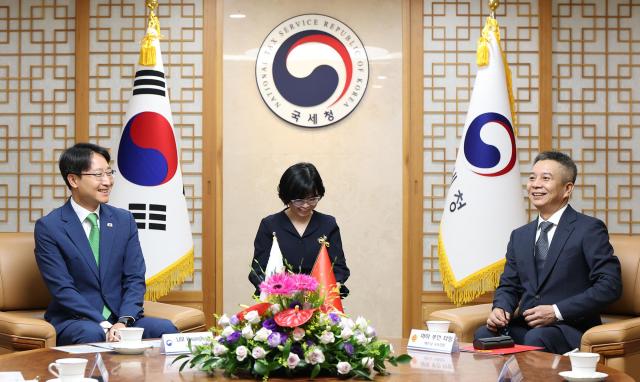
The National Tax Service (NTS) of South Korea has requested cooperation from Vietnamese tax authorities to address issues faced by Korean companies operating in Vietnam, including delays in value-added tax (VAT) refunds and challenges with advance pricing agreement (APA) procedures.
Im Kwang-hyun, Commissioner of the NTS, held the 25th Korea-Vietnam Tax Commissioner Meeting in Seoul with Mai Tuan Anh, the Commissioner of the Vietnam General Department of Taxation, to discuss these tax support measures.
Vietnam is South Korea's third-largest trading partner and a key economic cooperation country, with trade between the two nations reaching $94.5 billion in 2025, making it the third-largest trade partner after China and the United States. South Korea is the largest foreign investor in Vietnam, with direct investments totaling $92.1 billion.
As of the end of last year, there were 2,602 South Korean companies operating in Vietnam, surpassing the 2,397 from China and 933 from the United States. Given the diverse sectors in which these companies operate, including manufacturing, construction, and finance, the need for tax cooperation is significant.
During the meeting, Im emphasized the importance of ensuring predictability for companies operating in Vietnam. He noted that some Korean firms are experiencing operational difficulties due to delays in VAT refunds and urged the Vietnamese side to take an active interest and cooperate in resolving these issues.
The discussion also included the APA, which is a system that allows multinational corporations to agree on the pricing of international transactions between related companies in advance with tax authorities, thereby reducing tax uncertainties.
Im requested that the Vietnamese authorities expedite the APA discussions once their organizational restructuring and legal revisions are completed. In response, Mai Tuan Anh assured that they would promptly advance the APA discussions to alleviate tax uncertainties for companies from both nations.
The meeting also addressed ways to ease the reporting burden of the global minimum tax. Although Vietnam has introduced a domestic law on the global minimum tax, it has not joined the automatic exchange of information agreements, requiring Korean companies operating in Vietnam to submit tax reports in both countries.
Im asked the Vietnamese side to consider joining the automatic exchange of information agreement for the global minimum tax. Joining the agreement would allow companies to submit their global minimum tax reports to only one country, exempting them from obligations in the other. The NTS also offered to share its experiences and expertise if needed.
Both sides shared updates on tax digitalization and legislative revisions. Im explained the direction of the NTS's push for a major transformation in tax administration through the establishment of dedicated AI systems. The NTS plans to implement AI models suitable for detecting tax evasion and providing tax consultations by utilizing not only computerized data but also unstructured data such as operational manuals.
The Vietnamese side introduced the upcoming amendments to the Tax Administration Law, set to take effect in July. The amendments include improvements to the APA process and the recognition of pricing methods based on external commercial databases, which are positive developments for companies operating in Vietnam.
* This article has been translated by AI.
Copyright ⓒ Aju Press All rights reserved.