
The real estate market is difficult to navigate. Owning a home is equally challenging. The government’s policies are no exception. This is where the complex nature of real estate begins.
“Your neighborhood is being demolished. We need to supply housing.”
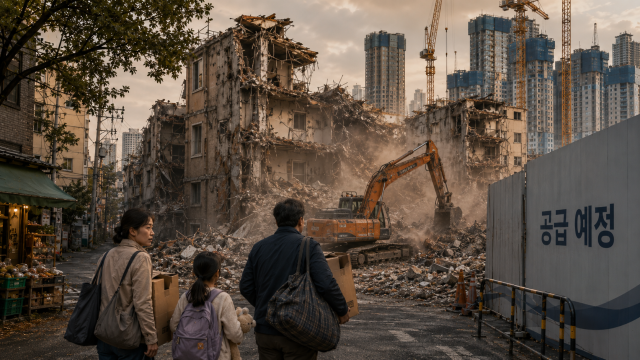
While this may sound strange, it succinctly captures the reality unfolding across Seoul. Construction barriers are being erected, moving trucks are coming and going, and neighborhoods that once housed thousands are becoming vacant lots. The barriers are labeled with the phrase “housing supply.” However, the first thing that begins within these areas is not supply, but loss.
This year, several large complexes in Seoul have emptied out. About 9,000 units are currently being vacated across nine complexes, including the Gangnam Gaepo Jugong 5 Complex (940 units), Yangcheon Sinjeong 4 District (1,592 units), and Yongsan Hannam 2 District (1,799 units). When adding in projects like Sangyeok 1, Noryangjin 3, and Samik Park, an additional 9,000 units are set to be vacated. With approximately 33,000 rental units available in Seoul, this significant influx of moving demand is overwhelming the market.
As a result, rental prices are rising, and the burden of relocation costs and finding alternative rental homes is slowing down the pace of development. Although this is framed as the beginning of supply, what is visible on the ground is not new homes, but the disappearance of existing ones. The more troubling issue is that this situation is increasingly being accepted as a normal supply strategy.
In one word, the current state of Seoul can be summarized as: under demolition.
What Comes Before Supply
The root of the problem is straightforward. The method by which Seoul addresses its aging housing stock has effectively become limited to “complete demolition followed by high-density reconstruction.” The primary avenue for introducing new apartments on a large scale in downtown Seoul is through redevelopment projects. However, most of these projects involve completely emptying neighborhoods.
Demolition occurs first, while construction follows later. There is often a gap of several years between the start of construction and completion. When redevelopment projects are expedited, the first thing that accelerates is not the move-in date for new apartments, but the evacuation of existing homes.
The Seoul city government has stated that under its Fast-Track Integrated Planning 2.0 initiative, approximately 310,000 units will begin construction by 2031. Once the projects are completed, the number of homes will increase. The basic structure of redevelopment involves demolishing old homes and building more new ones.
This is essentially a warning that 220,000 homes will be demolished by 2031, a figure that represents 7% of all housing in Seoul. While it is projected that around 80,000 homes will be added by 2031, the timeline for when residents must endure the disruption differs from the final numbers.
When discussing the number of units under construction, it may appear that supply is already on the way. However, the rental market experiences this in a different order. What Seoul faces first is not new homes, but the loss of existing ones.
A study by Choi Jin and Jin Chang-ha published in the Housing and Urban Finance Research analyzed 25 districts in Seoul, showing that demolitions temporarily push rental prices up, while completions stabilize prices over time. Notably, large-scale demolitions of over 2,000 units resulted in significantly higher rental price increases compared to smaller redevelopment projects. Although both demolitions and completions are grouped under the term “supply,” the timeline and impact felt by the market differ.
What is Disappearing is Not Just Homes, But Communities
The larger issue at hand is the people. The demolition of an apartment complex signifies more than just the loss of a building; it represents the disintegration of a community that has developed over decades. Under the pressure of anticipated profits from redevelopment, some residents are forced to leave neighborhoods they have lived in for years, sometimes relocating outside of Seoul. These places hold memories, daily routines, relationships, and a sense of belonging. While rising home prices in a few years may provide some comfort, they cannot compensate for the time lost in a community.
Even when new apartments are built years later, not everyone returns to their original homes. Research indicates that the rate of original residents returning after redevelopment is below 30%. While the numbers may vary based on criteria and scope, the trend remains consistent. Old homes may be replaced with new ones, but the residents and their living environments change significantly. Viewing a complex solely as a building may suggest renewal, but from a community perspective, it is disintegration.
Ultimately, the shock to the rental market and the disintegration of communities are not separate issues. A city that only knows complete demolition creates both problems simultaneously. By vacating homes all at once, the rental market is shaken first, and by scattering residents, communities eventually disappear. Therefore, the question surrounding Seoul's redevelopment should not merely focus on the quantity of supply but rather on the methods employed.
Breaking Free from the Myth of Successful Reconstruction
For a long time, reconstruction has been viewed not as a means of repairing old homes, but as a way to increase asset value. In some areas, this has indeed been the case. Aging complexes have transformed into new brand-name apartments, leading to significant increases in property values and substantial returns for residents. This successful narrative has been powerful in Seoul.
The problem lies in the fact that this memory does not apply uniformly to all aging complexes. Current reconstruction and redevelopment are not as straightforward as before. Construction costs have risen, financing has become burdensome, and the burden of shared costs has increased. The risks associated with permits, conflicts within associations, and general sales are also considerable. Outside of a few prime locations, the formula of “demolishing equals profit” no longer holds true.
Nevertheless, many discussions still revolve around reconstruction and redevelopment. The belief that building higher and selling at higher prices is the only way to improve the city has become entrenched. When viewed solely as a matter of asset growth, alternative options appear trivial, frustrating, and slow.
What is needed in Seoul is not a denial of property rights, but a separation of urban policy from the illusion of expected profits. Not every aging neighborhood can become a Gangnam reconstruction, nor can every member of a housing association expect to gain tens of millions in profits.
Thus, the question must change. Instead of asking how much more can be earned, the focus should shift to how to build less and live longer. Areas with high development potential can proceed with reconstruction and redevelopment. This may be the fastest and most certain form of supply. However, there is no reason to tie areas with lower development potential to the same dream. In such cases, it is essential to reassess whether complete demolition is genuinely feasible and whether residents can bear the costs.
In truth, there have always been alternatives. What has been lacking is not options, but the imagination to believe that there could be more than one solution.
Leveling the Playing Field to Create Options
The first alternative is remodeling. However, remodeling is currently facing setbacks. While regulations for reconstruction are easing and project viability is improving, remodeling is hindered by complex approval processes, limited general sales volume, and the disparity in asset values post-completion. The difference between being valued as a new apartment versus a remodeled one is significant. Consequently, complexes that once pursued remodeling are now reverting to “reconstruction instead.”
The reason is clear. If only reconstruction is incentivized while other methods bear the full costs and risks, associations will inevitably gravitate toward the more profitable route. Therefore, remodeling and cyclical maintenance should also receive financial support, expedited reviews, and adjustments to floor area ratios. It is not acceptable to create a fast and favorable path for reconstruction while claiming that “other options exist.” The playing field must be leveled to create real choices.
Of course, remodeling is not a panacea. Retaining the structure for repairs limits the supply effect, and burdens such as structural safety assessments are significant. Nevertheless, it holds value. The Songpa Seongji Apartment has become the first vertical expansion remodeling project in the country, increasing from 298 units to 327 units. This demonstrates that it is possible to improve aging complexes without complete demolition.
If remodeling represents a path of less demolition, then cyclical maintenance embodies the principle of returning residents. Not every complex can be remodeled. Ultimately, for those that must be demolished, the next question should be who can stay where and return afterward.
The development of the Yeongdeungpo goshiwon area serves as a relevant example. While it may not strictly qualify as cyclical maintenance under urban renewal laws, the principle of relocating goshiwon residents to temporary housing and then resettling them once public housing is completed is evident. Although it may be challenging to directly apply this to general reconstruction and redevelopment, the questions must shift. It should not be about how quickly to demolish, but rather where to relocate residents. Instead of focusing on how many units will increase in a few years, the emphasis should be on who can endure during those years.
The recently announced relocation REITs by the Seoul city government also reflect this line of thinking. Previous measures, such as relocation loans, focused on accelerating moves and hastening demolition timelines. In contrast, the relocation REITs aim to accommodate those vacating homes all at once to prevent disruption in the rental market. The direction is correct. However, if the focus remains solely on providing funds in a context of housing scarcity, it will not ease relocations but rather exacerbate demand in the rental market.
Demolition is not inherently wrong. Aging cities need to be repaired, and some homes must be demolished to rebuild. However, if Seoul's only solution is always complete demolition, the problem becomes different. Areas with high development potential should undergo proper reconstruction, while those with lower potential should be addressed through alternative methods.
The barriers are labeled “supply.” However, what disappears first within them are homes, what shakes first is the rental market, and what scatters first are communities. Your neighborhood is not an exception. To discuss supplying 310,000 units, we must first demonstrate how to accommodate the loss of 220,000 homes. This is the dividing line between the race for supply and housing policy.
* This article has been translated by AI.
Copyright ⓒ Aju Press All rights reserved.