
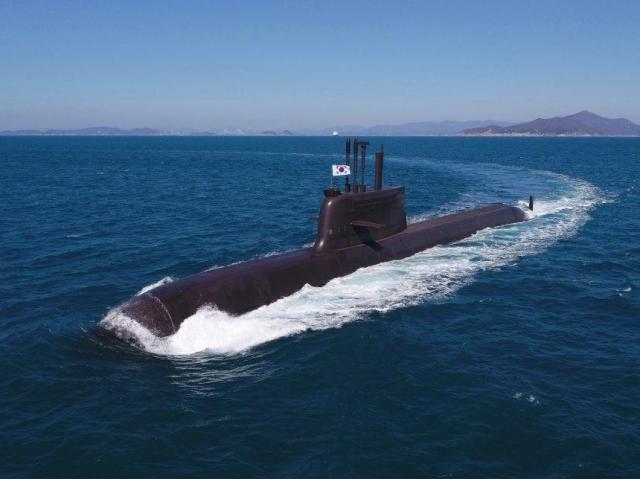
The Globe and Mail reported on June 25 that Philippe Schoen, the head of sales for TKMS's submarine division, recently stated on LinkedIn, "Canada must ask what cultural ecosystem it will enter for the next 40 years."
Canada is evaluating Hanwha's KSS-III submarine and TKMS's 212CD submarine for its upcoming submarine project.
This project involves a major contract for the acquisition of 12 submarines. The estimated cost for the submarines alone ranges from CAD 20 billion to CAD 30 billion (approximately USD 15 billion to USD 22.5 billion), and when including operational, maintenance, and upgrade costs, the total is projected to be between CAD 40 billion and CAD 50 billion (about USD 30 billion to USD 37.5 billion). The Canadian government is expected to soon select a preferred bidder or final candidate between Hanwha and TKMS.
Schoen emphasized that the 212CD program originated as a multinational collaboration between Germany and Norway, with English as the working language. He argued, "In defense cooperation, it is crucial for engineers and military personnel to communicate directly without translation," asserting that language is a fundamental basis throughout all processes, including technical documentation, software development, training, maintenance, combat system integration, and logistics support.
He also suggested that if Canada chooses Hanwha's submarine, it may need to adapt to a different country's language system. If Hanwha is selected, it would mark the first instance of Canada purchasing a major weapon system from a non-Western country.
TKMS stated that Schoen's comments were posted on his personal social media account and refrained from making an official comment. Later, Schoen clarified in a follow-up post that he did not intend to disparage any specific language, culture, or partner country, while maintaining that the 212CD could provide Canada with proven submarine capabilities and a long-term cooperation structure.
Glen Copeland, CEO of Hanwha Defense Canada, expressed regret over Schoen's remarks. He stated, "The Hanwha team responsible for the Canadian project possesses excellent multilingual capabilities based on overseas work and study experiences," adding that they have personnel fluent in English, French, Japanese, Italian, Arabic, and German. Copeland remarked, "Engineering and mathematics are universal languages for creating outstanding vessels and submarines."
Criticism also emerged within Canada. Vina Najibullah, vice president of the Asia Pacific Foundation, pointed out that viewing the submarine decision as a choice between different 'cultural ecosystems' is unnecessary, warning that it could create artificial cultural divides among close partner countries. She emphasized that South Korean companies have experience collaborating across various languages, regulations, and business environments in the global market.
Flavio Volpe, president of the Canadian Automotive Parts Manufacturers' Association, who has discussed potential collaboration with Hanwha, stated, "I have worked extensively with South Korean conglomerates over the past 20 years, and there have been no issues with English communication."
* This article has been translated by AI.
Copyright ⓒ Aju Press All rights reserved.