
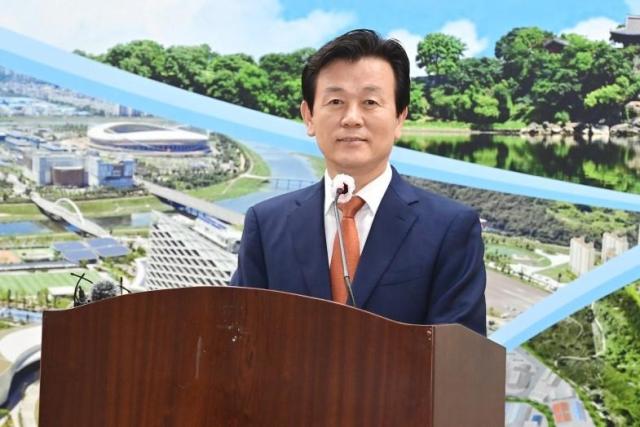
The landscape of South Korea's aerospace industry is undergoing significant transformation. With the establishment of the Aerospace Administration in Sacheon, Jinju is emerging as a key city responsible for aerospace research, industrial support, and residential functions. Jinju's newly elected Mayor Cho Gyu-il has presented a vision to leverage these changes as new growth opportunities.
He has highlighted the construction of an AI integrated data center, the establishment of an AI open lab, the implementation of satellite information utilization service demonstration projects, and support for AI startups as his core pledges, aiming to develop Jinju into a future industrial city based on AI. At the same time, he proposed a strategy to create new economic opportunities by combining the aerospace industry with AI.
This is not merely an industrial development policy but a future city strategy that integrates AI and the space economy. The question is clear: Can Jinju leap forward as South Korea's first AI space service city?
The Role of Jinju is Changing in the Aerospace Era
As the Aerospace Administration has been established in Sacheon, many people's attention has shifted to that city. However, Mayor Cho emphasizes that the aerospace industry is not solely Sacheon's responsibility but a national strategic industry that Jinju and the entire western Gyeongnam region must develop together. He has prioritized the growth of the aerospace industry as a key task for his administration and has outlined plans to complete an aerospace cluster through cooperative development with Sacheon.
The role he envisions for Jinju is clear. While Sacheon serves as the center for production and manufacturing, Jinju should become a city responsible for research, industrial support, education, and residential functions.
In the AI era, this division of roles becomes even more critical. The competitiveness of the space industry lies not in the number of rockets produced but in how quickly satellite data can be analyzed and connected to new services.
The AI Integrated Data Center as the Heart of Future Industries
Mayor Cho's flagship AI pledge is the establishment of an AI integrated data center. He has announced plans to attract this center through government public offerings and to create a data-driven industrial ecosystem. Additionally, he has promised to build an AI open lab where businesses, research institutions, and universities can collaboratively research and utilize AI technologies.
A data center is not merely a space for storing servers. In the AI era, a data center is a factory for creating new industries. Companies seek data centers not just to store data but to train AI and develop new services.
If Jinju establishes itself as an AI data hub, it can foster growth across the aerospace, biotechnology, and smart city industries. The competitiveness of cities in the AI era begins with how much data they can secure.
Satellite Data as the New Oil
Mayor Cho has also proposed a core pledge for the implementation of satellite information utilization service demonstration projects. His plan involves analyzing images and spatial information captured by satellites using AI for various applications, including disaster response, smart agriculture, environmental management, and urban planning.
The future of satellites is not merely as imaging devices. They are platforms that produce vast amounts of data daily. AI analyzes this data to predict wildfires, monitor floods, and assess crop growth conditions. The added value of the space industry is likely to be generated more significantly from data utilization than from launch vehicles.
If Jinju can seize the satellite data industry, it can grow into the central city of South Korea's space service industry.
A City Where Future Aircraft Meet AI
In his administration's ninth term, Mayor Cho has identified the operation of a future aircraft prototype center, the establishment of an AI platform for evaluating the safety of future flying vehicles, and the creation of a testing field for core materials and components of future mobility as key tasks.
AI is a core technology in the aerospace industry. Autonomous flight, drones, urban air mobility (UAM), and aircraft safety analysis all develop based on AI. Particularly, the safety evaluation of future flying vehicles requires real-time analysis of vast amounts of data, making it impossible without AI.
Jinju has the potential to become a central city for research and certification supporting this future aerospace industry. If production is handled by Sacheon while research and validation are managed by Jinju, the two cities could grow into a world-class aerospace cluster.
Jinju: An AI Startup City Where Youth Return
Mayor Cho has also outlined a strategy to grow the AI industry not around large corporations but through startups and local businesses. He aims to create an ecosystem where AI companies can thrive through the establishment of AI-specialized funds, startup support, industry-academia collaboration for talent development, and expanded employment opportunities for youth. Additionally, he has proposed plans to merge the aerospace and biotechnology industries with AI to secure new growth engines.
In the AI era, it is more important to foster innovative companies than to build many factories. Young people leave for the metropolitan area not just for jobs but to seek a future. If Jinju grows into an AI startup city, it could become a place where young people return.
Can Jinju Become South Korea's Space Service Hub?
In the United States, there is Houston, and in France, there is Toulouse. In South Korea, there are Sacheon and Jinju. While Sacheon is a city with the Aerospace Administration and a manufacturing base, Jinju can grow into a city responsible for research, data, and AI service industries.
Mayor Cho emphasized, "Jinju will enhance its residential functions in education, culture, healthcare, and transportation while building a partnership with Sacheon for research and industrial support." In the AI era, the winner in the space industry will not be the city that launches the most rockets but the one that can most effectively utilize space data. Jinju is challenging itself in this new competition.
Conclusion
Mayor Cho's AI strategy is not merely an information policy. The AI integrated data center, AI open lab, satellite information services, future flying vehicle AI platforms, and AI startup ecosystems all aim toward one goal: to make Jinju the central city of South Korea's space service industry.
AI will become the brain of the space industry, and satellite data will become a resource for the future economy. If Sacheon is the heart of the aerospace industry, Jinju could become the brain of AI space data. The new miracle of South Korea's space economy may begin with the cooperation of these two cities.
About Mayor Cho Gyu-il
Cho Gyu-il, the newly elected Mayor of Jinju, is a former civil service exam graduate who has served as the Deputy Governor of Western Gyeongsangnam-do and the Deputy Mayor of Jinju. He has successfully been elected for a third term in the ninth local election following his previous terms in the seventh and eighth elections. He has positioned the aerospace industry as a future growth axis for Jinju and has proposed key pledges including the establishment of an AI integrated data center, the creation of an AI open lab, the implementation of satellite information utilization service demonstration projects, and support for AI-specialized funds and startups. In his ninth term, he aims to operate a future aircraft prototype center, establish an AI platform for evaluating the safety of future flying vehicles, and promote the creation of an aerospace cluster, envisioning Jinju as a central city for research and industrial support in South Korea's space service sector.
* This article has been translated by AI.
Copyright ⓒ Aju Press All rights reserved.