
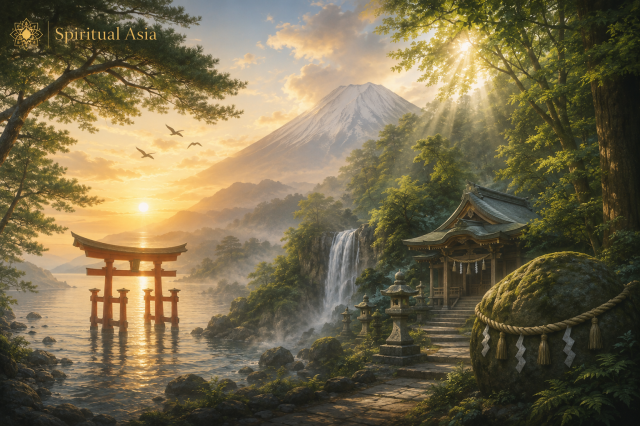
Japan stands at the threshold of a significant exploration of Shinto. In previous articles, we examined how Shinto perceives nature as sacred and how the spirituality of nature has supported community life through shrines and festivals. The final question remains: How did a religion that revered nature evolve into a national ideology, and how did community spirituality intertwine with state power? This inquiry is not unique to Japan; it reflects a historical dilemma faced by all religions and serves as a crucial lesson in civilization about the consequences when spirituality meets power.
Originally, Shinto was not a religion centered on doctrine. It lacked absolute scriptures or a founder. It was a life philosophy that naturally formed around the reverence for mountains, forests, rivers, seas, winds, suns, ancestors, and villages. The Japanese referred to this as the world of "kami" (神). Kami were not absolute deities dominating humans but sacred beings residing in life and nature. Thus, for a long time, Shinto functioned as a philosophy that respected nature and connected communities.
The arrival of Buddhism in Japan during the 6th century initiated a new transformation. Initially, there were conflicts, but over time, the Japanese chose to harmonize the two traditions rather than oppose them, a phenomenon commonly referred to as Shinbutsu Shugo. Deities were understood as different manifestations of the Buddha, and temples and shrines coexisted in the same spaces. People would visit shrines for blessings upon the birth of a child and hold Buddhist funerals when they died. This reflected a cultural emphasis on harmony in life over doctrinal consistency.
However, the Meiji Restoration in the late 19th century fundamentally altered Japanese society. New leaders, aiming to end the feudal order and establish a modern state, sought a spiritual focal point to unify the nation. Shinto was chosen for this purpose. Originally a life-centered religion, Shinto was restructured into a state-managed system, with the emperor elevated from a mere monarch to the sacred center of the nation.
In this process, Shinto began to take on a different character. Shrines transformed from mere centers of local communities into symbols of state authority, and education and rituals shifted to emphasize loyalty and sacrifice. The focus on nature gradually turned toward the state, and dedication to the community expanded into dedication to the nation. A structure emerged where the state utilized religion rather than the other way around.
Of course, there were positive aspects to Japan's modernization at that time. The rapid establishment of industry, education, administration, and military systems aimed at creating a nation on par with Western powers garnered global attention. However, when the goals of state growth and national unity intertwined with religion, the resulting power could easily transform into an absolute force resistant to criticism. History has repeatedly shown such patterns across various civilizations.
Entering the 20th century, Japan embarked on a path of imperialism. State Shinto gradually became an ideological foundation justifying nationalism and militarism. Visiting shrines became both a religious act and a symbol of loyalty to the state, while loyalty to the emperor was sometimes understood as a sacred duty beyond mere political obligation. The spirituality that once taught humility before nature became intertwined with a logic demanding absolute obedience to the state, leading Shinto to lose much of its original purity.
This point must be viewed critically from today's perspective. It is neither correct to equate Shinto with militarism nor to ignore historical responsibilities. Religion is fundamentally a spiritual culture that enriches human life, but when power uses it for political purposes, entirely different outcomes can arise. The crucial issue lies not in the name of the religion but in how it combines with power.
The defeat in World War II brought a monumental turning point for Japanese society. After the war, the state Shinto system was dismantled, and Shinto was separated from the state once again. The emperor was no longer a divine figure but became a symbolic presence. This process allowed Japanese society to redefine the relationship between religion and the state.
Today, the reasons Japanese people visit shrines differ significantly from the past. They visit shrines for the first prayer of the New Year, to wish for their children's health, and to commemorate important life events such as weddings and graduations. This reflects a cultural practice focused more on family, community, and peace in life rather than loyalty to the state. Shinto has returned to being a spirituality embedded in daily life.
However, history should not be easily forgotten. We must remember that beautiful traditions can transform when combined with power and that spirituality should always operate in a manner that protects human freedom and conscience. The moment reverence for nature turns into a logic that oppresses humanity, religion loses its original purpose.
At this juncture, we must return to nature. The starting point of spirituality is neither the state nor power but the awe toward the order of the universe surrounding mountains, rivers, forests, seas, seasons, and life. This was the essence that Shinto initially revealed to us.
This perspective resonates deeply with the natural spirituality emphasized by Korean thinker Dasuk Yoo Yeong-mo. He understood humans not as rulers over nature but as beings breathing alongside the life of the universe. He viewed all creation as filled with divine life and regarded nature not merely as material but as a manifestation of sacred life. This thought intersects with the spirit of reverence for nature inherent in Shinto while advancing toward a universal spirituality that does not absolutize any specific nation or power.
■ Shinto's Return to Daily Life and the Future of East Asian Spirituality
After the war, Shinto underwent a significant transformation. The state could no longer use Shinto as an ideological tool for governance, and shrines returned to being spaces within local communities. Today, many Japanese do not actively identify as followers of a specific religion, yet they visit shrines at the New Year, pray for their children's growth and health, and commemorate important life events. This reflects a cultural practice more than a religious one, emphasizing life rituals over doctrine.
This phenomenon illustrates that the Japanese view of religion is not contradictory but rather a practice-centered culture. People seek shrines at the beginning of life, celebrate weddings in various forms, and often follow Buddhist customs for funerals. While this may appear inconsistent by Western standards, Japanese society has naturally accepted this coexistence over many years. This understanding stems from viewing religion not as a competitive entity but as a cultural asset that enriches life.
At this point, we are reminded of Yoo Yeong-mo again. He perceived nature not as something for humans to exploit but as a sacred world imbued with divine life. Mountains, fields, trees, winds, rivers, and seas all contain the order of life, and humans must live humbly within that order. This view of nature resonates with the spirit of reverence for nature in Shinto. However, Yoo Yeong-mo's thought seeks to extend this reverence for nature into a love for all humanity and life.
Some cultural historians note that Japan's Kyushu region symbolizes "nine provinces," where the number nine signifies completion and fullness in East Asian tradition. In this context, interpretations of the 81 characters of Cheonbu-gyeong, our unique thought, as a symbolic and cultural connection to the number nine have emerged.
However, it is essential to distinguish that such connections are not currently established historical or religious doctrines but rather symbolic and cultural interpretations. The key point is not the number itself but the shared way of thinking across various East Asian cultures that sought to express the order of nature and the universe through numerical symbolism.
The most significant question posed by Shinto today is not about religion but about civilization. How will humanity relate to nature? Since the Industrial Revolution, humanity has become accustomed to viewing nature as a target for conquest. While achieving remarkable economic growth, we have also inherited the monumental challenges of climate change and ecological destruction. We have entered an era where a philosophy of coexistence is needed, not just growth.
In this regard, the spirit of reverence for nature in Shinto offers insights for modern civilization. There is no need to adopt Shinto in its entirety. The historical distortions shown by modern state Shinto remain clear lessons. However, a culture that respects nature, values community, and commemorates significant life moments with gratitude and moderation can serve as a point of reflection for us today.
Korea has also maintained community cultures such as mountain deity worship, Dangsanje, Seonghwangje, and communal labor traditions over many years. While many traditions have weakened amid rapid industrialization and urbanization, their spirit has not vanished. The future will require wisdom not to restore traditions as they were but to modernize the values of life and community embedded within them.
Ultimately, the core message of the three-part series on Shinto can be summarized in three points. First, nature is not a domain for humans to dominate but a foundation for living together. Second, communities are not sustained solely through competition but through rituals, memories, gratitude, and sharing. Third, any spirituality loses its original purity the moment it becomes a tool of power.
We must learn from the light of Shinto while guarding against its shadows. We should love nature without idolizing it, respect traditions without succumbing to exclusionary nationalism, and protect communities without losing human freedom and dignity. This embodies the wisdom accumulated by East Asian civilization over the years and is a value that humanity must reaffirm today.
Truth begins with reverence for nature, justice grows from responsibility toward the community, and freedom is realized when respect is given to conscience and life. The long journey of Shinto ultimately reminds us all of this ancient truth. This is the final message that the three-part series on the Spiritual Essence of Asia aims to convey to its readers.
* This article has been translated by AI.
Copyright ⓒ Aju Press All rights reserved.