SEOUL, June 29 (AJP) - "Sorry cannot make amends for the sense of betrayal for those who held onto hope until the very last minute," said 25-year-old Seoul resident Kim Sung-min.
Like millions of South Koreans, Kim spent the weekend after Thursday's devastating defeat to South Africa watching the remaining World Cup matches, clinging to the slim possibility that results elsewhere might yet rescue Korea's campaign.
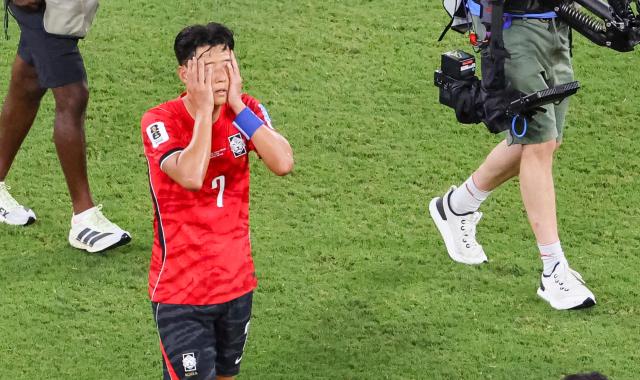
"Our only hope was to see Son Heung-min play in what could have been his last World Cup," Kim said. "That was taken away from us."
For South Koreans, the World Cup has always been an emotional contradiction. Expectations soar every four years, fuelled by memories of the country's extraordinary run to the semifinals on home soil in 2002, even when reality suggests otherwise. This time, even hope eventually ran out.
The fallout from South Korea's group-stage exit at the 2026 FIFA World Cup is now spreading far beyond the resignation of head coach Hong Myung-bo. It has reopened uncomfortable questions about the Korea Football Association's governance, its long-term planning and, once again, the search for the right man to lead one of Asia's traditional football powers.
Hong, one of the heroes of the 2002 team, offered to step down in Guadalajara on Sunday shortly after Korea's elimination became mathematically certain. By the time dawn broke in Seoul on Monday, the resignation was official.
South Korea had begun the tournament brightly with a 2-1 comeback victory over Czechia. But successive 1-0 defeats to hosts Mexico and South Africa left the Taeguk Warriors stranded on three points.
The decisive blow came against South Africa. A draw would have been enough to send Korea into the round of 32 under FIFA's expanded 48-team format. Instead, Hong's side delivered its most timid display of the tournament when everything was on the line.
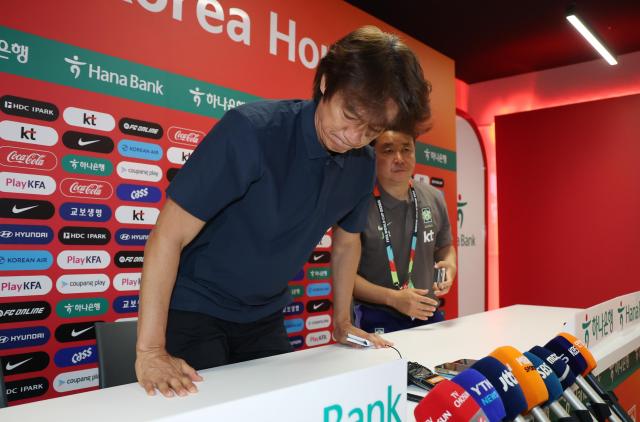
For Hong, it marked an unwanted piece of history.
It was his second World Cup campaign ending in a group-stage exit as national team manager, following the disappointing 2014 tournament in Brazil. Few Korean coaches have been given two opportunities to lead the national team at football's biggest stage. Hong failed to justify either.
The contrast with neighboring Japan has only sharpened the disappointment.
While Hajime Moriyasu has remained in charge since 2018, providing continuity through successive tournaments and a clear footballing identity, South Korea has lurched from one managerial reset to another, rarely allowing a coach enough time to build a lasting system.
Hong returned to the national team in July 2024 following Jurgen Klinsmann's dismissal. His appointment was controversial from the outset, arguably attracting even greater scrutiny than Klinsmann's own hiring.
At the time, the KFA defended its decision by pointing to Hong's tactical philosophy, his K League titles with Ulsan HD, his familiarity with both youth and senior national teams and his understanding of Korean football's structure.
Lee Lim-saeng, then technical director, argued that Hong's work at Ulsan demonstrated the possession structure, pressing discipline and squad management required at international level. He also said Hong could provide continuity throughout the national team programme.
Instead, the World Cup exposed precisely the qualities Korea was supposed to possess.
The team never established tactical control. Its pressing lacked conviction, possession seldom translated into genuine scoring opportunities and, when matches drifted away, there appeared to be neither an alternative plan nor the confidence to execute one. Against South Africa, Korea struggled to alter its tempo, reshape its attack or impose itself on a match that effectively became a knockout game.
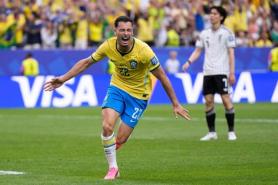
Marsch eventually took charge of Canada, guiding an injury-hit squad into the knockout rounds after defeating South Africa 1-0 with a stoppage-time winner. Korea, despite fielding one of the strongest generations of overseas-based players in its history, could not overcome the same opponent.
The comparison is an uncomfortable reminder of the decision the KFA ultimately made.
The appointment process itself remains under scrutiny.
In its 2024 audit, the Ministry of Culture, Sports and Tourism concluded that the KFA had violated its own procedures when selecting Hong. The ministry found that Lee Lim-saeng, who was not a member of the National Teams Committee, lacked the authority to recommend the final candidate and that the evaluation process had not operated as intended.
Following the resignation of committee chairman Chung Hae-sung during the search, Lee conducted meetings with foreign candidates before personally visiting Hong to offer him the job.
According to the ministry, Hong's meeting differed from those held with other candidates and did not follow the same interview process or procedural safeguards.
The controversy did not end there. Police opened an investigation following complaints over the appointment process, while a Seoul court later acknowledged procedural problems surrounding both the Hong and Klinsmann appointments.
Those governance questions have returned with greater force now that the sporting results have collapsed alongside them.
Criticism has also broadened to the KFA's wider administration, with some questioning decisions ranging from national team logistics to the construction of the new National Football Centre in Cheonan, roughly two hours from Incheon International Airport depending on traffic.
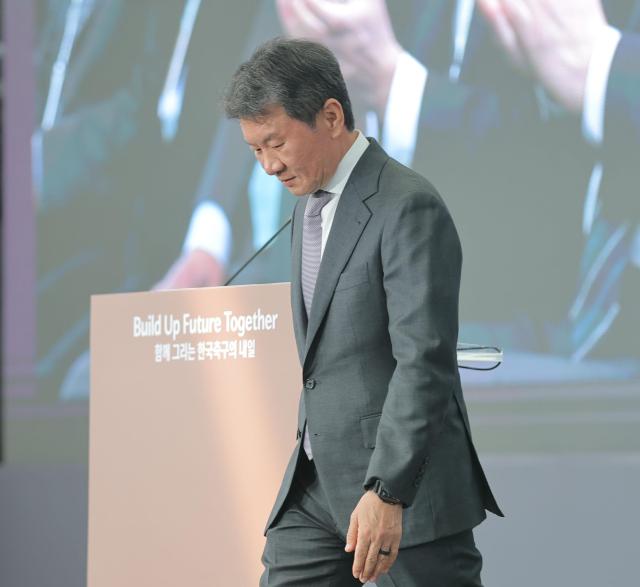
Attention has once again turned to KFA President Chung Mong-gyu, who has led Korean football since 2013 and indicated before the tournament that he intended to step down afterward.
Many within Korean football now argue that replacing another coach will not be enough. What the federation requires is structural reform after more than a decade of recurring managerial upheaval, inconsistent planning and mounting public distrust.
President Lee Jae Myung added political weight to the debate following Korea's elimination, saying the tournament demonstrated what happens when "an incompetent person is placed in charge." He instructed the Ministry of Culture, Sports and Tourism to examine the causes of the failure and recommend measures to prevent a repeat.
The national team now faces another familiar crossroads.
With less than a year remaining before the AFC Asian Cup in Saudi Arabia, Korea once again finds itself searching for a new head coach while debating the direction of its football administration. It is a cycle that has repeated itself after the departures of Shin Tae-yong following the 2018 World Cup, Paulo Bento after Qatar in 2022 and now Hong after North America.
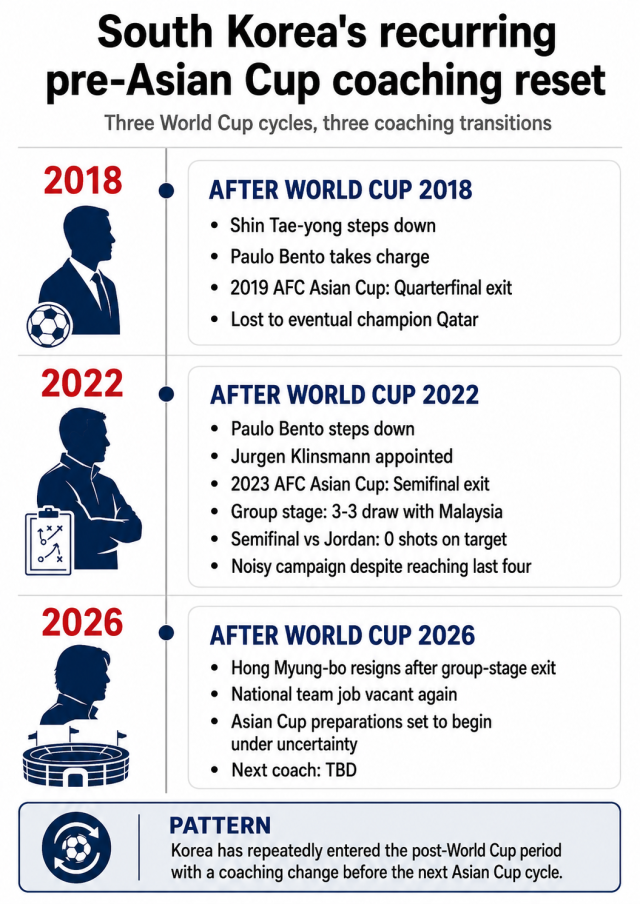
It is not simply that Korea failed to advance.
It is that, despite possessing arguably the finest generation of footballers in its history — led by Son Heung-min, Kim Min-jae, Lee Kang-in, Hwang Hee-chan and Hwang In-beom — the national team once again looked less than the sum of its parts.
Another World Cup has ended.
Another coach has fallen.
And Korean football is left asking the same questions it has been asking for more than a decade.
Copyright ⓒ Aju Press All rights reserved.