
The Fair Trade Commission (FTC) is intensifying its economic penalties, leading to heightened risks for companies. The immediate impact of substantial fines on financial statements can adversely affect the stock prices of publicly traded firms.
Even after the FTC concludes its investigations, ongoing disputes continue to pose challenges for businesses, prolonging litigation risks.
Investors React to Regulatory Scrutiny as Stocks Fluctuate
The FTC initiates cases through complaints or its own authority, proceeding through investigation, review, and final decisions. This structure effectively serves as the first instance of legal judgment under relevant laws.
However, the knowledge that an FTC investigation and potential sanctions are forthcoming can influence stock prices and investor sentiment. A notable example is Naver, which saw its stock decline after the FTC sent a report regarding allegations of abuse of monopoly power in 2019. Although the final decision had not yet been made, investors perceived it as a regulatory risk.
Once sanctions are imposed, the situation becomes even more complicated. Fines, which are reflected in financial statements, can negatively impact stock prices, leading to a decline in investor sentiment as immediate performance appears to worsen.
For instance, in 2024, the FTC imposed a fine of approximately 140 billion won on Coupang related to manipulation of its private brand product searches. This was the largest fine in the retail sector's history, causing Coupang's stock to drop from the low $20 range to the high $10 range. Such penalties can dampen investor sentiment across entire industries, as seen when news of fines related to a paper collusion case led to a decline in related stocks.
Recently, the FTC has begun to disclose the sending of review reports, which had previously been kept confidential, further increasing corporate risks. Between February and June, the FTC publicly announced the sending of review reports six times. Following the disclosure of the first report regarding flour price collusion, stocks of companies like CJ CheilJedang also fell.
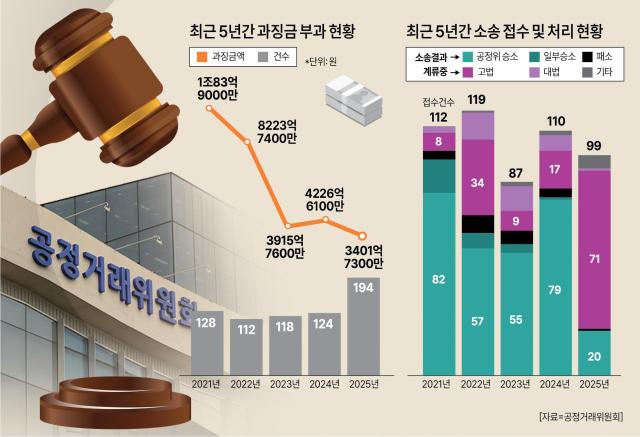
Long Legal Battles Leave Lasting Impact on Companies
Businesses express concerns that FTC investigations extend beyond mere legal issues, evolving into broader management risks. The likelihood of prolonged investigations, sanctions, and administrative lawsuits increases significantly once an FTC inquiry is announced. There are many instances where a violation is determined during the review process, only for the courts to later overturn that decision.
A prominent case involves Kakao Mobility's alleged preferential treatment of its own app drivers. In 2023, the FTC fined Kakao Mobility 27.1 billion won for violating franchise law by charging fees to drivers who did not use its app. However, the Seoul High Court later annulled this decision, prompting the FTC to appeal to the Supreme Court, where proceedings are ongoing.
A similar situation occurred with Naver's shopping search algorithm case. In 2020, the FTC fined Naver 26.7 billion won for adjusting its product search algorithm to favor its own products. Naver contested this in an administrative lawsuit, but the Seoul High Court upheld the FTC's ruling. The Supreme Court later overturned this ruling, sending the case back to the Seoul High Court for further review.
As these cases drag on, corporate risks continue to escalate. The timeline from the FTC's review to a Supreme Court decision can span two to three years, and if the Supreme Court orders a retrial, the process can extend even longer.
Even if companies ultimately prevail in court, the years of stock declines and reputational damage are often unavoidable. Cases involving SPC's improper support, Nongsim's ramen price collusion, and Hyundai Mobis's market manipulation have all seen FTC decisions overturned by the courts.
Moreover, the FTC's recent practice of disclosing review reports before final decisions adds to corporate burdens. While these reports reflect the findings and recommendations of investigators, they do not represent the FTC's final judgment. However, once allegations are made public, the market may interpret them as an acknowledgment of wrongdoing.
An industry insider commented, "While it is understandable for the FTC to explain its decisions after confirming fines or administrative orders, publicly disclosing content still under review is excessive. Even if a company wins a lawsuit three to five years later, it will be difficult to recover from the damage to its stock price and reputation."
* This article has been translated by AI.
Copyright ⓒ Aju Press All rights reserved.