
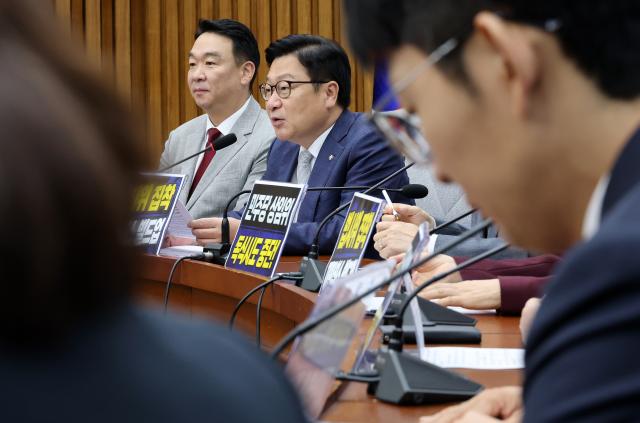
Jung Jeom-sik, leader of the People Power Party, speaks during a National Assembly countermeasure meeting on June 30. [Photo=Yonhap News]
The People Power Party has raised the possibility of a national investigation into the procedural fairness of semiconductor companies' investment plans announced at the previous day's "Three Major Mega Projects National Report Meeting." They argue that political calculations and strategic interests should not interfere with corporate investment decisions.
During a countermeasure meeting at the National Assembly on June 30, Jung Jeom-sik criticized the president for presenting astronomical investment figures while surrounded by corporate leaders, calling it a symbol of state-controlled economy.
He stated, "The $800 trillion investment in the Gwangju and Jeonnam semiconductor sector cannot escape criticism of being a politically motivated decision. Regional balanced development cannot be achieved through political engineering. Local governments must offer incentives to attract businesses, and companies should be guaranteed the freedom to choose."
He also noted that the Democratic Party is preparing for its national convention, suggesting that the recent report meeting resembled a pre-convention campaign. He warned, "If the government and ruling party evade legitimate issues, the opposition will have no choice but to consider a national investigation."
Secretary General Jeong Hee-yong welcomed plans for regional balanced development and the advancement of the semiconductor industry but questioned how many citizens would accept these as voluntary corporate decisions. He cautioned that pursuing these plans without detailed measures could weaken corporate competitiveness, ultimately harming the public.
The meeting also included criticism of National Assembly Speaker Cho Jeong-sik. Jung emphasized, "When negotiations between the ruling and opposition parties reach a deadlock, it is the Speaker's role to mediate and maintain order. If the Speaker is swayed by the ruling party's wishes, we can no longer claim that democracy and the separation of powers exist in this country."
During a countermeasure meeting at the National Assembly on June 30, Jung Jeom-sik criticized the president for presenting astronomical investment figures while surrounded by corporate leaders, calling it a symbol of state-controlled economy.
He stated, "The $800 trillion investment in the Gwangju and Jeonnam semiconductor sector cannot escape criticism of being a politically motivated decision. Regional balanced development cannot be achieved through political engineering. Local governments must offer incentives to attract businesses, and companies should be guaranteed the freedom to choose."
He also noted that the Democratic Party is preparing for its national convention, suggesting that the recent report meeting resembled a pre-convention campaign. He warned, "If the government and ruling party evade legitimate issues, the opposition will have no choice but to consider a national investigation."
Secretary General Jeong Hee-yong welcomed plans for regional balanced development and the advancement of the semiconductor industry but questioned how many citizens would accept these as voluntary corporate decisions. He cautioned that pursuing these plans without detailed measures could weaken corporate competitiveness, ultimately harming the public.
The meeting also included criticism of National Assembly Speaker Cho Jeong-sik. Jung emphasized, "When negotiations between the ruling and opposition parties reach a deadlock, it is the Speaker's role to mediate and maintain order. If the Speaker is swayed by the ruling party's wishes, we can no longer claim that democracy and the separation of powers exist in this country."
* This article has been translated by AI.
Copyright ⓒ Aju Press All rights reserved.