
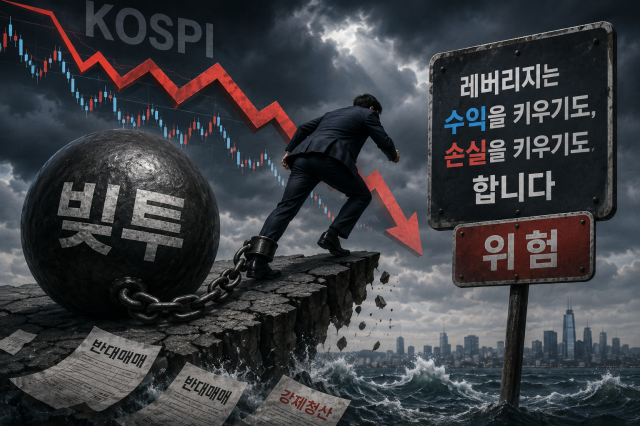
Recent fluctuations in the South Korean stock market have starkly illustrated the dangers of leveraged trading. Just a day after the KOSPI index reached an all-time high, it plummeted nearly 10%, followed by extreme volatility characterized by rapid rebounds and subsequent declines. Individual investors who borrowed funds to invest have borne the brunt of these losses. The volume of forced liquidations surged more than fourfold over the past week, with daily liquidation amounts exceeding 40 billion won for four consecutive days. Risks that were invisible during the bull market erupted all at once in the bear market.
Margin trading is inherently a double-edged sword. While rising stock prices can yield high returns with minimal capital, losses can escalate rapidly when the market moves in the opposite direction. If the maintenance margin is breached, stocks are forcibly liquidated regardless of the investor's judgment. More critically, forced liquidations can trigger further declines in stock prices, creating a vicious cycle that leads to additional forced liquidations. This pattern of excessive leverage among individuals amplifies overall market volatility.
Moreover, the current volatility of the KOSPI has reached unprecedented levels. Factors such as concentration in specific sectors like AI semiconductors, the rapid growth of single-stock leveraged ETFs, geopolitical risks in the Middle East, and fluctuations in global interest rates and exchange rates are simultaneously impacting the market, making it difficult for individual investors to predict outcomes. During a bull market, it is easy for anyone to overestimate their investment skills. However, when volatility increases, debt becomes not a tool for amplifying profits but the most dangerous factor that can devastate accounts.
It is also true that assigning blame is complex. However, the consequences of leveraged trading cannot be solely placed on individual investors. Brokerage firms cannot absolve themselves of responsibility either. They have been competing to increase credit limits, fueling investment enthusiasm, and when the market wavers, they shift the risk back to investors through forced liquidations. What about the financial authorities? While they claim to be "monitoring the market," there are concerns that they are merely issuing warnings after the fact. It is essential to closely manage the phenomenon of excessive concentration of credit in specific stocks and leveraged products, rather than just focusing on the total margin balance. Market stability begins with preemptively curbing excessive leverage rather than responding after the fact.
Above all, a shift in investor perception is urgently needed. In recent years, the notion that "leveraged trading is a viable investment strategy" has gained traction in the domestic market. However, the market does not always trend upward. Unexpected shocks can occur at any time, and the consequences are first felt by those who use leverage. The fundamental principle of investing is not to achieve high returns but to remain in the market steadily within the limits of what one can afford to lose.
The recent surge in forced liquidations should not be dismissed as merely the failure of a few individual investors. It highlights a structural risk where excessive leverage not only undermines individual assets but also increases overall market volatility and disrupts investor sentiment. While debt may obscure skill in a bull market, it presents the harshest reckoning in a bear market. In a market where volatility has become the norm, it is time for investors, financial institutions, and policymakers to recognize that leverage is not a shortcut to windfall profits but a pathway to risk.
* This article has been translated by AI.
Copyright ⓒ Aju Press All rights reserved.