

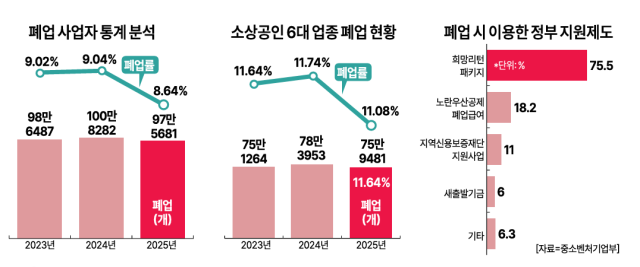
On June 30, the Ministry of SMEs and Startups released findings from its "Analysis of Business Closure Statistics and Survey on Closed Small Businesses." The total number of closures in 2025 decreased by 32,000 from the previous year, with a closure rate of 8.64%, down from 9.04% in 2024.
However, the reality for small business owners remains dire. The closure rate for the six key sectors reached 751,000, with a closure rate of 11.08%, significantly higher than the overall average. Individual business owners faced a closure rate of 9.06%, compared to 5.79% for corporations.
The primary reason for these closures was a decline in consumer sentiment. In a survey of 1,500 closed small business owners, 70.9% cited "deteriorating profitability and poor sales" as their reason for shutting down. Other reasons included personal circumstances (13.7%) and retirement due to health or age (12.1%).
At the time of their closure decision, 68.5% of business owners reported having debts, with an average debt amounting to 85.31 million won. Specifically, they owed an average of 34.83 million won to first-tier financial institutions, 25.85 million won in loans guaranteed by local credit guarantee agencies, and 12.93 million won to second-tier financial institutions.
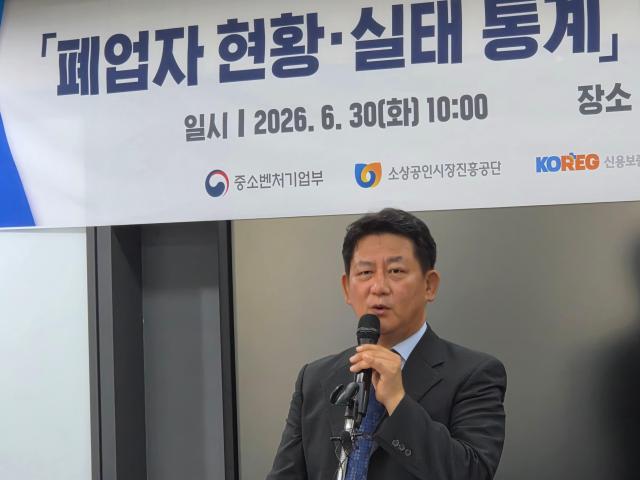
Choi Won-young, head of the Small Business Policy Office, stated, "It is the government's role to ensure that a single closure does not become a cliff that completely disrupts the lives of small business owners. We will establish a comprehensive support system that connects closure statistics with crisis diagnosis and notification before closure, as well as support for recovery afterward." He added that plans are underway to hold both online and offline consultation sessions in major regions this coming fall for small business owners facing management crises or closures.
As the landscape for self-employed individuals deteriorates, discussions surrounding next year's minimum wage, led by the Minimum Wage Commission, are adding further pressure on small businesses. Labor representatives have proposed a 16.3% increase to 12,000 won, up from the current minimum wage of 10,320 won. In contrast, employer representatives are advocating for a freeze at 10,320 won, citing that South Korea's minimum wage exceeds 60% of the median wage and is higher than the average of 49.3% among the G7 countries. The minimum wage has risen from 9,160 won in 2022 to 10,320 won this year, following increases in previous years.
* This article has been translated by AI.
Copyright ⓒ Aju Press All rights reserved.