
Foreign visitor arrivals surpassed 10 million by the third week of June, about a month earlier than 2025, according to the Ministry of Culture, Sports and Tourism. Arrivals from January through May totaled 8.72 million, up 21 percent from the same period in 2025. May alone brought 1.95 million visitors, up 19.4 percent year-on-year; China and Japan led the rankings that month, with 560,000 and 360,000 visitors respectively, followed by the Americas, Taiwan and Hong Kong.
Foreign tourists' card spending in May, including online purchases, reached an estimated 2.1 trillion won ($1.6 billion), the first time monthly spending has topped 2 trillion won since record-keeping began in 2018. Arrivals through regional airports outside Incheon also climbed, reaching 360,000 in May, up 32 percent from a year earlier.
A survey of 105 foreign visitors conducted by Han Jeong-hoon, head of K-Entertech Hub, suggests streaming content, particularly Netflix, has become one of the main ways younger travelers first encounter Korea. Ninety-eight percent of respondents said Netflix was their first exposure to Korean culture, and 85 percent said content was what first put the country on their radar.
Around three-quarters of respondents were between 25 and 34, and 93 percent had been in Korea less than six months, suggesting the pattern is concentrated among younger, short-stay travelers rather than the broader tourist population.

The viewing habits behind those numbers are intense: 70 percent of respondents said they watched more than five hours of Korean content a week, and recent Netflix-distributed titles including "Culinary Class Wars" and "KPop Demon Hunters" came up repeatedly as gateways.
About eight in 10 respondents said content influenced their decision to visit, and seven in 10 said they posted photos from their trip on Instagram, a loop Han described as self-reinforcing, with each wave of visitors generating content that pulls in the next.
"K-content drives people not just to watch, but to come, eat, spend and tell others," Han said.
The itineraries visitors described tracked closely with what they watched. Locations that appear repeatedly in Korean dramas and variety shows, including Myeongdong, Namsan Seoul Tower, Gyeongbokgung Palace, Nami Island, Gwangjang Market, Suwon, Siheung and parts of Busan, were named most often, alongside experiences like hanbok rentals, night markets and Han River outings that frequently appear on screen.
Food interest followed the same pattern: dishes such as gimbap, bingsu and makgeolli saw spikes in interest tied to specific shows, with visitors from the Philippines showing especially high conversion from watching to visiting restaurants and filming locations.
Where the pattern breaks down, Han said, is between interest and action. Plenty of viewers research a destination after watching a show, but stall before booking anything.
Closing that gap, he argued, depends less on convincing people to want to visit Korea and more on making it easy to act on that interest, bundling content and travel together, building K-food-focused itineraries, mapping filming locations with transportation guidance and designing campaigns around the user-generated content fans already produce. He pointed to Britain's VisitBritain campaign around Harry Potter filming sites and the tourism bump Switzerland saw from "Crash Landing on You" as examples of governments getting ahead of content-driven demand rather than reacting after it goes viral.
That kind of advance planning is already standard practice inside Netflix, even if the company frames it as marketing rather than tourism strategy. Kim Mi-hoo, director of marketing at Netflix Korea, told the same audience that campaigns for Korean titles are built with global audiences in mind from the earliest planning stages, not localized after a title takes off domestically, but designed from the start to travel.
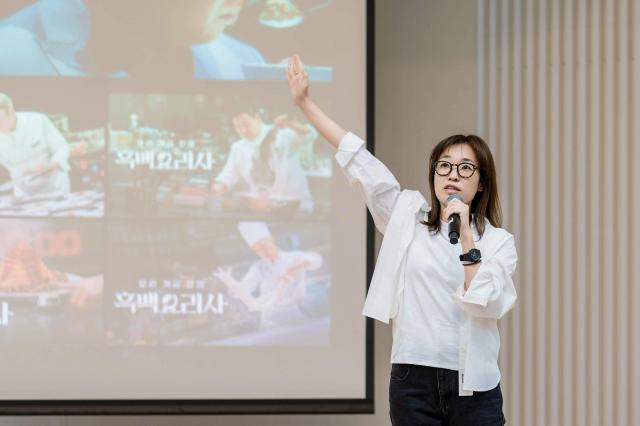
"Word of mouth is more powerful than any advertisement," Kim said. "When a friend or family member tells you to watch something, that has a stronger impact."
Netflix's Korean content also rides on a social media network Kim said reaches about 1.4 billion followers and generates roughly 224 billion organic views a year, scale that allows Korean titles to become global conversation points as fan-made clips, memes and reaction videos spread across platforms.
"Stories that started in Korea are reaching the entire world," Kim said, "in ways we could not have imagined before."
Taken together, the data suggests Korea's latest tourism wave is being shaped not only by concerts or government campaigns, but by shows foreign audiences are already watching before they ever start planning a trip.

Copyright ⓒ Aju Press All rights reserved.