

The simultaneous decline and aging of the construction workforce are raising concerns about the industry's competitiveness. While the influx of young workers is decreasing, the rapid aging of skilled labor is emerging as a structural issue threatening the sustainability of the construction sector.
According to the Construction Workers Mutual Aid Association's report on construction workforce trends, as of May, the number of employed construction workers stood at 1.308 million, a 4.1% decrease compared to the same month last year. This workforce includes skilled laborers, machine operators, and general laborers performing physical tasks on-site.
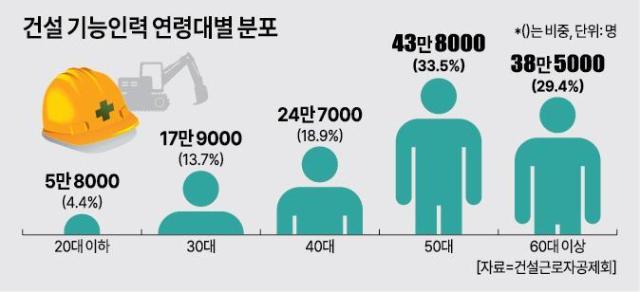
By age, the largest group is those in their 50s, totaling 438,000, followed by those aged 60 and over at 385,000, making up 29.4% of the total workforce. Approximately one in three construction workers is over 60, with 59,670 workers aged 70 and above, accounting for 4.6% of the total.
The average age of skilled workers is reported at 52.0 years, with those aged 40 and over comprising 81.9% of the workforce, significantly higher than the overall industry average of 68.9%. In contrast, the number of workers under 20 is only about 58,000, indicating limited new recruitment.
Among job categories, skilled laborers and related workers make up the largest segment at 921,000, with an average age of 51.4 years. Office workers average 46 years, highlighting a distinct age gap between field and office positions.
The aging workforce is also linked to safety concerns. An increase in older, inexperienced workers on-site raises the risk of accidents. According to the Korea Occupational Safety and Health Agency, 62.6% of fatal accidents involve workers aged 60 and over with less than six months of tenure. This suggests that not only age but also a lack of adaptability and skill contributes to accident risks.
The high physical demands, hazardous working conditions, and frequent job relocations characteristic of the construction industry are cited as barriers to attracting younger workers. As new recruitment declines, the workforce is becoming increasingly dominated by middle-aged and older workers, delaying the generational transition of skilled labor.
The gap left by the declining youth workforce is partially filled by foreign workers. However, the employment permit system (E-9), designed primarily for manufacturing, does not adequately reflect the unique characteristics of the construction industry, which often involves changing job sites.
Industry experts argue that to address the aging workforce and labor shortages in construction, efforts must focus on increasing youth participation, improving working conditions, systematically managing skilled labor careers, and promoting smart construction technologies.
Lee Eun-hyung, a researcher at the Korea Construction Policy Institute, stated, "The construction industry is not attractive to young people in terms of pay and working conditions, leading to a decline in new entrants. Given the decreasing working-age population, the proportion of foreign workers is likely to increase, necessitating improvements in working conditions and labor management systems."
* This article has been translated by AI.
Copyright ⓒ Aju Press All rights reserved.