

Religion does not endure simply by building grand temples or by having a multitude of followers. The great religions of humanity become powerful forces of civilization when they change lives, establish social order, and instill new ethics into the economy and culture. In this sense, Jainism, though not large in scale, has had a significant influence.
Founded in the 6th century BCE by Mahavira, Jainism has left a profound mark on Indian society for over 2,500 years. It did not establish dynasties or build empires, nor did it engage in large-scale missionary activities like other religions. However, Jainism provided the most thorough practical answers to the question of how humans should live. This practice has been a driving force in transforming India's economy, culture, and social ethics.
Jainism views the greatest asset of humanity not as wealth but as trust. Money can be gained or lost, but trust, once broken, is difficult to rebuild. Therefore, Jains regard honesty as their greatest competitive advantage. In transactions, they avoid deceit, keep promises, and are wary of unjust gains, which is considered a form of practice. This ethic naturally led to a high reputation for the Jain community in commerce, finance, jewelry, textiles, and trade.
Today, the Jain community is an indispensable part of discussions about the Indian economy. Although their population is relatively small, many entrepreneurs, merchants, financiers, and jewelers are Jains. This is not solely due to economic capability but also the result of long-accumulated trust and ethics. A culture of honoring contracts, conducting honest transactions, and giving back to society has become the community's greatest asset.
Jainism does not demonize wealth itself; rather, it scrutinizes the process of acquiring and using it. Wealth amassed through greed ultimately enslaves individuals, while sharing honestly obtained wealth with the community is a way to accumulate good karma. Consequently, a culture of donations for educational institutions, hospitals, scholarship programs, and relief efforts has long been developed within the Jain community. The belief that using wealth correctly is more important than accumulating it aligns closely with today's corporate social responsibility.
The recent global focus on ESG (Environment, Social, Governance) evokes the traditions of Jainism. The Jain worldview sees the environment not as human property but as a community of life with which we coexist. Their ethics resemble the commitment to protecting the vulnerable and respecting all life while maintaining community trust. Governance principles deeply resonate with Jain economic philosophy, which values honesty, responsibility, and transparency.
While many companies today adopt ESG as a new management strategy, it is not an exaggeration to say that Jainism has been practicing these principles in daily life for over 2,500 years. The idea that a business is not merely an organization for profit but a community responsible for society and nature reflects Jain wisdom.
The climate crisis also brings renewed attention to Jainism. Since the Industrial Revolution, humanity has achieved remarkable economic growth, but at the cost of a serious ecological crisis. Climate anomalies, loss of biodiversity, deforestation, and ocean pollution are consequences of humanity's insatiable desires. Jainism has long viewed nature not as something to conquer but as a partner to coexist with. Humans are part of nature, and harming nature ultimately harms ourselves.
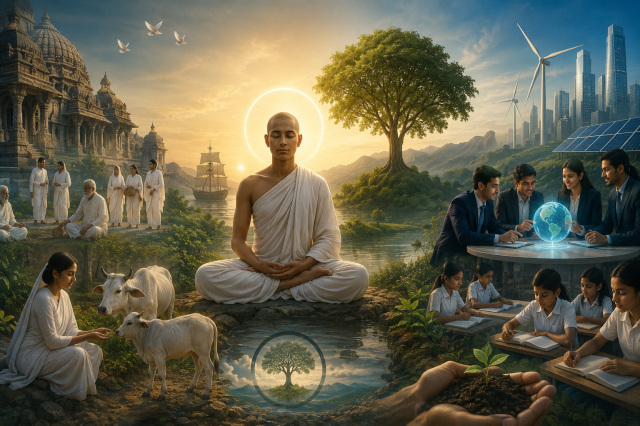
This respect for life is also evident in Jainism's strict vegetarianism. Vegetarianism is not merely a dietary choice but a practice of non-violence and compassion. The effort to minimize the sacrifice of other lives naturally connects with today's values of environmental protection, animal welfare, and healthy eating culture. The sustainable lifestyle that modern society has newly discovered has long been a part of daily practice in Jainism.
As the economy grows, ethics become increasingly important. As technology advances, human conscience faces greater tests. Jainism does not deny progress; it emphasizes that development should not foster human greed but should instead enrich life and communities. This is the ancient wisdom that the world is seeking today under the banner of sustainable development.
The level of civilization depends not on how much is produced but on how much one can exercise restraint. If nations, businesses, and individuals pursue endless growth, they will ultimately exhaust both nature and humanity. However, growth based on restraint can be sustainable. Jainism is regarded as a forward-looking religion today because it has long reminded us that a civilization prioritizing dignity over abundance, sustainability over speed, and coexistence over competition is the path humanity must take.
The scriptures convey the freedom of the soul—wisdom from Jainism that meets the AI era again.
Jainism emphasizes practice, but this practice has not merely been a matter of experience. Teachings passed down from master to disciple and from disciple to the next generation have been compiled into scriptures over the years. These texts are not just collections of doctrines but serve as life textbooks teaching how to live, how to manage desires, and how to liberate the soul.
The oldest scripture tradition in Jainism is the Āgamas. These texts, based on Mahavira's sermons and the teachings of the early community, encompass the precepts for practitioners, principles for community governance, meditation, ethics, and the path to liberation. The Śvētāmbara sect regards these as the most authoritative texts, which continue to this day. However, the Digambara sect believes that the original Āgama was lost during transmission and has developed a separate literary tradition. Despite these differences, both traditions accept non-violence, non-possessiveness, and self-restraint as the core of Jainism, which are Mahavira's fundamental teachings.
The Tattvārtha Sūtra is the classical text that systematically organizes Jain philosophy. This book is rare in that both major Jain traditions recognize its authority. It logically outlines the principles of soul (Jīva), non-soul (Ajīva), karma, reincarnation, and liberation (Moksha). Particularly, the idea that "correctly knowing true reality is the beginning of liberation" permeates the entire text. Humans must understand themselves before changing the world, and only by overcoming their greed, anger, and attachment can they become truly free beings.
Another well-known text, the Kalpa Sūtra, contains accounts of Mahavira's life, practices, the early community's history, and the rules for ascetic communities. It details Mahavira's birth, renunciation, enlightenment, teaching activities, and attainment of nirvana, making it one of the most familiar scriptures for Jain followers. The emphasis on compassion, restraint, and living for the community resonates deeply with many even today.
These scriptures, while differing in character, share a common message: humanity's greatest enemy is not external competitors but the greed, anger, and pride within oneself. Overcoming oneself is a more challenging and noble practice than defeating others, and the soul becomes free not when it dominates others but when it governs itself.
In this regard, Jainism offers remarkable insights even in today's AI era. Generative AI significantly expands human capabilities but simultaneously poses new ethical questions. How far can technology replace human abilities? When efficiency and respect for life collide, what should be chosen? Can algorithms replace human conscience?
Jainism provides clear standards for these questions. Technology must serve life and should be used to enhance human dignity. No matter how advanced the technology, if it amplifies greed and violence and undermines humanity, it is not true progress. Development should be evaluated by its direction, not its speed, and civilization is completed not by power but by responsibility, according to Jain philosophy.
Today, the world faces complex challenges, including the climate crisis, resource depletion, social polarization, and ethical dilemmas. In such times, the ancient teachings of Jainism become a new language for the future. Choosing sustainable living over unrestrained consumption, coexistence over endless competition, and mutual growth over domination is the insight humanity must pursue.
Businesses should not be organizations solely pursuing profit but communities responsible for society and nature. Politics should be a service to the people rather than a competition for power. The media should prioritize facts and truth over the race for breaking news, and education should not only increase knowledge but also nurture character and conscience. Science should serve humanity, and AI must also develop on the foundation of respecting life.
Today, we live in an era where we possess more than ever yet feel easily anxious, where we are quickly connected yet deeply lonely. Jainism delivers a quiet but firm message to this age: happiness lies not in having more but in being less attached, and freedom is not in gaining greater power but in liberating oneself from desires.
Non-violence is not a choice for the weak but the strongest form of courage, and non-possessiveness is not an ideology that glorifies poverty but a mental independence that is not dominated by any desire. Restraint is not an obstacle to growth but the starting point for opening a sustainable future.
The greatest challenge humanity faces today is not a lack of technology but a lack of wisdom. AI can replace human hands, but it cannot replace human conscience. Machines can calculate but cannot practice compassion, and algorithms can suggest answers but cannot choose between good and evil. Ultimately, the level of future civilization will be determined not by the speed of technology but by the dignity of humanity.
Mahavira taught over 2,500 years ago, "To change the world, one must first conquer oneself." That statement remains a living standard of civilization today. Only those who respect life, exercise restraint over desires, and practice truth can become truly free humans.
Thus, Jainism is not an ancient religion. Rather, it is the oldest beacon illuminating the future civilization where humanity, nature, technology, and ethics must coexist. As humanity stands at a significant turning point in the AI era, the spirituality left by Jainism asks us again: "Will we choose to have more, or will we choose to live more rightly?" The answer to that question will ultimately determine the direction of future civilization.
※ This article was generated using generative AI and has undergone editorial review.
* This article has been translated by AI.
Copyright ⓒ Aju Press All rights reserved.