

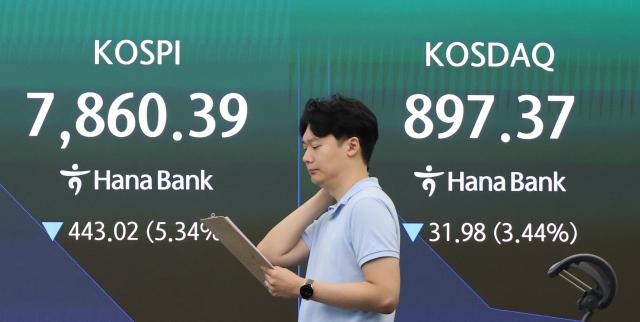
According to the Korea Exchange, the sell sidecar (which halts the effectiveness of program selling orders) was triggered at 9:07 a.m. on July 2. This is the 30th activation of the sidecar this year, with both sell and buy sidecars activated 15 times each.
The sidecar was triggered when the KOSPI 200 futures price fell from a reference price of 1,336.86 points to 1,255.94 points, a decline of 6.05% that lasted for more than one minute. As a result, the effectiveness of program selling orders was suspended for five minutes from the activation time and was automatically lifted afterward. At 9:07 a.m., the net selling amount from program trading reached 922.4 billion won.
The U.S. stock market's reaction to Meta's plans to enter the cloud business has raised concerns about a slowdown in AI investment cycles, which had a direct impact on the domestic market. Fears that Meta's provision of surplus AI computing power to external clients could dampen future AI infrastructure investments and memory demand led to a significant drop in semiconductor stocks in the U.S., with companies like Micron and SanDisk falling over 10%.
The domestic market opened with KOSPI down 370.31 points (4.46%) at 7,933.10, losing the 8,000 mark immediately. In early trading, Samsung Electronics and SK Hynix saw declines of around 6% and 7%, respectively, while other semiconductor-related stocks like SK Square and Samsung Electro-Mechanics also experienced significant losses.
This year's frequency of sidecar activations is unusually high. Since the sidecar system began operating in its current form in 2001, it was activated 26 times in 2008 during the global financial crisis. This year, the 30 activations in the first half alone have already surpassed that record, setting a new all-time high.
The sidecar is a market stabilization mechanism that halts the effectiveness of program trading orders for five minutes when the KOSPI 200 futures price rises or falls by more than 5% compared to the reference price for over one minute. It can only be activated once per day and does not apply during the first five minutes of regular market opening or within 40 minutes before market close.
* This article has been translated by AI.
Copyright ⓒ Aju Press All rights reserved.