
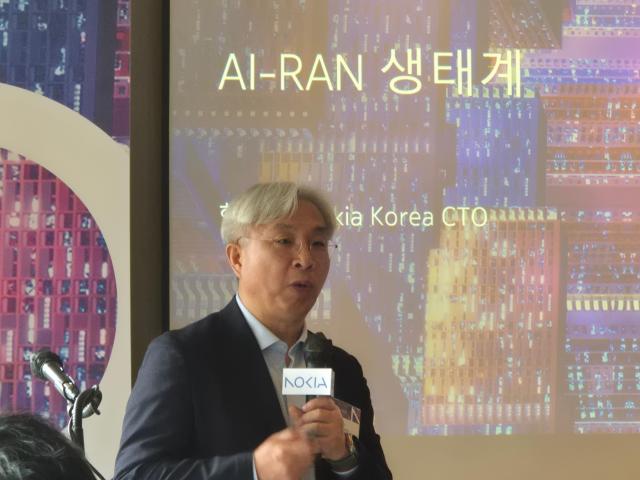
"We are transitioning from an era where humans ask questions to AI, to a time when machines communicate with each other through AI. To handle the traffic generated by AI, the network structure itself must change," said Han Hyo-chan, Chief Technology Officer of Nokia Korea, during the Amplify Korea 2026 event held at the Four Seasons Hotel in Seoul on July 2.
Han emphasized that we are entering an age where machines, not humans, will generate traffic, stating, "We are in a time where AI is transforming the network."
He noted that the network has evolved to accommodate services that generate the most traffic. Initially, voice calls between people dominated, followed by the rise of the internet and smartphones, which drove data and video traffic. Now, with the emergence of generative AI, agentic AI, and physical AI, AI has become the new center of traffic.
Han predicted that as agentic AI and physical AI proliferate, network demand will change significantly. Previously, users would ask questions to large language models (LLMs) in data centers, but in the future, communication between machines, such as AI glasses and robots, will increase, leading to a surge in real-time inference.
"If machines begin to communicate with each other, the scale of this change will grow by more than 15 times annually," Han said, adding that to manage this immense traffic, an 'AI grid' is needed to connect AI data centers, edge clouds, and access networks.
Nokia's AI grid connects AI factories, edge clouds, and access networks to position computing resources closer to users. Han described AI-RAN as the final segment of the AI grid, stating, "AI-RAN is the continuum where connectivity and AI are integrated."
AI-RAN is a next-generation network that combines AI computational capabilities with radio access networks. Unlike traditional base stations that primarily focus on communication functions, AI-RAN is designed to handle both wireless network processing and AI inference simultaneously on GPU-based infrastructure.
Nokia anticipates that AI-RAN could become a new revenue source for telecom operators. Base stations could evolve from merely providing connectivity to offering inference computing necessary for real-time services like autonomous vehicles and robots.
Currently, Nokia is applying AI-RAN in the advanced stage of 5G, with plans to develop it into an AI-native architecture for 6G. Han stated, "This technology is already being applied in 5G and will be completed in 6G," adding that they aim to demonstrate its potential by the end of 2026 and pursue cluster-level commercialization next year.
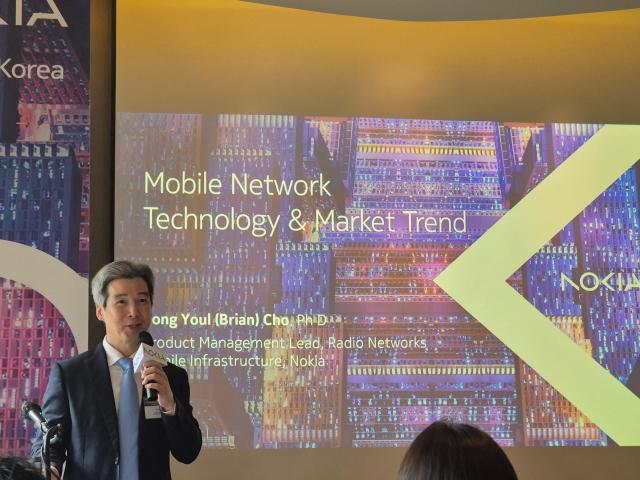
During the event, Nokia also showcased the current status of AI-RAN implementation through a demo tour. While the concept of AI-RAN was introduced at the Mobile World Congress in Barcelona last March, this time, they provided updates on actual testing using NVIDIA Blackwell GPU-based servers.
Nokia is currently conducting tests based on AI-RAN servers equipped with NVIDIA Blackwell GPUs, which are produced by Taiwanese ODM company Quanta.
Jo Bong-yeol, Nokia's Product Management Lead, stated, "Quanta was the first to launch servers optimized for NVIDIA," adding that they are currently using these servers for AI-RAN platform testing. He noted that while Quanta may not be familiar to the general public, it is a leading ODM company supplying servers to global hyperscale data centers like Google and Meta, highlighting its large-scale supply capabilities and competitive pricing as strengths.
* This article has been translated by AI.
Copyright ⓒ Aju Press All rights reserved.