SEOUL, July 26 (AJP) -About half of the U.S. trade investigations launched under Section 301 over the past decade ultimately ended with tariffs being suspended or withdrawn through negotiations rather than fully enforced, offering South Korea a potential playbook as it seeks to avoid additional duties from Washington's ongoing excess-capacity probe.
The finding comes from an analysis by the Korea International Trade Association (KITA), which argues Seoul should capitalize on that track record after the United States imposed a 12.5 percent Section 301 tariff on Korean goods over forced-labor concerns this week.
According to KITA's Institute for International Trade, the Office of the U.S. Trade Representative (USTR) has launched 14 Section 301 investigations since President Donald Trump's first administration began in 2017. Four cases, including the investigation into industrial overcapacity affecting South Korea, remain under review, while 10 have been completed. Of those completed cases, only five resulted in tariffs being implemented, while the other five ended with duties suspended or abandoned following bilateral negotiations or broader international agreements.
Section 301 of the U.S. Trade Act of 1974 authorizes Washington to impose retaliatory trade measures against countries deemed to engage in unfair or discriminatory trade practices.
One of the clearest precedents cited by KITA is the U.S. investigation into China's shipbuilding, maritime and logistics sectors. Although Washington decided to impose port fees on Chinese-built vessels, implementation was postponed until November 2026 after the United States and China agreed to a one-year trade truce.
Vietnam likewise avoided tariffs following Section 301 investigations into its currency policy and illegal timber imports, with both disputes settled through negotiated commitments and monitoring mechanisms rather than punitive duties.
Similar outcomes were reached in disputes over digital services taxes imposed by France, India, Italy and other countries, as well as the long-running Airbus subsidy case involving the European Union and the United Kingdom.
The report argues those cases demonstrate that Section 301 investigations have often functioned as negotiating leverage rather than automatic tariff actions, particularly for countries with strategic economic relationships with the United States.
The latest forced-labor case, however, followed a different path.
After opening simultaneous Section 301 investigations into forced labor and industrial overcapacity in March, the USTR finalized tariffs of 10 to 12.5 percent on 60 economies this week, replacing the temporary global tariff imposed under Section 122, which expired on July 24. South Korea, Japan and Switzerland were assigned an effective tariff ceiling of 12.5 percent.
KITA said the forced-labor investigation moved unusually quickly, reaching a final decision in just four months compared with the roughly one year typically required for Section 301 cases. The institute attributed the speed to Washington's need to replace the expiring Section 122 tariff regime after legal challenges to the International Emergency Economic Powers Act (IEEPA) tariffs.
The trade group nevertheless believes the still-pending excess-capacity investigation may leave more room for negotiation because it does not face the same policy urgency.
South Korea is among 16 economies under investigation for alleged structural overcapacity. KITA warned that additional tariffs could still be imposed, potentially pushing Korea's overall tariff burden above the 15 percent ceiling agreed during last year's bilateral tariff negotiations unless Seoul secures exemptions or preferential treatment.
The report recommends that Seoul use its previous trade agreement with Washington, pledged U.S. investment projects and the Korea-U.S. shipbuilding partnership under the MASGA initiative as bargaining chips in any forthcoming negotiations. It also urges the government to continue outreach even if new tariffs are announced, arguing that past Section 301 cases show implementation can still be delayed or modified through sustained engagement.
"The forced-labor tariffs have now been finalized, and the results of the excess-capacity investigation are expected to follow soon," KITA senior researcher Jeon Yoon-sik said in the report.
"Even during the first Trump administration, many Section 301 investigations ended with tariff suspensions or monitoring arrangements rather than immediate enforcement. Active negotiations could still secure a postponement or relief even after the investigation concludes."
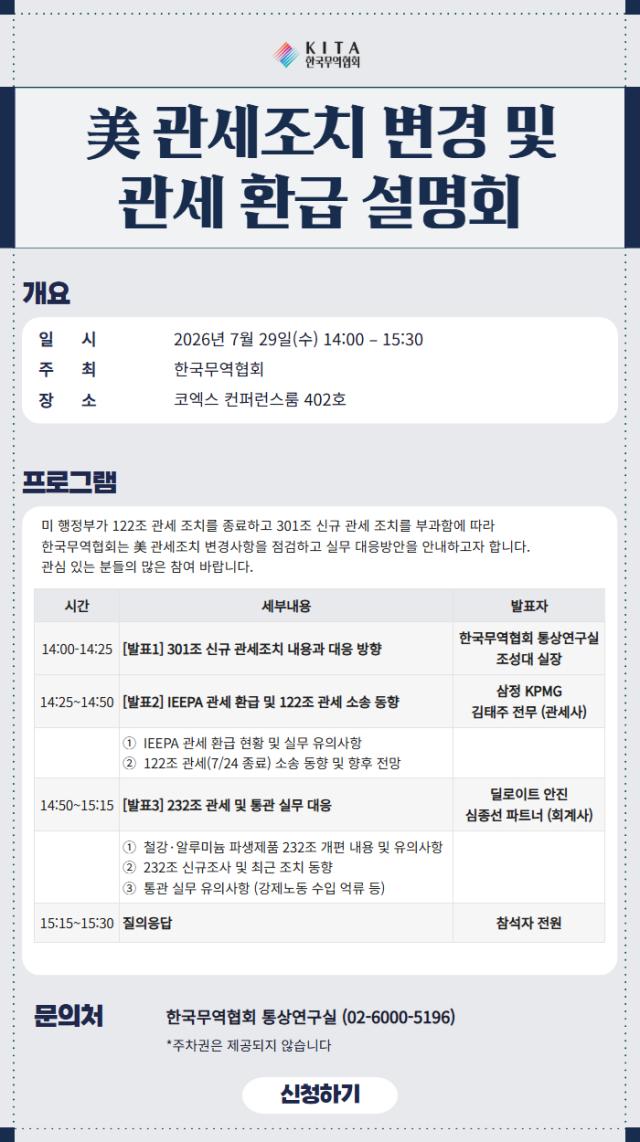
KITA will hold a briefing for businesses on July 29 at COEX in Seoul to explain the new U.S. Section 301 measures, developments surrounding Section 122 refund litigation and practical customs responses to Section 232 tariffs. The seminar will also cover IEEPA tariff refunds and the outlook for the ongoing excess-capacity investigation, reflecting growing concern among Korean exporters over the next phase of U.S. trade actions.
Copyright ⓒ Aju Press All rights reserved.