
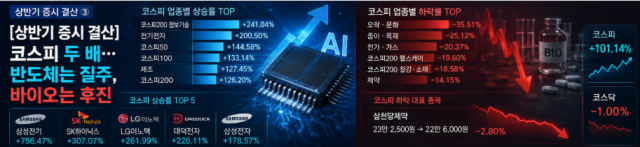
This year, the domestic stock market has shown stark contrasts across sectors. While semiconductor and related stocks surged due to increased investment in artificial intelligence (AI), sectors such as bio, content, and electric & gas struggled, leading to unprecedented disparities in returns across industries.
According to the Korea Exchange on July 2, the KOSPI index rose 101.14% from the end of last year to the end of June, more than doubling in value. The semiconductor sector was the primary driver of this bullish trend.
Among KOSPI sectors, the KOSPI 200 Information Technology index recorded the highest increase at 241.04%. The Electric & Electronics index also rose by 200.50%. Other sectors, including KOSPI 50 (144.58%), KOSPI 100 (133.14%), Manufacturing (127.45%), and KOSPI 200 (126.20%), all posted triple-digit gains, reflecting the strength of large-cap tech stocks.
In terms of individual stocks, Samsung Electro-Mechanics surged 756.47%, leading KOSPI returns, followed by SK Hynix (307.07%), LG Innotek (261.99%), Daeduck Electronics (226.11%), and Samsung Electronics (178.57%), all of which saw significant increases. Trading volumes were led by SK Hynix at approximately 844 trillion won and Samsung Electronics at about 843.9 trillion won, with Samsung Electronics also reaching around 113.9 trillion won.
This indicates that the market's rise was not limited to a few stocks but spread across the entire semiconductor sector. Notably, the KOSPI 200 Information Technology index's growth rate exceeded that of the KOSPI itself, underscoring that the first half of the year was essentially dominated by the semiconductor sector.
In contrast, traditional industries faced challenges. The KOSPI's Entertainment & Culture sector fell 35.51%, marking the largest decline, followed by Paper & Wood (-25.12%), Electric & Gas (-20.37%), KOSPI 200 Healthcare (-19.60%), KOSPI 200 Steel & Materials (-18.58%), Non-Metallic (-16.17%), and Pharmaceuticals (-14.15%). Other sectors, including Metals (-0.79%), Transportation & Warehousing (-1.61%), and Food & Tobacco (0.14%), also showed relatively poor performance.
The KOSDAQ index also reflected relative strength in the semiconductor value chain. The KOSDAQ 150 Information Technology index rose 74.29%, the highest among sectors, followed by Non-Metallic (56.23%), Machinery & Equipment (50.39%), and Electric & Electronics (24.56%). However, the overall KOSDAQ index fell 1.00%, indicating significant disparities in sector performance.
The strength of certain sectors was particularly evident in individual stocks. Juseong Engineering soared 625.63%, leading KOSDAQ returns, followed by Daehan Optical Communication (519.14%), Gigavis (510.16%), BL Pharmtech (442.88%), PSK (431.44%), and Tes (366.89%). Trading volume was highest for Daehan Optical Communication at approximately 44 trillion won, followed by Juseong Engineering (about 33.9 trillion won), Jeju Semiconductor (about 30.7 trillion won), Padu (about 11.8 trillion won), Light & Electronics (about 7.6 trillion won), and Wooriro (about 6.8 trillion won), with investment enthusiasm continuing around semiconductor and AI-related stocks.
Conversely, weak sectors in KOSDAQ were pronounced. The Entertainment & Culture sector recorded the largest decline at -41.78%, followed by Publishing & Media Replication (-36.54%), KOSDAQ 150 Communication Services (-33.48%), Textiles & Apparel (-31.27%), KOSDAQ 150 Consumer Discretionary (-28.94%), KOSDAQ Growth Companies (-27.27%), and IT Services (-27.46%). Pharmaceuticals (-20.08%) and KOSDAQ 150 Healthcare (-17.80%) also continued to show poor performance.
A notable example of this trend is Samchundang Pharmaceutical. Once buoyed by expectations for an oral obesity treatment, its stock price surpassed 1.2 million won, earning it the title of 'blue chip.' However, in the first half of the year, it fell from 232,500 won to 226,000 won, reflecting the struggles of the pharmaceutical sector.
* This article has been translated by AI.
Copyright ⓒ Aju Press All rights reserved.