
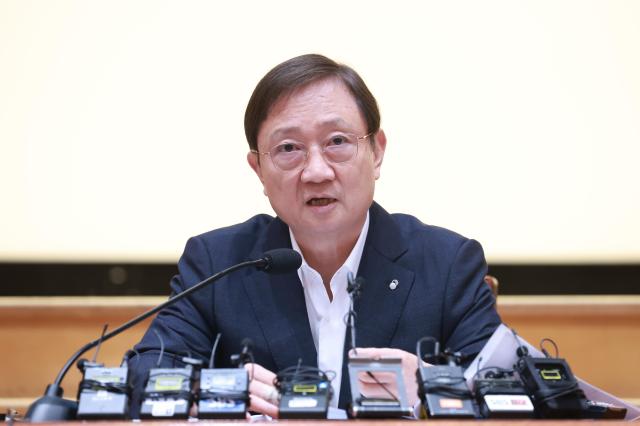
Lee Chan-jin, the head of South Korea's Financial Supervisory Service (FSS), met with CEOs of major virtual asset operators to emphasize the need for stronger internal controls and enhanced user protection. He noted that for the virtual asset market to transition into a regulated industry, robust internal control systems must be established before public regulations can take effect.
On July 2, the FSS held a meeting with CEOs from 15 virtual asset operators, including five Korean won exchanges, five cryptocurrency exchanges, and five custodians, along with representatives from the Digital Asset Exchange Alliance (DAXA).
Lee stated, "The virtual asset market showed signs of stagnation in the first half of this year due to the Middle East crisis and a shift of funds to the stock market. There were also incidents of Bitcoin overpayments at some exchanges due to inadequate internal controls, which undermined market trust." However, he acknowledged that attempts to utilize stablecoins, the integration of blockchain-based financial services, and the establishment of asset tokenization systems are expanding the industry's foundation.
He urged for immediate strengthening of internal controls across the board, stating, "Only those places where the general public can trade with confidence will gain market preference and sustain in the long term. The foundation of market trust lies in a control system that operates routinely within companies, rather than relying solely on strong public regulations or post-event sanctions."
Lee also called for proactive responses to regulatory changes. He noted that as the Digital Asset Basic Act is being prepared, related regulatory frameworks, including the Specific Financial Information Act and the Foreign Exchange Transaction Act, are being revised. He urged operators to closely monitor these changes to ensure compliance. The FSS pledged to support operators in adapting to the new regulations.
Additionally, he highlighted the importance of enhancing market surveillance functions at exchanges. Lee warned that as the virtual asset market grows, unfair trading practices are becoming more sophisticated and could increase in scale and variety. The FSS plans to strengthen market monitoring capabilities using artificial intelligence (AI) and to enhance its investigative systems.
Regarding user protection, Lee remarked, "Users are not merely targets for profit generation; they are partners in mutual growth and development." He pointed out that launching high-risk products, sensational events, delayed disclosures of insufficient information, and transferring losses to well-meaning users ultimately lead to a loss of user trust.
* This article has been translated by AI.
Copyright ⓒ Aju Press All rights reserved.