
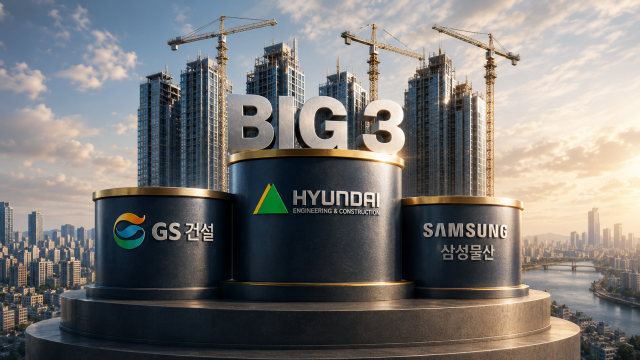
In the first half of this year, South Korea's Big Three construction firms—Hyundai Engineering & Construction, GS Engineering & Construction, and Samsung C&T—secured over 70% of the total contracts awarded in the urban renewal sector, which amounted to 27.1393 trillion won. The concentration of large firms in key areas like Gangnam and along the Han River is evident, but the increase in contract value does not necessarily translate to improved performance. As the second half approaches, selective bidding and margin management are expected to be critical.
According to the construction industry on July 2, the cumulative contract value for the top ten construction firms in urban renewal projects reached 27.1393 trillion won in the first half of the year. Of this, the combined contracts of Hyundai, GS, and Samsung totaled 19.8804 trillion won, accounting for 73.2% of the total.
Hyundai Engineering & Construction ranked first with contracts worth 7.6947 trillion won, solidifying its position in the Gangnam Han River redevelopment market by securing the Apgujeong District 3 and 5 projects. GS Engineering & Construction followed with 7.4694 trillion won, winning contracts for projects including the Seongsu Strategic Redevelopment Zone 1, Seongnam Sangdaewon District 2, Seocho Jinheung Apartments, and Songpa Hanyang 2nd. Samsung C&T accumulated 4.7163 trillion won, focusing on key projects in Gangnam, such as Apgujeong District 4 and Shinbanpo Districts 19 and 25.
While the urban renewal market appears to be recovering rapidly for large firms, the key issue remains profitability. Even with large contract values, this does not guarantee improved performance. After selecting a construction company, the process of relocation, demolition, commencement, sales, progress, and settlement takes time. Factors such as renegotiation of construction costs, rising financial expenses, and conflicts over member contributions can affect actual profit margins.
A representative from one construction firm stated, "Rising raw material and labor costs have driven up construction expenses, and interest rate burdens remain significant. We are evaluating project feasibility, commencement potential, marketability, and financial costs rather than simply expanding our scale."
Current performance indicators show that contract size and profitability do not necessarily move in the same direction. In the first quarter of this year, Hyundai's operating profit margin was 2.9%, GS's was 3.1%, and Samsung C&T's construction division was at 3.2%. Although these figures do not reflect the individual profitability of the urban renewal projects secured in the first half, they indicate that the large firms' performance has not improved in line with their contract sizes.
Conversely, some construction firms that lagged behind the Big Three in contract rankings reported higher profitability. Daewoo Engineering & Construction recorded an operating profit margin of 13.1% in the first quarter, while IPARK Hyundai Industrial Development and DL E&C reported margins of 11.8% and 9.12%, respectively. This is attributed to the completion of high-cost projects, improved cost ratios, and the execution of self-developed and high-quality contracts.
Recent trends indicate that the recovery of profitability for large construction firms has been slow. Hyundai returned to profitability last year, but its operating profit margin remained in the low 2% range. GS has shown gradual recovery following the aftermath of the Geomdan incident. Samsung C&T's construction division maintained an operating profit margin of 5-6% from 2022 to 2024, but it dropped to the 3% range last year.
As a result, the focus in the second half of the urban renewal bidding process is expected to shift from merely competing for contract value to evaluating profitability on a project-by-project basis. While the Big Three will continue to favor large urban renewal projects in areas like Seongsu, Mokdong, and Yeouido, construction firms are also adopting a selective approach, weighing construction costs, commencement feasibility, marketability, and financial burdens.
An industry insider noted, "Securing contracts in key areas is important for brand management, but considering construction costs and financial burdens, aggressive bidding could actually strain performance. In the future, the focus will shift from how much work is secured to how stable the margins are for construction firms."
* This article has been translated by AI.
Copyright ⓒ Aju Press All rights reserved.