
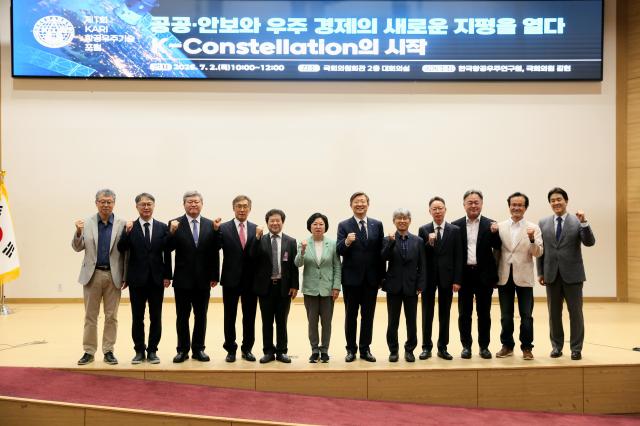
The Korea Aerospace Research Institute (KARI) has emphasized the necessity of establishing a Korean-style constellation satellite system (K-Constellation) that encompasses low Earth orbit satellite communication, satellite navigation, and infrared constellation satellites. This initiative aims to enhance national security and public services while fostering the space industry ecosystem and space economy through the early establishment of an independent constellation satellite system.
On July 2, KARI, in collaboration with lawmaker Kim Hyun, hosted the "KARI Aerospace Technology Forum" at the National Assembly's member office building, focusing on the theme "A New Horizon for Public Security and the Space Economy: K-Constellation."
In his welcoming remarks, Kim Hyun, a member of the Democratic Party, stated, "In the space age, information superiority is determined not by the size of territory but by who secures data first and how stably a global integrated network is operated. To achieve this, a national-level commitment and bold budget support, along with a stable legal and institutional foundation, must be established."
The forum featured experts from academia and industry who discussed the direction and strategies for building an independent constellation satellite system. Presentations focused on three main topics: low Earth orbit satellite communication, multi-layer orbit satellite navigation, and infrared constellation satellites.
Participants noted that as data-driven decision-making and hyper-connectivity become more prevalent globally, constellation satellites are establishing themselves as essential infrastructure for communication, navigation, Earth observation, disaster response, and national security. Consequently, there were calls for the establishment of a national-level independent constellation satellite system to enhance public services and security capabilities while creating new industries and services.
Constellation satellites utilize a distributed structure of multiple small satellites, characterized by high resilience that allows the overall system to continue its mission even if some satellites encounter issues. The ability to mass-produce satellites based on standard platforms facilitates the establishment of a mass production system in the space industry, and the potential for rapid application of the latest technologies through repeated launches was also highlighted. This could lead to increased launch demand and invigorate the space industry ecosystem.
In the field of Earth observation, it was analyzed that the security importance of satellite information is growing due to escalating geopolitical conflicts, and the utility value in private industries such as energy and finance is also expanding. As a result, the need for research and development of not only visible light and synthetic aperture radar (SAR) satellites but also infrared observation and hyperspectral payload technologies is expected to increase.
Lee Sang-cheol, the head of KARI, remarked, "Future space competitiveness will not be determined by individual satellites or single technologies but by an integrated space architecture that organically connects communication, navigation, and observation. An open research and development system is needed, where the government, research institutions, and industry collaborate from the early stages of research and development to plan future projects and share roles."
* This article has been translated by AI.
Copyright ⓒ Aju Press All rights reserved.