
Vietnam has been upgraded to upper-middle-income status by the World Bank, yet it has not crossed the threshold to be classified as an emerging market in capital markets. While economic growth and increased exports have elevated the country's income classification, challenges remain in foreign investor accessibility, settlement and clearing processes, and disclosure regulations, according to MSCI.
On July 1, local media including VnExpress reported that the World Bank adjusted Vietnam's classification based on an increase in gross national income (GNI) per capita from $4,490 in 2024 to $4,970 last year. The threshold for upper-middle-income countries this year is set between $4,636 and $14,375 per capita, which Vietnam has surpassed.
The upgrade in income classification is attributed to a combination of growth rates and export expansion. The World Bank noted that Vietnam's exports are projected to increase by over 15% from 2024 to 2025, while the country's GDP growth rates are expected to reach 7% and 8%, respectively. From 2021 to 2025, Vietnam's GNI is anticipated to grow at an average annual rate of 10%, which World Bank experts have described as "one of the most sustained growth trends in the region."
This classification change aligns with Vietnam's medium- to long-term economic goals. The country aims to become an upper-middle-income developing nation with a modern industrial base by 2030 and to achieve high-income status by 2045. To reach these goals, the government is pursuing measures to boost economic growth rates above 10%.
However, unlike its income classification, Vietnam's stock market has not shown significant changes in global index evaluations. In its annual market classification report released on June 24, MSCI did not mention Vietnam. The country remains classified as a frontier market on separate statistical pages, meaning it was not included in this year's MSCI upgrade watch list.
MSCI's market classification is closely tied to global capital flows. The organization categorizes stock markets into developed, emerging, and frontier markets based on criteria such as market size, liquidity, and accessibility for foreign investors. This classification is crucial for many global funds when constructing portfolios and allocating capital, making a country's stock market upgrade a key indicator for foreign capital inflow expectations.
Not being included on the watch list poses a burden for Vietnam's stock market. MSCI typically places markets with potential for upgrade or downgrade on a separate watch list for further evaluation. Generally, a market must be included on the watch list at least once during an annual assessment to be considered for an upgrade, indicating that Vietnam's inclusion in the emerging market category may be delayed.
MSCI has not dismissed the reform trends in the Vietnamese market. In a global market accessibility assessment released on June 19, MSCI acknowledged positive factors such as trading models through global brokers, the establishment of a central clearing party (CCP), English disclosure timelines, and changes related to foreign ownership limits. However, it noted that many key criteria still require resolution.
The barriers that Vietnam's stock market must overcome primarily focus on foreign investor accessibility and market regulations. MSCI highlighted issues such as foreign ownership restrictions, equality of rights for foreign investors, foreign exchange, disclosure, settlement and clearing, securities lending, and short selling as major challenges. The actual freedom of foreign investors to trade and move capital remains a critical evaluation criterion.
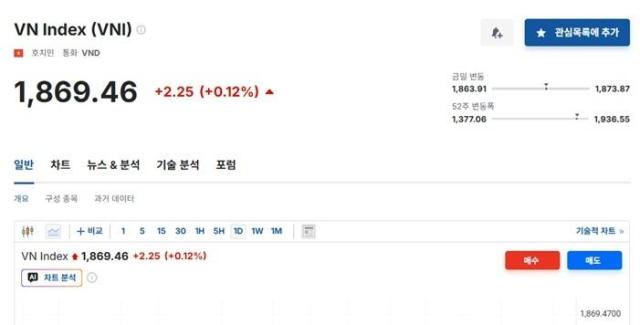
Despite the VN-Index showing an upward trend in the first half of the year, the stock market has experienced significant volatility. The VN-Index, which represents the Ho Chi Minh Stock Exchange, rose from 1,784 points at the end of last year to 1,860 points, marking a 4.2% increase in the first half. However, this trend was accompanied by considerable fluctuations, with the index dropping below 1,600 points at one point due to rising tensions in the Middle East, before rebounding strongly to reach 1,927 points in mid-May.
The VN-Index's rise is largely influenced by a few large-cap stocks. Excluding four Vingroup-related stocks, the representative index of the Ho Chi Minh Stock Exchange calculates to 1,747 points, which is over 2% lower than at the end of last year. Analysts at An Binh Securities (ABS) noted that this level is close to last March's low, indicating that while market valuations are attractive, capital has yet to return.
In summary, while Vietnam has achieved recognition for its economic growth by being upgraded to upper-middle-income status by the World Bank, it still needs to demonstrate improvements in foreign investor accessibility, settlement and clearing systems, and disclosure regulations to be included in the MSCI emerging markets category. Despite the VN-Index's gains in the first half of the year, the reliance on a few large-cap stocks and the outflow of foreign capital highlight ongoing challenges for Vietnam's capital markets.
* This article has been translated by AI.
Copyright ⓒ Aju Press All rights reserved.