
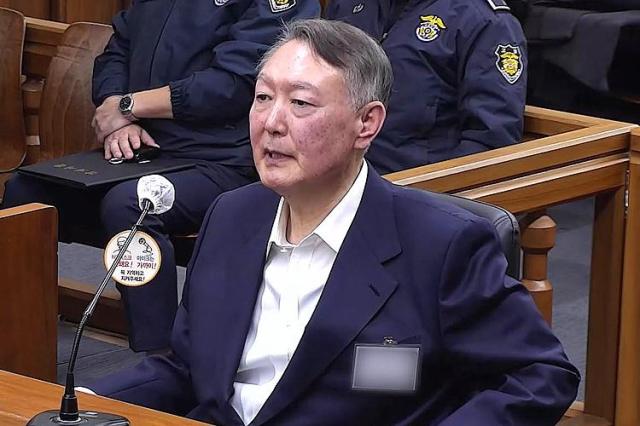
Yoon Suk Yeol, who was sentenced to life imprisonment for leading an insurrection after declaring martial law on December 3, has continued to deny the charges during his appeal hearing.
On July 2, the Seoul High Court's Criminal Division 12-1, presided over by judges Lee Seung-cheol, Jo Jin-goo, and Kim Min-a, held a continuation of the hearing regarding Yoon's insurrection charges.
Yoon, along with former Defense Minister Kim Yong-hyun and former head of the Defense Investigation Headquarters Kim Yong-gun, attended the hearing. They argued that the special prosecutor's indictment was unjust and requested the court to dismiss the charges.
During the proceedings, Yoon reiterated his stance that the martial law declaration was not a foundation for long-term dictatorship and that he did not instruct any illegal actions during the enforcement of martial law.
He stated, "At that time, the National Intelligence Service pointed out the hacking risks and security vulnerabilities of the election commission's computer management system. Therefore, checking whether security was properly reinforced was a legitimate action that could be carried out under Articles 7 and 8 of the Martial Law Act." This statement was made in response to the special prosecutor's characterization of the military's entry into the election commission as an attempt to investigate and manipulate the election.
Yoon expressed his frustration regarding the special prosecutor's claim that he had a 'long-term dictatorship' motive, saying, "If I were trying to establish dictatorial power or attempt long-term rule, it would have been more advantageous for dictatorship to leave the election commission system in a problematic state. Instead, I directed security checks to enhance the transparency of the electoral system and maintain public trust, so interpreting this as a psychological coup aimed at destroying the constitution is an unreasonable interpretation."
He added, "Investigation and checks are fundamentally different, and I took minimal preservation measures knowing that martial law could not be maintained for a long time."
Yoon's defense team also argued that the special prosecutor was intentionally conflating 'unconstitutionality assessment' and 'criminal insurrection charges' to frame the case. They contended that the political and constitutional judgments made by the Constitutional Court regarding impeachment do not directly prove the intent to disrupt the constitution or the individual defendants' criminal intent as required for insurrection charges.
A lawyer for former Minister Kim stated, "The special prosecutor claims that the martial law was unconstitutional, and therefore it constitutes insurrection, which is a typical circular reasoning. It was merely a short-term emergency measure in response to the opposition's behavior, akin to parliamentary dictatorship, and there were no substantial restrictions on civic activities or the press."
He also noted that to prevent bloodshed during the enforcement process, the military was strictly prohibited from issuing live ammunition, and the military withdrew immediately after the National Assembly passed a resolution calling for the lifting of martial law, indicating that there was no actual insurrection aimed at seizing the state.
In contrast, the special prosecutor dismissed Yoon's statements as 'excuses to evade responsibility' and criticized them sharply.
The special prosecutor stated, "The declaration of martial law and the contents of the announcement and decree were clearly unconstitutional and illegal. The president abused his inherent power of national emergency to completely paralyze the constitutionally guaranteed separation of powers and parliamentary politics."
They specifically refuted Yoon's defense team's claim that the military's deployment to the election commission and National Assembly was for maintaining public order or protecting servers.
The special prosecutor emphasized, "At that time, there was no security demand or chaotic situation that warranted military deployment to the election commission or National Assembly. Given that a joint arrest team targeting key politicians such as National Assembly Speaker Woo Won-shik, Democratic Party leader Lee Jae-myung, and People Power Party leader Han Dong-hoon was specifically planned and activated, the essence of the military's deployment was an exercise of force aimed at suppressing the legislature and infringing on the voting rights of National Assembly members."
Regarding Kim, who is also on trial for insurrection-related charges, the special prosecutor demanded a harsher sentence than the 30 years imposed in the first trial, citing Supreme Court precedents that indicate a declaration of martial law aimed at disrupting the constitution is subject to judicial review.
In the afternoon session, a heated debate ensued over key evidence regarding the premeditated nature of the alleged crimes, specifically a notebook belonging to former Army Intelligence Commander Noh Sang-won.
The special prosecutor claimed the notebook was a 'draft plan for martial law' written well before the declaration in October 2023, containing specific plans for the early arrest of opposition politicians.
Conversely, Noh's defense team argued, "If the notebook is a planning document, why are the names of Park Jong-geun, the commander of the Special Warfare Command, or Lee Jin-woo, the commander of the Defense Security Command, omitted? The list of politicians in the notebook is merely personal reflections written after watching news and movies following the lifting of martial law."
They further contended that terms like 'Silmi-do,' 'Cha Bum-kun,' and 'Kim Du-hwan' were simply miswritten musings from watching news or dramas while intoxicated.
Additionally, Kim's defense team reiterated their argument against the special prosecutor's claim that Yoon and the military conspired to provoke North Korean military actions, stating, "We had already decided to halt the operation by mid-November, and we did not resume operations on November 28 when North Korea actually carried out provocations. Furthermore, there is no mention of North Korea in the reasons for the martial law decree, strongly denying any manipulation of the martial law justification."
* This article has been translated by AI.
Copyright ⓒ Aju Press All rights reserved.