
The Honam semiconductor cluster, expected to be the largest investment in the southwestern region since the founding of Korea, faces serious concerns regarding its reliance on foreign technology and equipment in the offshore wind power sector, which is critical for its energy infrastructure.
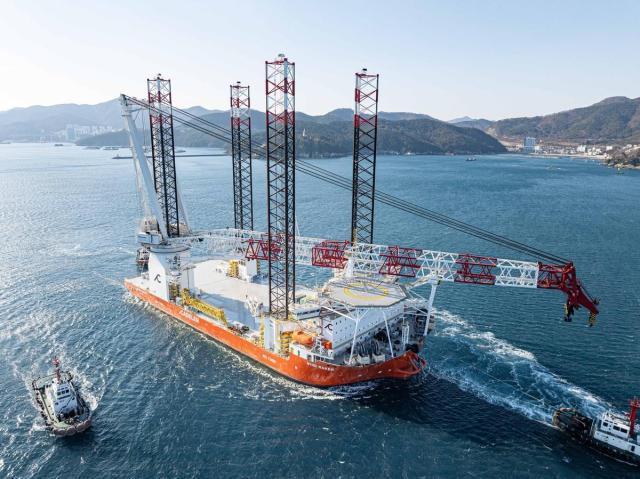
According to data submitted to Rep. Kim So-hee of the People Power Party by companies developing domestic offshore wind farms, the current projects are utilizing two 10MW-class wind turbine installation vessels (WTIVs), the Hyundai Frontier and Hansan 1. The Hyundai Frontier has recently been deployed for the construction of the Sinan Uihye offshore wind farm, while the Hansan 1 is currently working on the Nakwol offshore wind farm.
WTIVs are specialized vessels designed for transporting and installing offshore wind turbines in rough seas, making them essential for large-scale offshore wind farm development.
Companies anticipate a surge in domestic offshore wind demand due to the Honam semiconductor cluster and the West Sea energy highway, prompting plans to introduce three larger 15MW-class WTIVs. One vessel is being constructed by Hanwha Ocean, aiming for launch in the second quarter of 2028 for deployment at the Sinan Uihye offshore wind farm.
However, the remaining two vessels cannot be built domestically due to the current capacity constraints of the country’s three major shipyards, which have already filled their order books for the next three years, pushing delivery dates to after 2030. Given the rapid increase in demand for WTIVs following the passage of the Offshore Wind Special Act, the only options left are to place orders with Chinese shipyards or purchase existing WTIVs operating abroad and reflag them as domestic vessels.
In fact, unlike the domestically built Hyundai Frontier, the Hansan 1 was acquired from China and had its name and nationality changed. This raised suspicions of importing a Chinese vessel without government approval, leading to an investigation by the Coast Guard and subsequent prosecution.
According to Rep. Kim So-hee's office, the reliance on foreign technology is also significant for the 14-15MW wind turbines to be installed in large-scale offshore wind farms of 100MW or more. Currently, turbines from Vestas (Denmark) and Siemens Gamesa (Spain and Germany) are predominantly used. Domestic companies Doosan Enerbility and Unison have received technology transfers from Siemens Gamesa and Vensys (Germany and China) to produce 14-15MW wind turbines, making it difficult to classify them as purely domestic products.
Choi Hong-jong, a professor of economics at Dankook University, expressed concerns that the offshore wind industry could be overtaken by China due to technological gaps and economic factors. He emphasized the need for the government to provide incentives, such as bonus points for using domestic technology and equipment in wind farm development.
Professor Choi pointed to Taiwan as a model for narrowing the technology gap with China and Europe, suggesting a government-led total package approach to develop essential infrastructure like back ports, wind turbine manufacturing facilities, and WTIVs.
* This article has been translated by AI.
Copyright ⓒ Aju Press All rights reserved.