
The great religions of humanity gain new meanings as times change, embodying timeless truths. Jainism is no exception. Originating over 2,500 years ago in India, this small community of practitioners poses urgent questions for humanity today, as we navigate an era marked by artificial intelligence, climate crises, and relentless competition and consumption. How far should humanity grow? What does abundance mean, and what is the essence of freedom? What is the purpose of civilization?
Mahavira, the founder of Jainism, did not seek to establish a vast empire during his lifetime. He believed that changing the hearts of individuals was more crucial than altering the world. He was convinced that if humans could not overcome greed, anger, and attachment, no institution, power, or civilization could endure. This teaching remains relevant even after 2,500 years.
Until his last moments, Mahavira preached nonviolence, truth, moderation, and non-possessiveness. He viewed death not as an end but as the completion of liberation, where the soul frees itself from all bondage. Thus, his nirvana is remembered not as a source of sorrow but as a symbol of the highest freedom attainable by humanity. This is why Jain followers continue to commemorate Nirvana Day with deep reverence.
Mahavira's greatest legacy lies not in the expansion of the religious order but in the enhancement of human dignity. He warned against the arrogance of believing that humans are the only special beings, asserting that all life, regardless of size, holds intrinsic value. His insight into the worth of even the smallest insect or nameless blade of grass has become a focal point in modern ecological philosophy and environmental ethics.
This spirit profoundly influenced India's independence movement. Notably, Mahatma Gandhi developed his philosophy of nonviolent resistance, drawing significant inspiration from Jainism's principle of ahimsa. The belief that violence cannot overcome violence and that truth and conscience ultimately drive history has become an essential spiritual asset for global human rights and peace movements.
Today, humanity has achieved remarkable advancements in science and technology, yet we face crises of climate change, ecological destruction, polarization, and ethical dilemmas. Generative AI significantly enhances human capabilities but cannot replace human conscience and responsibility. At this juncture, Jainism is reinterpreted as an ethical framework for future civilizations, transcending its ancient roots.
Jainism does not urge humans to accumulate more possessions. Instead, it advocates for less greed, deeper reflection, and broader coexistence. This does not mean abandoning growth but rather redirecting its trajectory. The true measure of civilization lies not in productivity but in the respect for life, and not in the speed of technology but in the dignity of humanity, a lesson Jainism has imparted for centuries.
◆ The Greatest Legacy of Jainism: Expanding Human Dignity
The most significant legacy of religion is not the construction of numerous temples but the transformation of individual conscience, which in turn reshapes the course of human history. Jainism's greatest contribution to world civilization is the spirit of nonviolence, or ahimsa.
In Jainism, ahimsa is not merely a commandment against killing. It embodies a way of life that avoids harming any living being in thought, word, or deed. Violence begins not with the act of wielding a weapon but when hatred, greed, malice, and arrogance take root in the heart. Therefore, true peace is not merely the absence of war but the eradication of violence from the human heart.
This philosophy has served as the ethical foundation of Indian society for thousands of years and expanded into world history through a great leader in modern times: Mahatma Gandhi. Gandhi prioritized human conscience over political independence, believing that victories achieved through violence only beget further violence. His Satyagraha movement, rooted in the power of truth, was deeply influenced by Jainism's principle of ahimsa.
Gandhi's nonviolent resistance became a new model for global human rights movements, inspiring figures like Martin Luther King Jr. in the American civil rights movement and Nelson Mandela in South Africa, who sought to build a new nation through reconciliation and coexistence. Despite differing historical contexts and ideological foundations, they shared Jainism's long-standing commitment to prioritizing conscience and justice over violence.
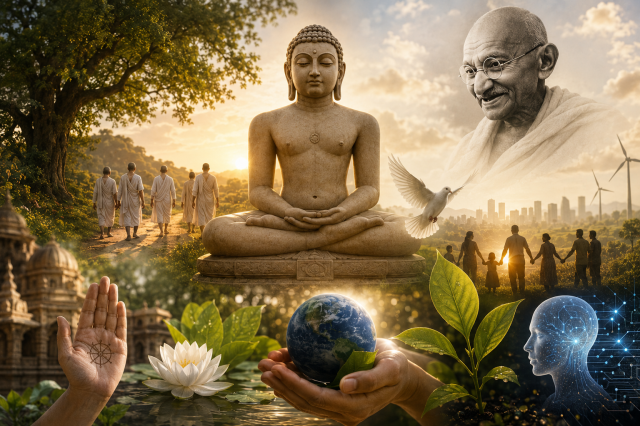
Even in an era marked by nuclear weapons, drones, and AI weaponry, peace still begins in the human heart. Jainism's insight that advanced weaponry does not end wars but that human conscience does is becoming increasingly urgent.
◆ Sustainable Development and ESG: Ancient Philosophies for Modern Challenges
One of the most frequently used terms in the 21st century is sustainability. The understanding that economies must grow while nature thrives, and that businesses must generate profits while fulfilling social responsibilities, has become a global standard.
However, Jainism has practiced these values for over 2,500 years. Nature is not a target for human conquest but a community of life with which we coexist, and respecting other lives is the path to preserving humanity itself. Strict vegetarianism and a culture of restrained consumption are not merely religious rituals but practices aimed at protecting life.
Today, ESG has established itself as a new standard for corporate management. The lesson learned by the global economy is that companies that protect the environment, fulfill social responsibilities, and maintain transparent governance can achieve sustainable growth. Jainism argues that this must begin with human conscience. When greed diminishes, the environment thrives, and when honesty increases, societal trust grows. Ultimately, sustainability stems from human ethics rather than technology.
◆ Jainism in the Age of Generative AI: Ethical Considerations for the Future
Generative AI is opening new doors to civilization for humanity. It showcases remarkable possibilities for enhancing human creativity and innovating healthcare, education, and various industries. However, it also poses fundamental questions: For whom does technology exist? What takes precedence, efficiency or life? How far can we entrust human judgment to machines?
In the face of these questions, Jainism provides clear guidelines. Technology must serve life and be used to elevate human dignity. No matter how advanced the technology, if it harms life and undermines humanity, it cannot be considered true progress.
AI can replace calculations but cannot replace conscience. Algorithms can provide answers but cannot choose between good and evil. Ultimately, the level of future civilization will be determined not by AI's performance but by the ethical standards of those who use it. The principles of moderation, responsibility, and respect for life emphasized by Jainism will remain crucial benchmarks in the age of AI.
Today, humanity lives in the most prosperous era in history while experiencing unprecedented conflict and anxiety. The belief that greater possession leads to happiness has not materialized. Instead, unrestrained desires have devastated nature, disrupted communities, and ravaged the human spirit.
Jainism offers a quiet yet clear answer: Freedom lies not in having more but in being less attached, and peace is not about subduing others but conquering oneself.
Politics should prioritize the people over power. Businesses must value trust more than profit. The media should choose truth over speed, and education must cultivate character and conscience beyond mere knowledge. Science and technology should serve humanity, and AI must develop on the foundation of life-respecting ethics.
Mahavira taught over 2,500 years ago that "the one who conquers oneself is the greatest victor." This statement remains a compass for civilization today. While we live in the age of AI, it is ultimately human dignity that will determine the future. Those who respect life, moderate their greed, and practice truth will be the true leaders of future civilizations.
Thus, Jainism is not an ancient religion but an ancient future. As humanity stands at a turning point in a new civilization, Jainism asks us again: "Will we choose to possess more, or will we choose to live more rightly?" The answer to that question will shape the future of human civilization.
This philosophy of respect for life is not unique to Jainism; it flows deeply within our own spirituality. The Korean thinker Yu Yong-mo, who respected Gandhi, viewed all life as interconnected within a larger existence, emphasizing the oneness of humanity, nature, and the universe. This perspective resonates deeply with Jainism's principle of ahimsa, which holds that all life is sacred and should not be harmed. Despite differing civilizations, the wisdom of valuing life is universal, and the great spiritual traditions of the East stand on the common values of respect for life, moderation, and coexistence.
※ This article was generated using generative AI and has been reviewed by an editor.
* This article has been translated by AI.
Copyright ⓒ Aju Press All rights reserved.