
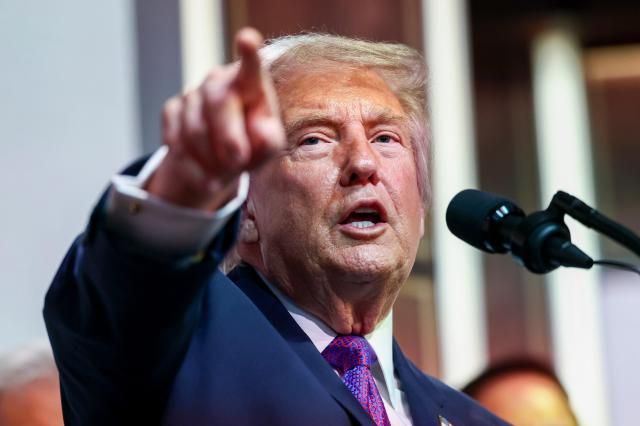
President Donald Trump has repeatedly stated that "the war will soon end." However, beneath the negotiation table, the most dangerous flashpoints are becoming increasingly evident.
At the center of this tension is one critical issue: Iran's enriched uranium.
On May 21, Trump asserted at the White House, "We will secure it." He reaffirmed the U.S. position to acquire and dispose of Iran's 440 kilograms of 60% enriched uranium. This is not merely a technical issue in nuclear negotiations; it symbolizes the entire war and represents a "visible victory" that Trump must achieve for domestic political reasons.
Trump has characterized this conflict as a war to stop Iran from reaching the brink of nuclear weapons capability.
For Trump, securing enriched uranium directly from Iran and transporting it to the U.S. or a third country could serve as a historic achievement, surpassing the Iran nuclear deal (JCPOA) established during the Obama administration.
However, this point also represents an absolute red line for Iran. The Iranian leadership has reportedly solidified its stance against the export of enriched uranium. While the U.S. views this as a matter of eliminating nuclear potential, for Iran, it is a question of national pride and regime survival.
The war has fostered a dangerous collective psychology within Iran. The prevailing sentiment is that "North Korea, which possesses nuclear weapons, has not been attacked, while Iran, which lacks them, has been targeted."
This perception could lead to a more hardline stance within the Iranian regime. Analysts suggest that the strategic thinking among Iran's military and Revolutionary Guard emphasizes the need to maintain the "potential" to develop nuclear weapons rather than the weapons themselves.
Thus, a significant gap remains between the U.S. demand for "complete removal" and Iran's desire for "domestic preservation and dilution."
Trump is eager to expedite negotiations, driven not only by diplomatic considerations but also by domestic political and economic factors. The U.S. economy continues to grapple with high inflation and interest rates.
The prolonged conflict in the Middle East is exacerbating international oil prices and logistics costs, directly impacting American consumers through rising gasoline prices. This is why Trump repeatedly states that "gas prices will drop once the war ends."
With the midterm elections approaching in November, inflation poses a critical challenge for Trump. American voters are more sensitive to immediate issues like gas prices and living costs than to democracy or geopolitics. Trump understands this dynamic well.
However, the conflict has already escalated beyond a simple U.S.-Iran confrontation.
The issue of the Strait of Hormuz is particularly illustrative. Iran has effectively begun to leverage the "Hormuz toll" card. The Strait of Hormuz, a key artery for global oil transport, sees approximately 20 million barrels of oil and LNG transit daily. Should Iran impose tolls or military pressure in this region, the global economy would feel immediate repercussions.
In response, U.S. Secretary of State Marco Rubio publicly warned that such actions would render diplomatic agreements impossible. The U.S. is already considering responses at the United Nations Security Council level. The Hormuz issue transcends mere maritime navigation rights.
It is intrinsically linked to global hegemony. The Persian Empire has historically been at the center of civilization and trade through the Hormuz and Silk Roads for thousands of years. The Iranian leadership remains acutely aware of this geopolitical legacy. Conversely, the U.S. views "freedom of navigation in international waters" as an absolute principle. Ultimately, both sides possess vastly different historical memories and strategic concepts regarding the same body of water.
A more pressing concern is the rapid escalation of U.S. military fatigue, which is occurring faster than anticipated.
According to The Washington Post, the U.S. has utilized over 200 THAAD interceptors during this conflict, nearing half of its total stockpile. Naval vessels in the Eastern Mediterranean have also deployed significant quantities of SM-3 and SM-6 interceptors.
The issue lies in the production rate not keeping pace with consumption. The U.S. missile defense system was originally designed as a core component of its Indo-Pacific strategy to counter both China and North Korea. However, the ongoing Middle Eastern conflict is rapidly depleting these reserves. Consequently, South Korea and Japan are also feeling the pressure.
In fact, discussions about the potential redeployment of THAAD forces in South Korea have begun, shaking the security structure in Northeast Asia.
Interestingly, Trump's "America First" policy appears to be caught in a paradox at this juncture.
The U.S. is expending significant strategic assets and intercept systems to defend Israel. However, there is growing discontent domestically over why American military stockpiles are being depleted in the Middle East. Even American think tanks have begun to express concerns that the Middle East is encroaching upon the Indo-Pacific strategy.
This is precisely why Trump continues to oscillate between war and negotiation. The mix of hardline rhetoric and conciliatory messages shifts daily.
Another intriguing variable is Russia. President Vladimir Putin has revived the "Russian export" card, proposing to send enriched uranium to Russia as a bargaining chip, similar to the approach taken during the 2015 Iran nuclear deal.
On the surface, this may appear as a mediation proposal. However, it conceals a different calculation. Putin aims to secure leverage in negotiations with Trump by intervening in the resolution of the Iranian conflict.
His strategy is to create negotiation space with the U.S. concerning the Ukraine war and sanctions against Russia. Trump's irritation at the suggestion to focus on the "Ukraine issue" stems from this context.
Ultimately, the current situation in the Middle East is not merely a regional conflict.
It is a microcosm of 21st-century complex geopolitics involving the U.S., Iran, Israel, Russia, Europe, and China. While negotiations appear to be underway, they remain precarious. Trump needs a victory, Iran must avoid the image of capitulation, Israel seeks to eliminate Iran's nuclear potential entirely, and Russia aims to expand its influence through mediation.
The global economy is sensitive to even the slightest shifts in the Strait of Hormuz.
While the war may pause temporarily, the geopolitical dynamics in the Middle East are far from resolved.
This situation raises profound questions for the world. This conflict is not merely about nuclear negotiations; it represents a clash of two histories and two civilizations.
On one side stands the United States, a superpower with a 250-year history. On the other is Iran, inheritor of a 5,000-year-old Persian civilization. The U.S. has shaped the modern world order.
The dollar, military power, technology, finance, the internet, and AI platforms all operate largely within a U.S.-centric framework. In just 250 years since its independence in 1776, the U.S. has become the most powerful nation in human history.
Conversely, Iran is not merely a Middle Eastern country. Its roots trace back to the Persian Empire of Cyrus and Darius. The Achaemenid dynasty managed a vast multi-ethnic empire as early as the 6th century B.C., creating a network of civilizations connecting Mesopotamia, Central Asia, India, and the Mediterranean.
While the Western world often views Iran as a "rogue state," the collective memory of Iranians insists they are not a small nation. They see themselves as "heirs of civilization."
Thus, the U.S. and Iran fundamentally differ in their interpretations of each other. The U.S. views the Iranian nuclear issue as a matter of international security and non-proliferation, while Iran perceives it as a question of national regime and civilizational pride.
This is why what is needed now is not merely a logic of power. Instead, a new imagination at the level of human civilization is essential.
This could embody the spirit of the "Noah Accord." The Middle East has already experienced a significant change with the Abraham Accords, established between Israel, the UAE, and Bahrain. This agreement, which recognizes Abraham as a common ancestor for Judaism, Christianity, and Islam, transcends a simple diplomatic document to become a symbol of civilizational reconciliation.
Now, a greater imagination is required. Noah, as a common ancestor of humanity predating Abraham, symbolizes "survival and reconciliation" in the traditions of Judaism, Christianity, and Islam. What the Middle East needs now is not just nuclear negotiations.
It is about establishing a new order where humanity can survive together, transcending the question of "who wins." Neither the U.S. nor Iran can fully subjugate the other. The U.S. can destabilize the Iranian regime through military might, but it cannot erase the pride of Persian civilization.
Conversely, Iran cannot completely dismantle the U.S.-centric world order.
Ultimately, both sides will have to compromise at some point. This compromise must not be a mere transaction but a peace that acknowledges each other's dignity, history, and civilizational pride.
In Eastern philosophy, the concept of "coexistence" has long existed. The belief is that a victory that completely defeats the opponent does not last long. Within the traditions of Confucianism, Buddhism, and Taoism, East Asia has sought harmony amid conflict.
South Korea also shares this historical experience. It has had to survive among powerful nations like China, Japan, the U.S., and Russia. Therefore, Koreans value not only the balance of power but also the balance of relationships.
This kind of thinking is now needed for both the U.S. and Iran. The U.S. must allow Iran to maintain at least a modicum of dignity, while Iran must move away from outright rejection of the U.S. international order.
For instance, instead of the direct export of enriched uranium to the U.S., a compromise could involve transferring it to an internationally managed system or a joint management approach involving Russia, neutral countries, and the International Atomic Energy Agency (IAEA).
Ultimately, what matters is not victory or defeat. It is whether humanity can take a step back from the brink of war. The global economy is already nearing a breaking point.
The Strait of Hormuz is the lifeblood of global energy. If it is disrupted, international oil prices will soar, affecting logistics, shipping, insurance, and financial markets as a whole. This is particularly fatal for countries like South Korea.
South Korea has a high dependency on energy imports. Oil and LNG from the Middle East are lifelines for its industry. The semiconductor factories of Samsung Electronics and SK Hynix, as well as Hyundai Motor's production lines, ultimately rely on stable energy supplies.
If the Hormuz crisis deepens, the won may weaken, and inflationary pressures could rise simultaneously. As an export-driven economy, South Korea would be directly impacted by global maritime logistics instability.
The larger issue is security. The U.S. has significantly depleted its THAAD interceptor stockpile during this conflict. Some reports indicate that nearly half of the stockpile has been used for Middle Eastern defense. This could have implications for security in Northeast Asia.
U.S. strategic assets are not infinite. The limitations of managing conflicts in the Middle East, Ukraine, the Taiwan Strait, and the Korean Peninsula simultaneously have become evident during this war.
Consequently, South Korea must contemplate increasingly complex strategies. The U.S.-South Korea alliance remains crucial. However, South Korea must also maintain a certain level of diplomatic space with the Middle East, China, and Russia. Energy security, supply chain stability, and the reliability of the semiconductor and AI industries are now matters of national survival strategy, not just economic issues.
The world is currently discussing the era of the AI revolution.
Yet paradoxically, humanity is once again confronted with the oldest questions. How will civilizations coexist? How far will great powers go in wielding their strength?
And can humanity transcend war? The 5,000-year-old Persian civilization and the 250-year-old United States now stand before these questions, and the world awaits their answers.
※ This article was generated using generative AI and has undergone editorial review.
* This article has been translated by AI.
Copyright ⓒ Aju Press All rights reserved.