
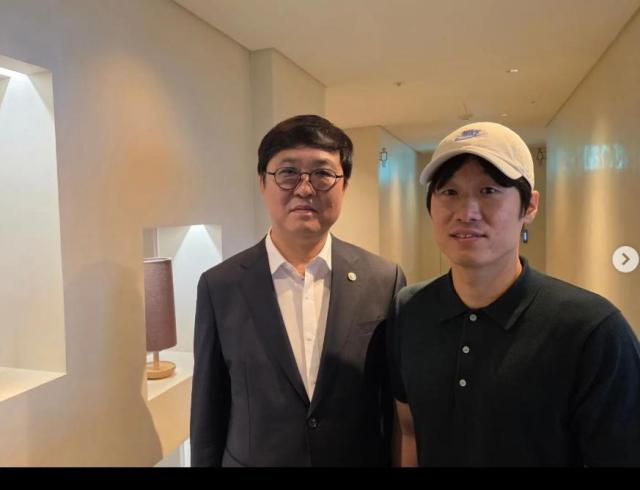
The K-Football Innovation Committee, aimed at fundamentally improving the structure and personnel of Korean football, officially launched on July 6. The committee, led by the Ministry of Culture, Sports and Tourism, is co-chaired by Minister Choi Hwi-young and Park Ji-sung, a member of FIFA's committee and a legendary captain of Korean football. Notable former players, including Lee Young-pyo and Park Joo-ho, who have experienced advanced systems abroad and are known for their candid critiques, have also joined the initiative. The government's direct involvement in reforming football governance underscores the current crisis facing the Korea Football Association (KFA), which has reached a point where self-regulation is no longer viable.
The formation of this committee is rooted in the urgent crisis of Korean football. The national team recently suffered a disastrous exit from the group stage of the 2026 North and Central America World Cup, marked by a lack of strategy and poor performance. However, the real source of public outrage stemmed from the opaque selection process for former coach Hong Myung-bo and the KFA's long-standing administrative issues characterized by nepotism and arbitrary decision-making. The integrity of football administration has been severely compromised, leading to a complete loss of public trust, prompting even the President to call for comprehensive reforms in sports administration.
The most pressing task for the Innovation Committee is to overhaul the KFA's opaque decision-making structure. Historically, the KFA has operated under a dysfunctional model dominated by specific networks and factions, leading to systemic paralysis. The committee aims to actively incorporate voices from the field, especially regarding the election of the next association president, to establish a transparent and fair governance model that operates based on a system rather than personal connections. Creating institutional mechanisms for self-regulation is crucial to ensure that personnel renewal goes beyond mere changes in individuals.
Securing future competitiveness is also a key focus. The committee plans to completely revamp the domestic youth development system, which has been overly fixated on short-term results, to align with global standards. It is essential to eliminate the chronic issues of academy and club football and implement a long-term talent identification system akin to those in advanced countries to ensure a sustainable future for Korean football. The initiative to introduce data-driven scientific analysis into team management and league operations is timely, as modern football increasingly relies on science rather than intuition, necessitating advanced management systems for national teams.
Expectations from football fans and the public for this committee are higher than ever. Trustworthy figures like Park Ji-sung, Lee Young-pyo, and Park Joo-ho, who have no debts to administrative power and solely focus on the future of Korean football, are at the helm. If their rich experiences and insights from advanced leagues are effectively integrated into the reform proposals, it could serve as a powerful catalyst for the much-needed transformation of the KFA. The public's attention is keenly focused on the committee's actions.
To avoid being mired in the long-standing controversy of government-controlled football, the Innovation Committee must carry out its reform tasks objectively and in line with international standards, keeping the public's perspective in mind. The KFA should also regard the launch of this committee as a critical warning for its organizational future.
If the committee resorts to mere stopgap measures as in the past, it will inevitably face complete alienation from football fans. There is a strong hope that the Innovation Committee will correct the distorted framework of Korean football and serve as a historical turning point, revitalizing it into a 'K-Football' that inspires and brings hope to the public.
The formation of this committee is rooted in the urgent crisis of Korean football. The national team recently suffered a disastrous exit from the group stage of the 2026 North and Central America World Cup, marked by a lack of strategy and poor performance. However, the real source of public outrage stemmed from the opaque selection process for former coach Hong Myung-bo and the KFA's long-standing administrative issues characterized by nepotism and arbitrary decision-making. The integrity of football administration has been severely compromised, leading to a complete loss of public trust, prompting even the President to call for comprehensive reforms in sports administration.
The most pressing task for the Innovation Committee is to overhaul the KFA's opaque decision-making structure. Historically, the KFA has operated under a dysfunctional model dominated by specific networks and factions, leading to systemic paralysis. The committee aims to actively incorporate voices from the field, especially regarding the election of the next association president, to establish a transparent and fair governance model that operates based on a system rather than personal connections. Creating institutional mechanisms for self-regulation is crucial to ensure that personnel renewal goes beyond mere changes in individuals.
Securing future competitiveness is also a key focus. The committee plans to completely revamp the domestic youth development system, which has been overly fixated on short-term results, to align with global standards. It is essential to eliminate the chronic issues of academy and club football and implement a long-term talent identification system akin to those in advanced countries to ensure a sustainable future for Korean football. The initiative to introduce data-driven scientific analysis into team management and league operations is timely, as modern football increasingly relies on science rather than intuition, necessitating advanced management systems for national teams.
Expectations from football fans and the public for this committee are higher than ever. Trustworthy figures like Park Ji-sung, Lee Young-pyo, and Park Joo-ho, who have no debts to administrative power and solely focus on the future of Korean football, are at the helm. If their rich experiences and insights from advanced leagues are effectively integrated into the reform proposals, it could serve as a powerful catalyst for the much-needed transformation of the KFA. The public's attention is keenly focused on the committee's actions.
To avoid being mired in the long-standing controversy of government-controlled football, the Innovation Committee must carry out its reform tasks objectively and in line with international standards, keeping the public's perspective in mind. The KFA should also regard the launch of this committee as a critical warning for its organizational future.
If the committee resorts to mere stopgap measures as in the past, it will inevitably face complete alienation from football fans. There is a strong hope that the Innovation Committee will correct the distorted framework of Korean football and serve as a historical turning point, revitalizing it into a 'K-Football' that inspires and brings hope to the public.
* This article has been translated by AI.
Copyright ⓒ Aju Press All rights reserved.