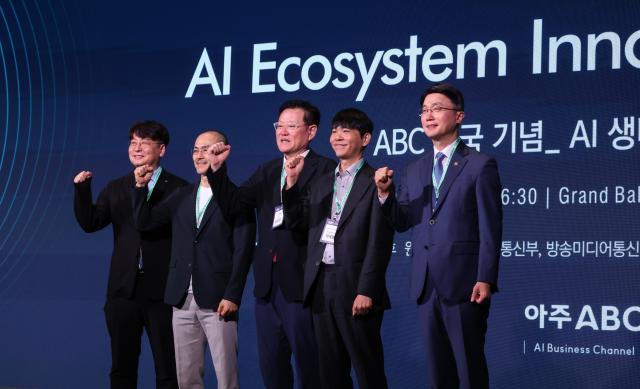
The forum, held at The Plaza Seoul, followed the official launch of ABC, or AI Business Channel, a day earlier as Aju Media Group expands into television broadcasting with a channel dedicated to artificial intelligence.
Key participants included Ryu Je-myung, second vice minister of Science and ICT; Lee Sedol, former professional Go player and special professor at UNIST; Jeong So-young, NVIDIA Korea Country Manager; and Lim Sung-shin, head of AI development at Korea Aerospace Industries.
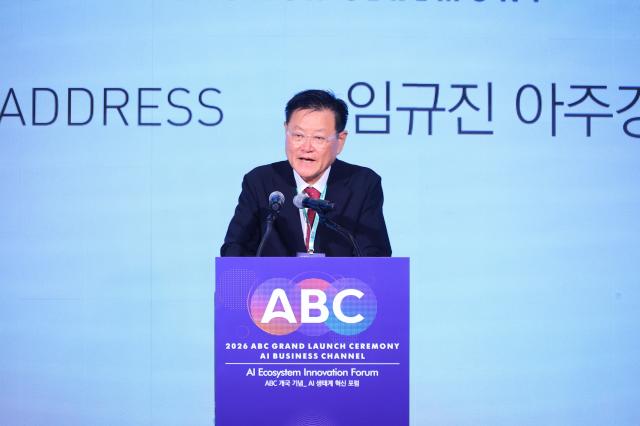
The morning session opened with remarks by Lim Kwu-jin, president of Aju Business Daily, followed by a congratulatory speech from Ryu, a keynote by Lee and a presentation by Jeong.
Lim described ABC as South Korea's first AI-focused economic broadcasting channel, launched at a time when artificial intelligence is rapidly changing industry, the economy and everyday life.
The channel, Lim said, aims to serve as a media platform linking AI technology, industry, policy and the economy while contributing to the development of South Korea's AI ecosystem.
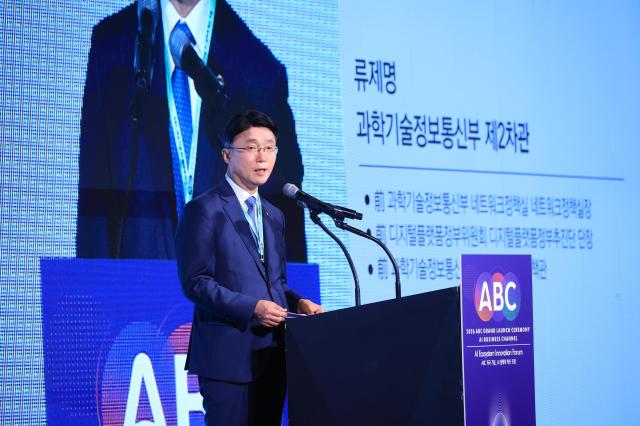
Ryu said the global AI economy is being reshaped by massive investment and intensifying competition over technologies that will determine the next generation of industrial leadership.
South Korea has been building the foundation for its AI ambitions, he said, pointing to the country's rise to third place in the number of notable AI models in Stanford University's AI Index 2026, behind the United States and China.
Ryu also cited the implementation of the AI Basic Act and legislation related to AI data centers as part of the government's efforts to support large-scale private investment.
The government plans to build a Korean-style AI ecosystem by combining semiconductors, AI data centers and next-generation technologies such as agentic AI and physical AI, he said.
AI leadership, Ryu stressed, cannot be achieved through models and infrastructure alone, adding that ordinary citizens, companies and regions must be able to use AI in daily life and work.
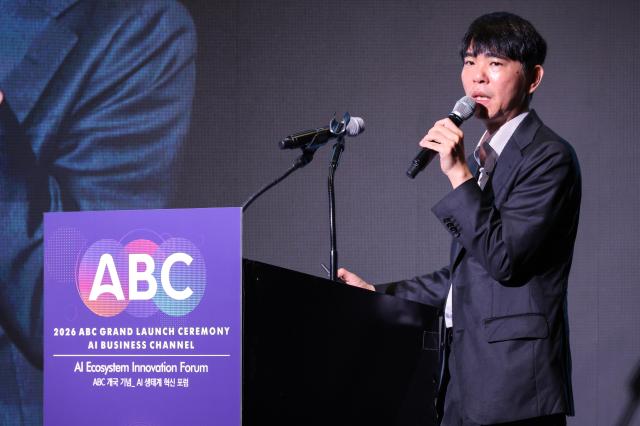
Lee used the phrase "new illiteracy" to describe a widening gap between people who understand and use AI and those who do not, comparing it to the divide between those who can read and write and those who cannot.
When he first received the proposal to play AlphaGo, Lee recalled, he did not view it as a decisive contest between humans and machines, but more as a public event.
He believed at the time that Go would eventually be conquered by computers, but did not expect that moment to arrive in 2016.
Lee also reflected on his connection with Demis Hassabis, co-founder of Google DeepMind, saying the AlphaGo match helped show how AI could move beyond games into fields such as science and medicine.
The match showed both the power and limits of AI, Lee said, arguing that even in a rule-based domain such as Go, the technology could not simply be left to operate without human judgment.
The lesson was not that humans had become unnecessary, but that they need to focus on setting direction, planning, designing and making final judgments, he said.
AI has since widened the gap within professional Go, Lee noted, because top players have been better able to understand and use AI tools.
He added that ABC could play a meaningful role if it goes beyond simply listing AI news and helps viewers understand what fast-moving developments mean for business and society.
NVIDIA views AI as a broad stack of components that includes energy, high-performance semiconductors, infrastructure, models and applications, with each layer needing to operate without bottlenecks to create new value, he said.
Energy, chips and data centers remain key constraints as demand for AI continues to exceed supply, leaving significant room for the technology to expand as those bottlenecks ease, according to Jeong.
Jeong described AI factories as revenue-generating infrastructure that can create industrial value by turning electricity and data into intelligence, rather than simply as cost centers.
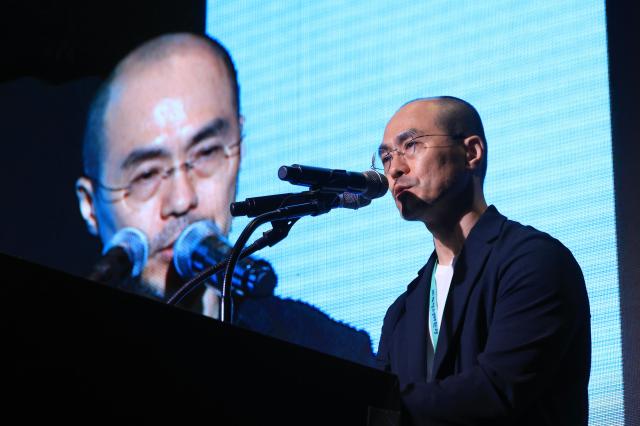
NVIDIA is working with partners on platforms for designing, building and operating large-scale AI factories more efficiently, with the economics of AI infrastructure increasingly tied to power use, cooling, networking and system-level optimization, Jeong said.
Jeong also pointed to agentic AI as the next phase of software development, where systems can understand user requests, reason through tasks and produce results beyond fixed input-output rules.
Physical AI will extend artificial intelligence into the real world through robotics, autonomous vehicles, smart factories, intelligent cameras and digital twins, he said, requiring simulation platforms that can test and validate AI systems before they are deployed in physical environments.
The afternoon program is scheduled to feature speakers from AWS Korea, MakinaRocks, Shinhan Bank, Mirae Asset Global Investments and Korea Aerospace Industries, focusing on AI applications across finance, manufacturing and aerospace.

Copyright ⓒ Aju Press All rights reserved.