

SEOUL, July 15 (AJP) - President Lee Jae Myung pressed economic policymakers Wednesday to identify the structural causes of South Korea’s high living costs and address barriers delaying the country’s inclusion in MSCI’s developed-market index.
The government reaffirmed its projection that Asia’s fourth-largest economy will grow 3.0 percent this year, supported by strong semiconductor exports and investment in artificial intelligence.
“South Korea is being described as an expensive country by global standards, and there must be reasons for that,” Lee said during a joint policy briefing by the Ministry of Economy and Finance, the Financial Services Commission and other economic agencies.
He called on officials to identify and remove the market and distribution structures behind persistently high consumer prices rather than relying mainly on short-term price controls.
Prime Minister Han Sung-sook also urged the government to focus on longer-term reform of distribution networks, particularly those involving food and everyday consumer goods.
Lee cited petroleum prices, which tend to rise quickly when international oil prices increase but fall slowly when global prices decline, as an example of abnormal practices becoming accepted as normal.

The government also aims to keep annual inflation below 3 percent while pursuing its “3-4-5” vision of raising the potential growth rate to 3 percent, becoming one of the world’s four largest exporters and lifting per capita income to $50,000.
The potential growth target is a medium- to long-term objective separate from the government’s 3.0 percent real GDP growth forecast for this year.
To sustain growth beyond the semiconductor upcycle, authorities plan to concentrate fiscal, financial and regulatory support on semiconductors, AI data centers and physical AI, while preparing measures for employment-weakened manufacturing and construction.
The government will also introduce tax credits for domestic production of strategically important goods and strengthen early-warning systems for supply-chain disruptions highlighted by the conflict in the Middle East.
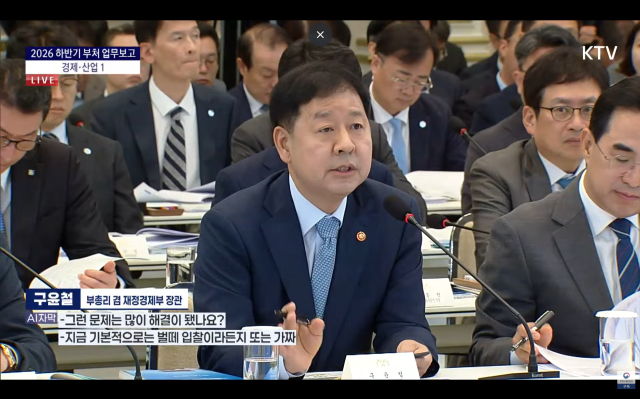
Lee separately questioned officials over South Korea’s failure to enter MSCI’s watch list for a potential upgrade to developed-market status in its latest annual review.
“We intend to move forward step by step at our own pace toward MSCI inclusion,” Koo said. “It is not that things are going badly.”
Koo cited the launch of round-the-clock onshore foreign exchange trading this month as a key measure to improve market accessibility and said additional solutions would be prepared by the first half of next year.
MSCI’s concerns, however, extend beyond trading hours to restrictions on offshore won transactions, liquidity during overseas hours and operational burdens involving foreign investor accounts, settlements and short selling.
The effectiveness of the expanded foreign exchange market and whether global investors can use it without significant operational constraints are therefore expected to influence future assessments.
Financial Services Commission Chairman Lee Eog-weon said authorities were expanding rewards for reporting stock manipulation, strengthening shareholder protection and accelerating the delisting of companies that no longer meet listing standards.
The government also plans to ease entry barriers for technology companies and redirect financial resources away from excessive property investment toward advanced industries, innovative businesses and regional development.
The discussion later turned to fraudulent claims involving government subsidies, with Lee calling for stronger rewards for whistleblowers and tougher restrictions on entities found to have deliberately abused public support programs.
Officials said more than 10,000 suspected cases were under investigation and that repeat offenders could face participation restrictions or corporate dissolution.
“With the introduction of a CBDC, a purpose can be assigned to the currency and transactions can be traced more easily, making it possible to prevent fraudulent claims at the source,” Koo said.
The proposal would involve purpose-bound digital payment instruments for distributing and settling public funds, rather than necessarily representing an immediate rollout of a retail central bank digital currency.
Opening the meeting, Lee praised officials for their work over the past year but said the administration’s remaining three years and 11 months would be critical for implementing long-term policies and institutional reforms.
Copyright ⓒ Aju Press All rights reserved.
