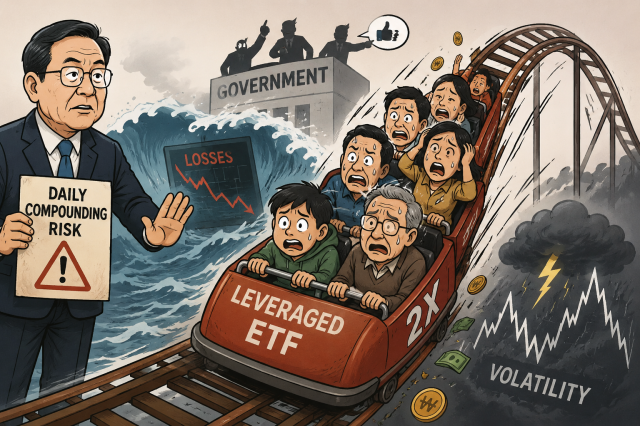
"Were we guinea pigs?" one investor wrote after watching losses mount in the newly launched single-stock leveraged ETFs.
"Will anybody help?" another asked.
The outpouring of anger quickly shifted toward the government, which approved the products near the peak of the semiconductor rally.
Surely, investors knew the risks. But many ants, as retail investors are known in South Korea, took the government's approval as an endorsement, believing products cleared by regulators could not be excessively dangerous.
Their jitters intensified after Bae Jae-kyu, chief executive of Korea Investment Management and widely regarded as the pioneer of Korea's ETF industry, publicly urged investors to stop buying single-stock leveraged and inverse ETFs.
Although his company manages the products, Bae warned that sharp daily price swings can destroy returns through daily compounding.
As a result, both leveraged and inverse ETFs can lose money even when the underlying stock ends little changed.
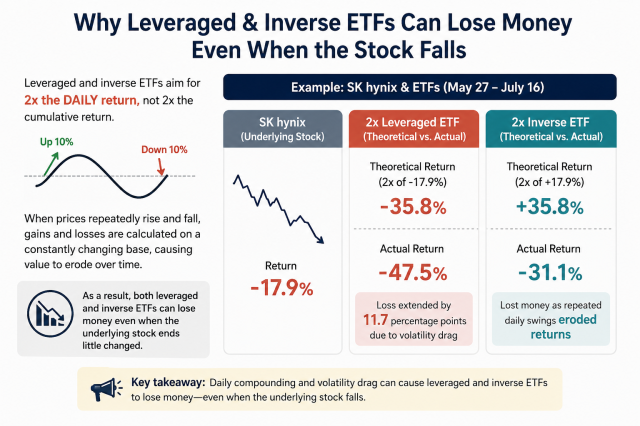
Bae illustrated the effect using SK hynix-related ETFs.
Between May 27 and July 16, SK hynix shares fell 17.9 percent. A 2x leveraged ETF theoretically should have declined about 35.8 percent, but instead plunged 47.5 percent, extending losses by another 11.7 percentage points because of volatility drag.
A 2x inverse ETF should theoretically have gained 35.8 percent over the same period. Instead, it lost 31.1 percent as repeated daily swings steadily eroded returns.
His warning came only after retail investors had already poured unprecedented sums into the products.
Demand exploded after Korea introduced its first single-stock leveraged ETFs in late May, attracting investors across virtually every age group—including retirees and minors.
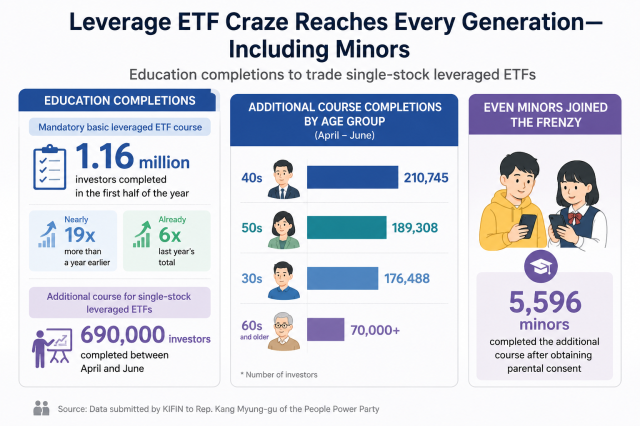
According to data submitted by the Korea Institute of Financial Investment (KIFIN) to Rep. Kang Myung-gu of the opposition People Power Party, 1.16 million investors completed the mandatory basic leveraged ETF course during the first half, nearly 19 times more than a year earlier and already six times last year's total.
Seoul has made a three-hour mock-trading session in addition to online basic course mandatory for trading high-risk products like leveraged ETFs.
Despite the hassle, nearly 690,000 investors also completed the additional education required to trade single-stock leveraged ETFs between April and June.
Investors in their 40s accounted for the largest group with 210,745 participants, followed by those in their 50s with 189,308 and those in their 30s with 176,488. More than 70,000 investors aged 60 or older also completed the training, along with 5,596 minors who obtained parental consent.
The enthusiasm translated into massive inflows. Between May 27 and July 16, investors poured a net 13.4 trillion won ($9.6 billion) into 16 leveraged and inverse ETFs linked to Samsung Electronics and SK hynix.
SK hynix leveraged products alone attracted 8.5 trillion won, while Samsung Electronics leveraged ETFs drew another 4.7 trillion won. Inverse products received only 146.6 billion won.
The reversal in chip fortunes proved devastating. The KODEX SK hynix Leveraged ETF, the most heavily purchased product, lost 47.5 percent from launch through July 16, while its Samsung Electronics counterpart dropped 41.7 percent.
Products designed to profit from falling prices fared little better. The SOL SK hynix Futures Single Stock Inverse 2X ETF lost 31.1 percent over the same period, while the PLUS Samsung Electronics Futures Single Stock Inverse 2X ETF fell 8.9 percent.
Wild swings across the broader market compounded the damage.
According to the Korea Exchange, the KOSPI's average intraday fluctuation reached 6.75 percent between July 1 and July 16, the highest since comparable records began in 1987, surpassing the peaks recorded during both the 2008 global financial crisis and the 1997 Asian financial crisis.
Three of the 10 highest monthly average intraday fluctuations over the past two decades have occurred this year. The VKOSPI volatility index, often referred to as Korea's "fear gauge," climbed to 96.94 on June 29, its highest level since the index was introduced in 2009.
Analysts said fragile investor sentiment, widespread use of leveraged products and weak institutional buying had amplified volatility, allowing even modest negative news to trigger indiscriminate selling.
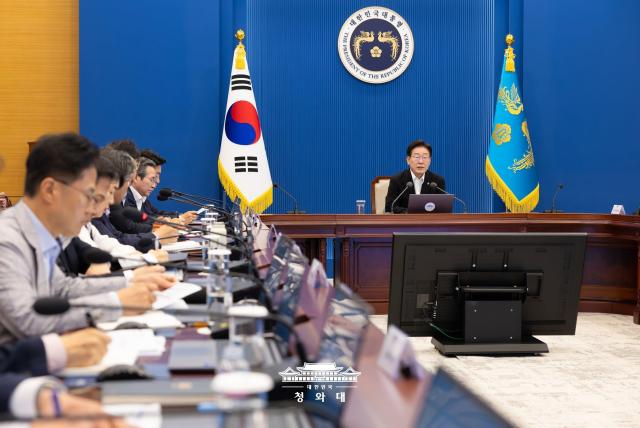
The growing investor angst has reached the highest government level.
President Lee Jae Myung on Tuesday ordered financial authorities to draw up "swift and thorough" stabilization measures for controversial single-stock leveraged ETFs, saying the government must not neglect retail losses.
Speaking at a Cabinet meeting, Lee said the products had helped keep domestic capital from flowing overseas but had also amplified market volatility.
"They nonetheless have become a source of grievance for investors, haven't they?" he said, instructing regulators to review additional investor protection measures while reassessing the role of high-risk investment products.
Opposition lawmakers have been ratcheting up attacks on the government for encouraging excessive speculation by approving the products, arguing that older and underage investors could not have fully understood the risks they were taking.

Copyright ⓒ Aju Press All rights reserved.