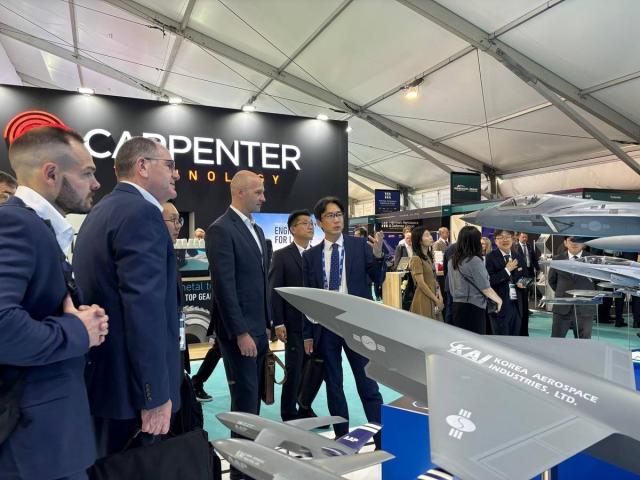
SEOUL, July 21 (AJP) - South Korea's aerospace contractor Korea Aerospace Industries is pitching its TF-50 trainer jet for a Royal Air Force competition that has not yet formally launched, using this week's Farnborough International Airshow in Britain to make its case against rivals with a significant head start.
Korea Aerospace Industries (KAI) said Tuesday it is showcasing next-generation air combat systems and aerospace solutions at the airshow, running July 20 to 24, as part of a push into the global market. The event, marking its fortieth edition this year, has drawn 1,500 companies from 41 countries.
The Royal Air Force needs to replace its aging Hawk trainer fleet, a requirement the British government's 2025 Strategic Defence Review made explicit, and the Ministry of Defence has committed £360 million ($483.5 million) toward the overhaul, funding that will also cover new aircraft for the Red Arrows aerobatic display team. But the competition to decide which jet gets that money has not formally launched, and KAI is one of several contenders rather than the clear favorite.
The leading bid appears to come from Boeing, teamed with BAE Systems and Saab, offering the T-7A Red Hawk with final assembly built in Britain, an advantage that matters because the Defence Review called for the replacement to prioritize British industrial workshare. Leonardo's M-346 and Turkish Aerospace's Hürjet are also in contention. A homegrown design from the British startup Aeralis had been floated as well, but that company has since gone into administration.
KAI is instead betting on pedigree. The T-50 family, of which TF-50 is a variant, was designed from the outset as a derivative of the world's favorite jet fighter, the F-16, sharing similar wing geometry, a single-engine layout and cockpit architecture developed with Lockheed Martin, at roughly eighty percent of the F-16's physical size. Air forces that already fly the F-16 have tended to favor it for exactly that reason, since pilots trained on the T-50 family can move into F-16 cockpits with comparatively little relearning. Britain does not fly the F-16, relying instead on the Typhoon and the F-35, so that particular argument carries less direct weight in London than it has in markets where the T-50 family has found buyers.
That footprint has grown considerably. The T-50 and FA-50 family now operates in seven countries with roughly 210 aircraft in service, and close to 290 once contracted and in-production units are counted, KAI's largest export presence in its aircraft class. Poland, Indonesia, Malaysia, Iraq, Thailand and the Philippines all fly variants of the jet, and the aircraft is battle-proven, having flown combat missions for the Philippine Air Force during the 2017 Battle of Marawi and, more recently, for Thailand's air force during its December 2025 border conflict with Cambodia. The Philippines has continued expanding its fleet, signing a $700 million deal last year for 12 additional FA-50 Block 70 jets on top of the 12 already in service, bringing its total toward 24 aircraft with deliveries underway. KAI is pairing the TF-50 pitch with FA-50, the light attack variant of the same airframe, aimed more broadly at expanding the company's footprint across Europe.
Beyond the trainer competition, KAI used the airshow to lay out a broader vision of where South Korea's combat aircraft ambitions are headed.
The company presented an artificial intelligence-based logistics and support system it described as central to future warfare, then put its KF-21 Boramae, a homemade 4.5-generation fighter jet, at the center of its display, flanked by unmanned combat aircraft, a multipurpose drone and a micro synthetic aperture radar communication satellite, framed together as a single manned-unmanned combat network rather than standalone platforms.
On the rotary wing side, KAI showed its marine attack helicopter, light armed helicopter and next-generation medium utility helicopter, outlining its concept for how each would be used in future operations.
Throughout the run of the airshow, KAI is meeting with senior military officials and executives from partner companies across Europe, the Middle East, Africa and the Americas, marketing its aircraft on NATO interoperability and delivery speed. The company also plans to deepen partnerships with GE, Safran and Martin-Baker, key suppliers of engines, avionics and ejection seats across its aircraft lines.
Copyright ⓒ Aju Press All rights reserved.