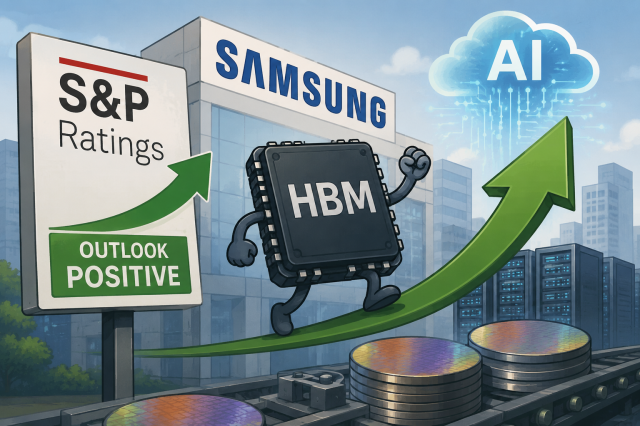
The agency revised its outlook on the chipmaker to positive from stable, saying favorable industry conditions, including strong demand for high-bandwidth memory (HBM) and a prolonged supply shortage, are likely to support memory prices through 2027.
"The positive outlook reflects our expectation that Samsung will strengthen its technological competitiveness, expand its market share in HBM and foundry businesses, and deliver solid operating performance over at least the next two years as the memory industry continues its structural growth," S&P said.
The stock rose 3.86 percent to 269,000 won in Wednesday afternoon trading following the outlook.
The optimism rests on a widening gap between AI demand and chip supply.
The ratings agency expects Samsung to be among the biggest beneficiaries of the AI-driven memory supercycle, as investment in hyperscale data centers continues to outpace new semiconductor capacity. Some DDR5 chip prices have already risen three- to fourfold from a year earlier.
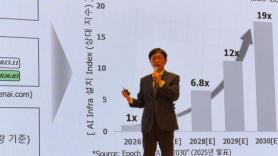
It also sees memory shortages persisting for at least two more years as AI infrastructure spending continues to accelerate. The world's four largest hyperscale cloud operators are projected to quadruple capital spending from 2024 levels to around $1 trillion by 2028, with much of the money directed toward AI infrastructure, while meaningful supply growth is not expected before then.
Reflecting that outlook, the agency forecasts Samsung's annual revenue will reach a record 683 trillion won ($495 billion) in 2026 before climbing to 821 trillion won in 2027. EBITDA, a widely used measure of operating earnings, is expected to surge from around 91 trillion won in 2025 to 393 trillion won in 2026 and 502 trillion won in 2027.
The agency also expects this cycle to be less volatile than previous memory booms.
As shortages persist, customers are increasingly seeking long-term supply agreements lasting three to five years. The growing use of customized memory products should also give chipmakers clearer order visibility and help protect earnings when the market eventually turns.
Samsung's advances in HBM technology further reinforce that outlook.
According to S&P, Samsung has advanced its HBM technology by pairing its latest 1c DRAM with a 4-nanometer base die in next-generation HBM4 chips, while largely fixing the production yield issues that affected its earlier HBM3E products.
The agency also sees improving prospects for Samsung's foundry business. It said yields on its most advanced manufacturing processes are beginning to stabilize.
At the same time, capacity constraints at Taiwan Semiconductor Manufacturing Co. could give Samsung an opportunity to win more orders as an alternative supplier.
Backing that expansion, Samsung's annual capital expenditure is projected to rise from 52 trillion won in 2025 to between 81 trillion won and 84 trillion won over the next two years.
Even so, S&P expects the balance sheet to remain resilient. Strong cash generation is forecast to lift free cash flow from 33 trillion won last year to 201 trillion won this year and 288 trillion won in 2027.

Copyright ⓒ Aju Press All rights reserved.