
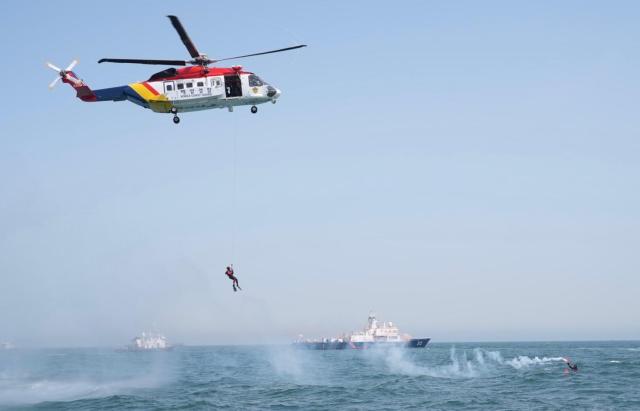
The KCG held a graduation ceremony for the first class of its helicopter pilot training program at Hanseo University’s Taean campus on Thursday.
The four graduates — Inspectors Kim Gyu-beom and Cho Hee-young, and Assistant Inspectors Park Jong-seon and Woo Hyo-jin — entered the program in February last year and completed 17 months of training.
The course included 580 hours of ground instruction, 170 hours of flight training and 20 hours of simulator training. The graduates completed private, commercial and instrument helicopter pilot courses.
They will be assigned to Coast Guard aviation units, where they will carry out missions such as maritime search and rescue, coastal patrols and other public safety operations.
The KCG has been building its own pilot training system to reduce its shortage of helicopter pilots. Except for the military, it is the only helicopter-operating government agency in South Korea — among organizations such as the fire agency, forest service and police — to run an internal pilot training program.
According to publicly available figures, the Coast Guard had 88 helicopter pilots as of March, leaving about 28 percent of positions unfilled. A parliamentary audit figure from September 2024 showed an even wider gap, with 78 rotary-wing pilots against an authorized strength of 122, or a shortage of 36 percent.
The personnel gap has continued despite repeated hiring efforts. From 2019 to September 2024, the KCG hired 47 rotary-wing pilots, but 33 left during the same period. Another recent report said 27 Coast Guard helicopter pilots had left over the past five years, including departures to fire, emergency medical and other helicopter units offering better conditions.
The KCG’s difficulty in retaining pilots is partly linked to the nature of its missions as they often fly at night, operate over open water and conduct shipboard takeoffs and landings, all of which are considered more demanding than many land-based helicopter missions. Flying over the sea can also increase the risk of spatial disorientation because pilots have fewer visual references, particularly in darkness or poor weather.
The agency also has said Coast Guard helicopter pilots have generally been hired at lower ranks than pilots at other government agencies, making it harder to compete for experienced personnel. The shortage can increase the workload on remaining pilots, creating a cycle in which heavier operational burdens further weaken retention.
The agency plans to train 20 helicopter pilots through the program by 2030, including the four graduates from the first class. It also plans to expand recruitment of experienced pilots.
To improve retention, the KCG is considering upgrading aviation unit chief positions from senior inspector to superintendent, along with broader measures to improve working conditions for aviation personnel.
“We will continue to train pilots who combine the Coast Guard’s field experience with aviation skills, and do our utmost to ensure maritime safety and protect maritime sovereignty,” said Yeo Sung-soo, director general of the KCG’s Guard Bureau.

Copyright ⓒ Aju Press All rights reserved.
