Remarks by U.S. Secretary of State Marco Rubio this week have revived that debate, raising fresh questions over what Seoul can realistically offer should Washington turn its expectations into a concrete request.
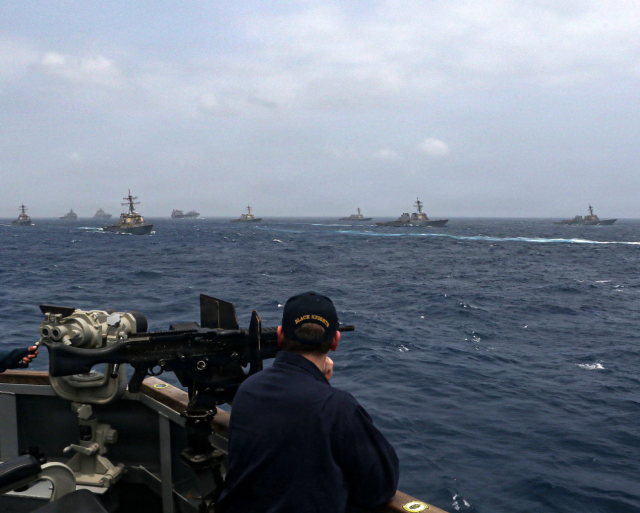
Speaking to reporters in Manila on Wednesday after meetings on the sidelines of ASEAN-related forums, Rubio said the United States had not asked South Korea or other allies that day to provide naval assets. But Washington had raised the issue with several countries previously, he said, arguing that participation would be in their own interest because many Asian economies depend heavily on Middle Eastern oil and natural gas.
Rubio also singled out mine-clearing as one area where allies with "unique capabilities" could make meaningful contributions to securing the waterway.
His remarks followed reports in Seoul that the Trump administration had asked South Korea to consider deploying a warship to help protect commercial shipping through Hormuz. South Korea's presidential office has said there has been no additional U.S. request for a specific contribution while reiterating that Seoul is considering practical ways to help restore freedom of navigation.
The issue is difficult for Seoul to ignore. South Korea imports roughly 70 percent of its crude oil and about one-fifth of its liquefied natural gas from the Middle East, making safe passage through Hormuz a core energy security concern.
The military options, however, are far less straightforward.
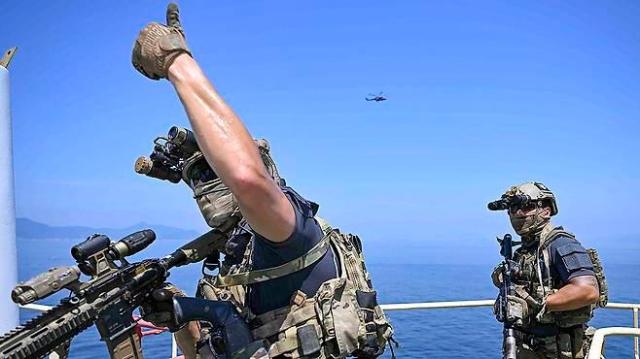
Yet analysts say a single destroyer would fall far short if South Korea intends to operate independently rather than under U.S. command.
"If South Korea conducts an independent operation, it would need at least 10 ships," Paik Seung-hoon, a senior researcher at the HUFS Middle East Institute, said.
"It cannot be done by sending just one Aegis destroyer."
Paik said South Korea could participate with a smaller naval presence if it operated within a U.S.-led command structure, relying on American intelligence and missile defense support. But that would fundamentally alter the political meaning of the deployment.
"If we say we are joining the operation under U.S. command, that means we are participating in a U.S.-led war," he said.
If Seoul wants to avoid that perception, Paik said, it would need to define the mission narrowly as protecting South Korean nationals and commercial shipping, similar to its 2020 expansion of the Cheonghae Unit's operational area during heightened U.S.-Iran tensions.
Unlike six years ago, however, the current crisis involves an active war, making parliamentary approval likely before any major deployment.
Nor would the mission amount to a symbolic naval dispatch.
Mine threats, anti-ship missiles, drones and fast attack craft would require not only a destroyer but also command-and-control assets, escorts, mine countermeasure vessels and potentially submarine or maritime patrol support, Paik said.
Japan could further complicate Seoul's calculations.
Rubio's reference to mine-clearing capabilities was widely interpreted as applying, at least in part, to Japan, whose Maritime Self-Defense Force has long maintained one of the world's strongest mine countermeasure fleets.
If Tokyo decides to participate, pressure on Seoul could quickly intensify.
"If Japan sends forces, can South Korea simply refuse to send anything?" Paik said, noting that alliance politics often narrow Seoul's room for maneuver.
Kim Houng-yu, a committee member of the Korea Defense Industry Association, said Japan's mine-clearing expertise reflects decades of preparing for the security challenges of an island nation.
"Japan is strong in naval operations because it is an island country," Kim said, adding that its mine-clearing capabilities are regarded as among the world's most advanced.
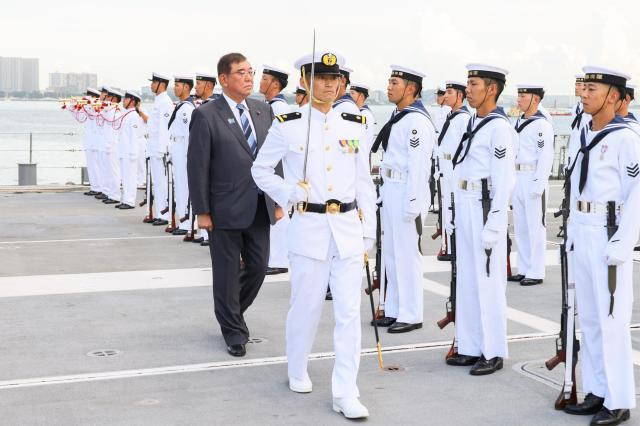
In April, Japan lifted its long-standing ban on lethal weapons exports, marking a major shift in its postwar security policy and opening the door to broader overseas transfers of defense equipment. Around the same time, Tokyo and Washington accelerated defense industrial cooperation aimed at strengthening supply chains, production capacity and long-term sustainment.
The momentum continued at a Japan-U.S. defense ministers' meeting in Singapore on May 30, where both sides agreed to accelerate a broad range of initiatives to strengthen deterrence and military readiness.
Against that backdrop, Kim said a mine-clearing mission in Hormuz would also allow Tokyo to present its expanding military role as a response to international demand rather than purely domestic policy changes.
South Korea's calculus is considerably more complicated.
Keeping Hormuz open is clearly in Seoul's economic interest. Yet any naval deployment would immediately raise difficult questions over command authority, combat risk, parliamentary approval and the diversion of naval assets from waters closer to the Korean Peninsula.
South Korea's stake in Hormuz is beyond dispute.
The harder question is whether Seoul can translate that stake into a military contribution substantial enough to satisfy Washington, yet limited enough to avoid being drawn into a U.S.-led conflict with Iran.

Copyright ⓒ Aju Press All rights reserved.