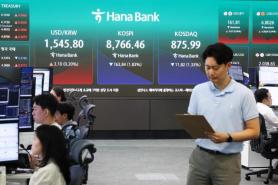
The benchmark KOSPI dropped 2.2 percent in early trade to 6,939.11, giving up the 7,000 line it had reclaimed only days earlier, while the Nikkei 225 fell 2.5 percent in Tokyo, the two markets named together in the U.S. action.
Chipmakers and automakers, the shares carrying the export exposure, led the decline, with Hyundai Motor down 6.1 percent and Samsung Electronics down 3.5 percent, while defense and pharmaceutical names ran the other way.
The index shed 157.78 points.
Samsung Electronics fell to 260,500 won, or $177.56. SK hynix lost 3.4 percent to 1,854,000 won, or $1,263.72.
SK square dropped 6.3 percent to 1,144,000 won, or $779.77.
Hyundai Motor traded at 405,500 won, or $276.40, and Kia lost 5.1 percent.
The U.S. Trade Representative announced the findings of its investigation under the Section 301 of the Trade Act the previous day, imposing 12.5 percent tariffs on South Korea, Japan and dozens of other economies, while applying a lower 10 percent rate to a smaller group including Britain, Canada, and Mexico.
The main index in Seoul was also carrying the previous session's Wall Street losses, where the Nasdaq fell 2.2 percent to 25,137.69.
Oil supplied the second blow. Brent settled above $100 for the first time since May after Houthi forces said they struck two Saudi tankers in the Red Sea, opening a route risk beyond the Strait of Hormuz.
Defense and shipbuilding names ran against the tape. Hanwha Aerospace gained 5.2 percent to 1,008,000 won, or $687.07, and HD Hyundai Heavy Industries added 1.2 percent.
Samsung Biologics jumped 7.7 percent to 1,485,000 won, or $1,012.20, in the day's strongest sector.
The Nikkei traded at 64,755.96, down 1,666.64 points.
The junior KOSDAQ fell 2.3 percent to 772.19.
Foreigners sold a net 117.9 billion won on the main board in early trade and institutions sold 122.2 billion won, while individuals bought 247.5 billion won.
The won traded at 1,467.10 per dollar, stronger than the previous session.
Copyright ⓒ Aju Press All rights reserved.