
![삼성전자 평택캠퍼스 생산 라인 [사진=삼성전자]](https://image.ajunews.com/content/image/2026/07/27/20260727133459509104.jpg)
SEOUL, July 27 (AJP) -The generative artificial intelligence boom has not simply created another semiconductor supercycle. It has redrawn the geography of the global chip industry.
Three years after ChatGPT triggered an unprecedented race to build AI infrastructure, South Korea's semiconductor trade map looks markedly different. Taiwan has become Korea's second-largest chip export destination. The Netherlands has overtaken Japan as largest supplier of semiconductor manufacturing equipment. And what was once a diversified electronics supply chain has evolved into an increasingly concentrated AI ecosystem anchored by four companies: Nvidia, TSMC, Samsung Electronics and SK hynix.
The transformation is captured in the Bank of Korea's Manufacturing Production and Supply Chain Map released on Monday, which explains that AI, alongside geopolitical fragmentation and China's industrial rise, has become one of the principal forces reshaping Korean manufacturing.
Rather than merely recording trade flows, the report illustrates how the country's production, exports and imports have been reorganized around new technological bottlenecks.
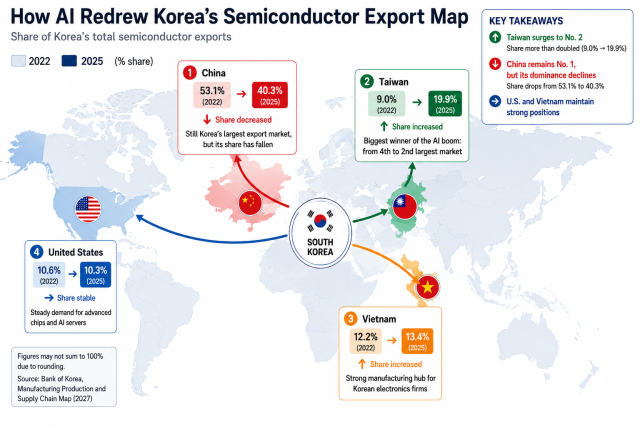
The most striking change appears on the export map.
For years, China overwhelmingly dominated Korea's semiconductor exports because it assembled much of the world's smartphones, PCs and consumer electronics.
The AI era has created a different destination.
According to the Bank of Korea's map, Taiwan's share of Korea's semiconductor exports more than doubled between 2022 and 2025, making it the country's second-largest export market after China. The shift reflects the emergence of Taiwan not as a consumer of chips but as the world's AI manufacturing hub.
The reason lies in the new AI production chain.
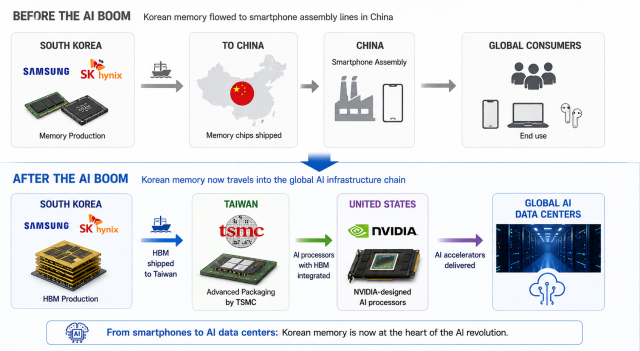
High-bandwidth memory produced by Samsung Electronics and SK hynix is shipped to Taiwan, where TSMC combines it with Nvidia-designed AI processors using advanced packaging before the finished accelerators are delivered to hyperscale cloud operators.
Instead of flowing primarily toward smartphone assembly lines in China, an increasing share of Korean memory now travels directly into the world's AI data centers.
The export map therefore illustrates something larger than changing trade statistics. It shows that the industry's center of gravity has shifted from consumer electronics to AI infrastructure.
The BOK describes a supply chain increasingly organized around specialized technological leaders.
Nvidia dominates AI processors. TSMC leads advanced foundry manufacturing and advanced packaging.
Samsung Electronics and SK hynix have become the principal suppliers of high-bandwidth memory required by AI accelerators.
Rather than competing directly with one another, the companies occupy complementary positions within the same production system.
The report argues that expanding AI infrastructure has strengthened this ecosystem by replacing the traditional combination of CPUs and commodity DRAM with GPUs and HBM optimized for AI computing.
The consequence is a much more concentrated supply chain.
Instead of broad semiconductor demand spread across PCs, smartphones and conventional servers, investment is increasingly focused on a relatively small number of products whose production depends on only a handful of companies.
Korea's equipment map changed as well
The AI boom has also pulled Korea more deeply into another concentrated segment of the supply chain: semiconductor manufacturing equipment.
Imports of chip materials, parts and equipment rose to $49.9 billion in 2025 from $27.9 billion in 2019 and $23.4 billion in 2014, according to the BOK. Manufacturing equipment made up $23.7 billion of the 2025 total.
The Netherlands accounted for 26.0 percent of Korea’s chipmaking equipment imports, up from 22.8 percent in 2022. It overtook Japan, whose share stood at 23.7 percent, to become Korea’s largest equipment supplier.
That dependence is largely explained by ASML. The Dutch company is the sole commercial supplier of extreme ultraviolet lithography equipment, which is required to produce the world’s most advanced logic and memory chips.
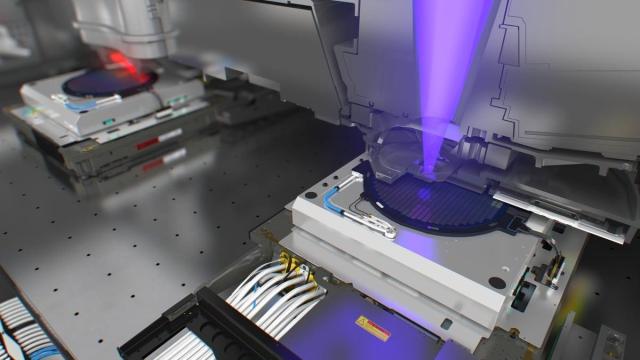
As Samsung and SK hynix expanded advanced memory and foundry investment, Korea became one of ASML’s most important markets.
Korean customers generated 25.0 percent of ASML’s total net sales in 2025, up from 22.7 percent a year earlier. That placed Korea fractionally behind Taiwan, at 25.5 percent, and China, at 29.1 percent — making it one of ASML’s three largest national markets rather than the single largest.
The distinction is important. Korea’s rise as a major ASML customer demonstrates the scale of its investment, but it also reveals a vulnerability.
Domestic chipmakers depend entirely on imported EUV systems. Korea also imports large quantities of semiconductor equipment from Japan and the United States, while its material and component supply chain remains closely tied to China, Japan and the U.S.
The more Korea expands advanced chip production, the more it depends on a small number of foreign equipment and materials suppliers.
Its role now lies in being an essential link in a tightly connected AI system.
Korean HBM travels to Taiwan rather than directly to the ultimate customer. Dutch lithography equipment travels to Korean fabs. American-designed processors return from Taiwanese factories packaged alongside Korean memory. The finished systems then power data centers around the world.
This circular flow explains why Taiwan’s share of Korea’s chip exports has soared and why the Netherlands has become Korea’s largest semiconductor-equipment supplier.
It also explains the strategic stakes. Korea has secured a powerful position because advanced AI processors cannot perform effectively without high-bandwidth memory. But its position remains dependent on Nvidia’s platform, TSMC’s manufacturing capacity and ASML’s machines.
The AI era has placed Korea closer to the center of the semiconductor world than ever before. It has also made that world more concentrated, more interdependent and more exposed to disruption.
Copyright ⓒ Aju Press All rights reserved.
