
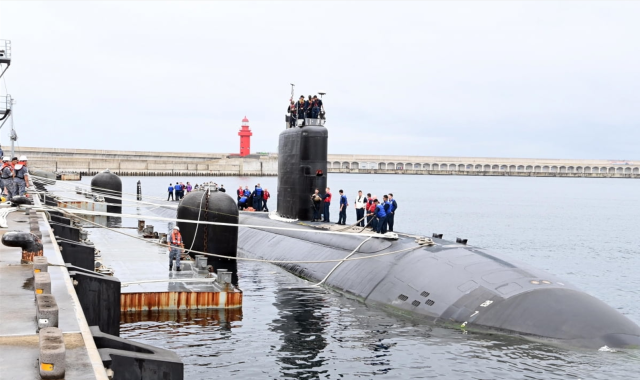
The Ministry of National Defense is expected to soon issue a legislative notice for a bill tentatively titled the Special Act on the Acquisition, Operation and Safety Management of Nuclear-Powered Submarines.
The move would mark the first time South Korea has written into domestic law a principle rejecting nuclear weapons development in connection with a defense acquisition project. It appears aimed at easing international concerns that Seoul could use its nuclear-powered submarine program as a step toward developing nuclear arms.
According to sources, the bill lays out five basic principles for the submarine project. The first states that the project “shall not be aimed at the development, production, possession or use of nuclear weapons” and that it shall not involve the diversion of nuclear material or actions that undermine confidence in the nuclear nonproliferation regime.
The bill also includes principles on compliance with the Nuclear Non-Proliferation Treaty, cooperation with verification procedures by international organizations such as the International Atomic Energy Agency, protection of public safety and the environment from radioactive materials, and the establishment of nuclear safety standards for the submarines.
The bill would allow the project to bypass some feasibility review requirements, shorten development and testing procedures, and apply more flexible cost rules in defense contracts.
The bill also requires the government to establish and implement a basic plan for nuclear-powered submarines every 10 years. A separate 10-year safety management plan would cover radioactive waste management and prevention and response measures for radiological disasters.
South Korea is pursuing the program under the name Jangbogo N Project. The submarines are expected to use low-enriched uranium with an enrichment level below 20 percent.
The government aims to launch the lead vessel in the mid-2030s and deploy it in the late 2030s. Detailed specifications have not been disclosed, but military authorities are known to be planning to develop three 8,000-ton-class nuclear-powered submarines.

Copyright ⓒ Aju Press All rights reserved.
