
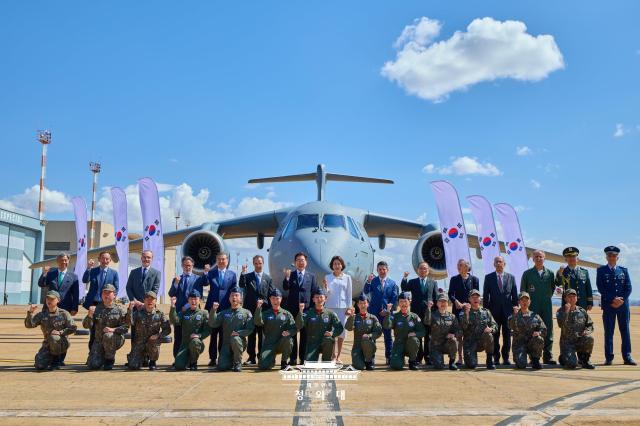
Upon arriving in Brasilia for a state visit, Lee headed straight to inspect a Brazilian-built C-390 Millennium military transport aircraft before holding summit talks with President Luiz Inácio Lula da Silva.
The acquisition addresses two strategic objectives: replacing South Korea's aging tactical transport fleet while diversifying defense procurement and industrial partnerships beyond traditional U.S. suppliers.
South Korea has ordered three C-390 transport aircraft from Brazilian aerospace manufacturer Embraer under a contract worth about $603 million. The first aircraft is scheduled for delivery in December, with the remaining two arriving by the end of next year.
During the visit, Lee described the acquisition as "the first step" in bilateral defense cooperation and called for broader collaboration between the two countries.
The timing is significant.
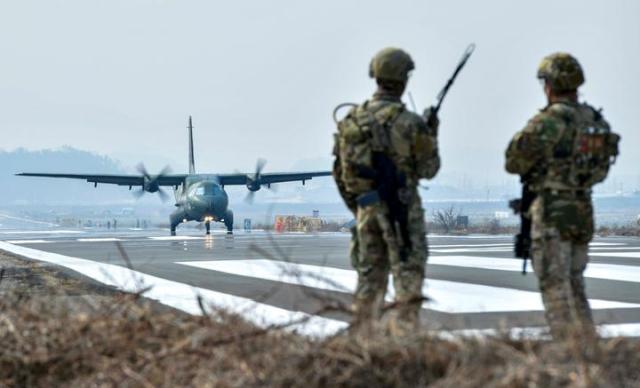
South Korea's tactical transport fleet is increasingly showing its age as the military expands its role beyond the Korean Peninsula to overseas deployments, humanitarian assistance, disaster relief and civilian evacuation missions.
Publicly available data indicate the Republic of Korea Air Force operates about 34 tactical transport aircraft, including 16 C-130 Hercules variants and 18 CN-235 transports.
Among the Hercules fleet, 12 are older C-130H and C-130H-30 aircraft introduced from 1988, while only four are the newer C-130J-30 models delivered in 2014. Those older aircraft represent the Air Force's most pressing modernization challenge.
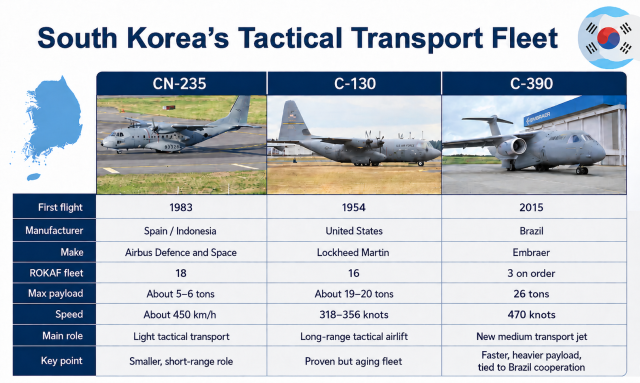
The C-390 offers a different operating profile from the C-130 that has long formed the backbone of South Korea's tactical airlift capability.
According to Embraer, the aircraft can carry up to 26 metric tons of concentrated cargo, or 23 metric tons of distributed payload, and cruise at 470 knots, or about 870 kilometers per hour.
By comparison, the U.S. Air Force lists the C-130J-30's maximum payload at about 20 metric tons and the older C-130H's at roughly 19 metric tons. Their cruising speeds are 356 knots and 318 knots, respectively.
The comparison, however, is not one-sided.
The stretched C-130J-30 can transport up to 128 combat troops, 92 paratroopers, 97 medical litters or eight cargo pallets. The older C-130H carries 90 troops, 64 paratroopers, 72 litters or six pallets. Embraer's C-390 accommodates up to 80 troops, 64 paratroopers, seven 463L pallets or as many as 80 litters depending on its medical evacuation configuration.
Its main advantage lies elsewhere.
The C-390 combines greater payload with substantially higher speed and a wider, taller cargo compartment, allowing it to transport bulkier military vehicles and equipment. Although its cargo bay is shorter than that of the stretched C-130J-30, its larger cross-section provides greater flexibility for oversized loads.
Rather than replacing the Hercules outright, the C-390 complements the existing fleet with a newer platform optimized for heavier cargo and faster deployment.
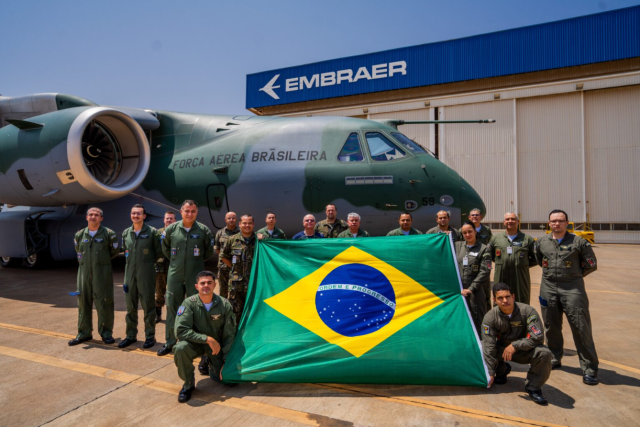
The procurement attracted attention because the Brazilian aircraft defeated Lockheed Martin's C-130J and Airbus' A400M in South Korea's Large Transport Aircraft II competition in 2023.
The outcome surprised many defense analysts given the Air Force's decades of experience operating the U.S.-built Hercules.
The Defense Acquisition Program Administration (DAPA) said at the time that the competing aircraft offered broadly comparable performance and cost. The decisive difference came from industrial cooperation, contract conditions and technology partnerships.
Embraer assembled a consortium with three South Korean companies, offering domestic industrial participation valued at about $135 million. Lockheed Martin partnered with a single Korean company with local participation worth about $129 million, while Airbus did not establish a comparable consortium.
DAPA said the consortium model—used for the first time in the program—would enable Korean manufacturers to enter Embraer's global supply chain through parts production, extending the project's value beyond aircraft procurement.
Maintenance also factored into the decision.
"The C-390 is expected to offer significant savings in maintenance costs," a defense expert said.
"Its parts supply is relatively fast, and its supply chain management appears more active than that of the C-130. Since the Hercules is an aging platform, parts procurement has become more difficult, with operators increasingly relying on substitute components."
Lee's visit also highlighted Brazil's growing importance as a strategic defense partner.
Brazil fields the Western Hemisphere's second-largest military after the United States and possesses Latin America's largest defense industry, anchored by Embraer—one of the world's few globally competitive aircraft manufacturers.
The relationship has already begun expanding beyond the transport aircraft deal.
DAPA signed a memorandum of understanding with Embraer during ADEX 2025 to broaden Korean suppliers' participation in Embraer's global production network while exploring additional defense cooperation. Korea Aerospace Industries' FA-50 light combat aircraft has also emerged as a potential contender in Brazil's future light attack aircraft program, opening opportunities for two-way industrial collaboration rather than a conventional buyer-seller relationship.
For Seoul, the C-390 therefore represents more than a fleet replacement.
It reflects a broader shift toward building defense partnerships with technologically capable middle powers that can complement—rather than replace—its longstanding alliance with the United States. As geopolitical competition reshapes global supply chains, diversification has become as important in defense procurement as it has in semiconductors and critical minerals.
Three aircraft alone will not solve South Korea's long-term airlift requirements. But if the C-390 integrates smoothly into Air Force operations and the industrial partnership delivers as promised, the purchase could mark the beginning of a much deeper aerospace relationship between Seoul and Brasilia—one extending well beyond military transport aircraft.

Copyright ⓒ Aju Press All rights reserved.
