For South Korea, the decision also sharpened a larger question: how does a middle power preserve its strategic autonomy when the world's two largest economies are steadily forcing countries to choose sides?
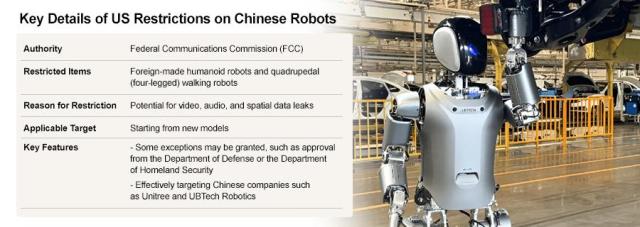
The FCC on Tuesday (local time) placed foreign-made humanoid and quadruped robots, along with connected power inverters, on its national-security "Covered List," effectively blocking new models from receiving the authorization required to enter the U.S. market. Machines already operating in the field remain unaffected, but the door has largely closed for future Chinese entrants.
"Following President Trump's leadership, the FCC will continue to do our part to secure America's critical supply chains, and, with today's action, the FCC is acting in lock step with our national security agencies to do just that," FCC Chairman Brendan Carr said.
The unnamed target was unmistakable: China. The country accounts for an estimated 85 percent of the global humanoid robot market, and the restrictions fall most heavily on Unitree Robotics, whose backflipping G1 humanoid has become the symbol of China's rapidly advancing robotics industry.
For Seoul, the story began with dirt.
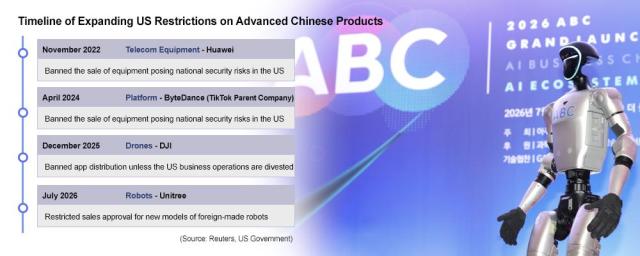
The latest robot restrictions are part of that broader strategy.
This month, the Trump administration also convened a coalition of more than 20 countries, including Britain, Germany and Japan, to establish the security architecture and technical standards for sixth-generation wireless networks. The initiative, known as the Call to Action for 6G Leadership and Security, aims to ensure that the next communications infrastructure is designed largely outside China's technological sphere.
"Today's action recognizes that 6G will be dramatically different from 5G, and that advancing U.S. and allied leadership requires a dramatically different playbook," said Arielle Roth, administrator of the National Telecommunications and Information Administration (NTIA).
Taken together, the measures illustrate how Washington's strategy has expanded from controlling critical minerals to securing the entire AI technology stack — including semiconductors, communications networks, robotics and frontier AI models. Rare earths, batteries, advanced chips and artificial intelligence are increasingly treated not as separate industries but as components of a single strategic ecosystem.
This is where South Korea occupies a different position from most middle powers.
Rather than standing on the sidelines, Korea sits at the center of several supply chains Washington is trying to secure. Samsung Electronics and SK hynix dominate the world's advanced memory market, supplying the high-bandwidth memory (HBM) chips that underpin Nvidia's AI accelerators and much of today's generative AI infrastructure.
That makes Seoul a partner Washington cannot easily sideline, even as strategic competition with Beijing intensifies.
The importance of that relationship was evident last week in San Francisco, where President Lee Jae Myung unveiled what his office described as an "AI declaration" before meeting the leaders of America's most influential AI companies. Lee dined with Nvidia Chief Executive Jensen Huang, OpenAI CEO Sam Altman and Anthropic CEO Dario Amodei, alongside the heads of Samsung Electronics, SK Group and Hyundai Motor Group.
"The Republic of Korea intends to dramatically expand its investment in artificial intelligence going forward, so we look forward to Anthropic's particular interest, investment and contribution," Lee said.
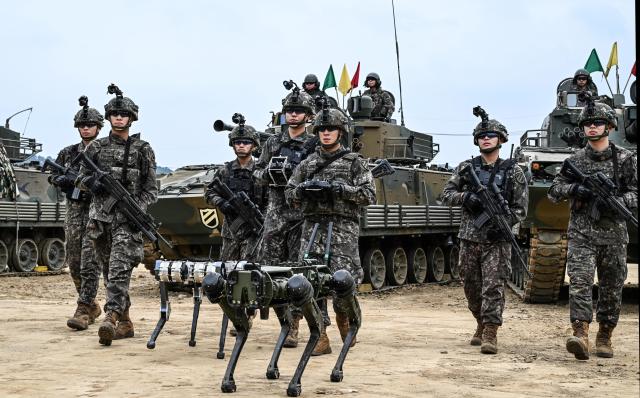
The same pattern is emerging in physical AI.
A similar dynamic is unfolding in frontier AI.
In May, OpenAI expanded the government-focused tier of its Daybreak cybersecurity initiative to South Korea, making it the third participating country after the United States and Canada, and one of the first in Asia.
"The latest cyber AI capabilities must not remain confined to a select few," Jason Kwon, OpenAI's chief strategy officer, said in Seoul, describing advanced AI security as a shared responsibility among trusted partners.
Anthropic has adopted an even more selective approach. Its most capable model, Mythos, remains unavailable to the public and is shared only through Project Glasswing, an invitation-only program focused on autonomous vulnerability detection. In June, Anthropic expanded the initiative to roughly 150 organizations across about 15 countries. South Korea was among the beneficiaries, with the Korea Internet & Security Agency (KISA), Samsung Electronics, SK hynix and SK Telecom gaining early access.
Yet the episode also underscored the limits of partnership.
Barely a week after Korea joined the program, Anthropic temporarily suspended access to its most advanced models to comply with new U.S. export-control rules — a reminder that even close allies remain subject to policies ultimately written in Washington.
Strategic value, however, does not eliminate vulnerability.
For decades, South Korea prospered by navigating between competing powers.
The AI era presents a different proposition.
Rather than relying on neutrality alone, Seoul is increasingly betting on indispensability — supplying the memory chips, advanced manufacturing, cybersecurity expertise and industrial capabilities that neither Washington nor Beijing can easily replace.
Whether that strategy proves durable will depend on forces largely beyond Seoul's control. Yet as the technology rivalry moves from critical minerals to robots, frontier AI models and the infrastructure that connects them, becoming indispensable may offer South Korea a stronger form of strategic insurance than attempting to remain equidistant between two increasingly irreconcilable superpowers.
Copyright ⓒ Aju Press All rights reserved.