
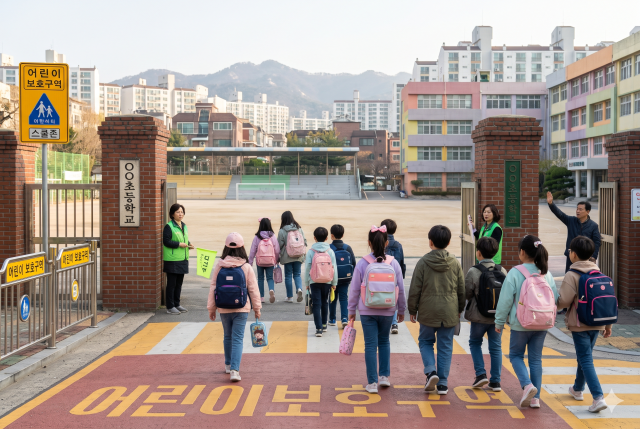
SEOUL, November 08 (AJP) - South Korea will enroll fewer than 300,000 children in elementary school next year for the first time on record, even as births grow at a record pace.
The children starting school next March were born in 2020. That year, births fell 10 percent from a year earlier to 272,337, according to the Ministry of Data and Statistics. It was the first time annual births had dropped below 300,000 since the agency began keeping records in 1970.
This year's entering class of 301,442 was already the smallest since records on first-graders began in 1964.
An entering class never exactly matches the number of children born in its birth year, because deaths, emigration and early school entry all play a part. Over the past 20 years, every entering class has been smaller than its birth year's count, by 2.6 percent on average. This year's class came in 1,234 below the number of children born in 2019.
Applying those gaps to the 2020 birth year puts next year's class at between about 265,000 and 271,000, by AJP's calculation. Official figures will be compiled after the school year begins in March.
The number of first-graders peaked at 1,055,632 in 1968. Next year's class will be roughly a quarter of that size.
Enrollment was still 610,769 in 2007. It fell to 540,799 in 2008 and into the 400,000s in 2009, where it largely held for more than a decade. Since 2023, it has dropped every year, by roughly 7 to 12 percent annually, and in 2024 it fell below 400,000 for the first time, to 353,828.
Births have turned around in the meantime. In 2024, they rose for the first time in nine years, to 238,317. In 2025, they climbed another 6.7 percent to 254,341.
In the first eight months of this year, 193,783 babies were born, up 14.5 percent from the same period last year. It was the fastest growth for that period on record. The ministry has attributed the recovery to a rise in marriages after the pandemic and to growth in the population in their early 30s, the peak age for childbirth.
None of those children will reach school before 2031. Births fell every year from 2016 through 2023, when they bottomed out at 230,028. Entering classes will therefore keep shrinking until the children born in 2023 start school in 2030.
The damage reaches well beyond classrooms, Hwang Seung-yeon, an emeritus professor of sociology at Kyung Hee University, told Aju Business Daily, AJP's Korean-language sister publication, that South Korea treats low fertility, regional decline, the crisis facing universities, a slump among the self-employed and weakening corporate competitiveness as separate problems, when all of them branch from the same tree.
"Student numbers fall. Universities falter. The commercial strips around campuses collapse. The self-employed struggle. Companies cannot find workers. Jobs disappear. Young people leave. Marriages decline. Children are not born. And student numbers fall again," Hwang said.
He also cautioned against judging the country's health by the recent rise in exports and stock prices driven by the semiconductor boom. "A forest is not healthy just because its single biggest tree is green while the whole forest grows sick," he said.
The government has started to reshape education funding around the shrinking student population. On Aug. 21, the Ministry of Planning and Budget and the Ministry of Education announced a plan to end a system, in place since 1972, that ties grants to local education offices to a fixed share of domestic tax revenue, currently 20.79 percent.
Under the new formula, the previous year's grant would be adjusted by the three-year average of nominal economic growth and 35 percent of the three-year average change in the school-age population. On that basis, next year's grants would come to 78.9 trillion won ($58.2 billion). Under the current system, they had been projected at roughly 100 trillion won, so the change works out to about 20 trillion won less. The money freed up would go into an education and talent account within a planned Future Response Fund, mainly to pay for early childhood, higher and lifelong education.
The government's bill is still pending in the National Assembly. On Nov. 2, Park Beom-kye, a Democratic Party lawmaker on the National Assembly's education committee, introduced a competing amendment that would cut the weight given to school-age population change to 30 percent.
Copyright ⓒ Aju Press All rights reserved.
