SEOUL, July 30 (AJP) - Every powerful earthquake beneath the East Sea sends more than tremors across South Korea. As the country races to build the world's next artificial intelligence manufacturing hub — from semiconductor fabs to hyperscale data centers — seismic resilience is becoming an industrial necessity rather than simply a matter of public safety.
The urgency was underscored this week after a powerful earthquake struck southwestern Japan, temporarily disrupting semiconductor production despite causing little direct damage to manufacturing facilities.
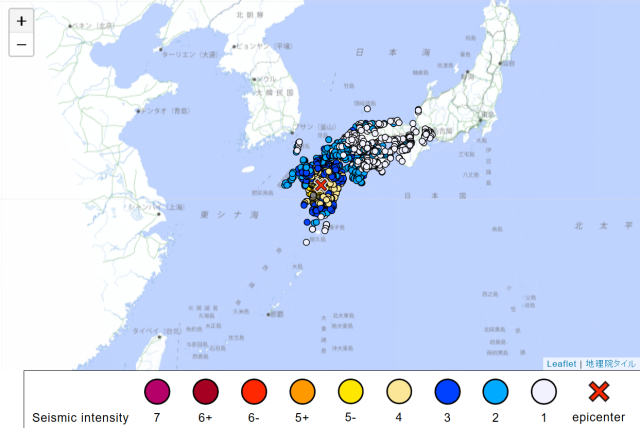
The July 28 earthquake measured magnitude 7.1 on the Japan Meteorological Agency's scale and Mw 6.8 on the moment-magnitude scale. It reached Japan's highest seismic intensity of 7, leaving at least 17 people dead as of Thursday, while authorities continued examining whether another 28 deaths were linked to the disaster.
The quake temporarily halted operations at Japan Advanced Semiconductor Manufacturing (JASM), Taiwan Semiconductor Manufacturing Co.'s manufacturing arm in Kumamoto. Employees were evacuated and later confirmed safe while the company inspected buildings and precision equipment before beginning a phased restart. Construction work at a second fabrication plant was also suspended because of continuing aftershocks.
The disruption illustrated a growing reality for the semiconductor industry: modern chip production depends not only on intact buildings but also on ultra-sensitive manufacturing equipment that can be interrupted by even moderate ground vibrations.
That lesson carries particular significance for South Korea.
The government is accelerating plans to establish a new semiconductor manufacturing belt in the Honam region as part of its broader AI industrial strategy. In July, it selected the site of the Gwangju military air base as the preferred location for a national semiconductor cluster, citing its expansive publicly owned land and established transport and urban infrastructure. About 8.3 million square meters has since been designated as a candidate site for a national high-tech semiconductor industrial complex.
The project is expected to attract hundreds of trillions of won in private investment over the coming decades as semiconductor manufacturing expands beyond the country's traditional southeastern production base. Together with new AI data centers and related power infrastructure, the region is poised to become one of South Korea's most important high-tech manufacturing corridors.
The Japanese earthquake also reverberated across the Korean Peninsula. A magnitude-5.8 tremor was detected Wednesday night in parts of southern South Korea, including Gwangju, Yeosu and parts of South Gyeongsang Province. Instrumental intensity reached only Level II, meaning the shaking was felt by some people indoors but was too weak to cause damage.
Scientists say the two events were not directly connected.
Michael Manga, distinguished professor of Earth and Planetary Science at the University of California, Berkeley, said large earthquakes can trigger distant geological responses ranging from landslides to volcanic eruptions, but the Kumamoto earthquake was extremely unlikely to alter stresses beneath the Korean Peninsula.
"Earthquakes do trigger distant responses, ranging from landslides to volcanic eruptions," Manga told AJP. "But given the distance and magnitude of the earthquake, the odds of any effects in Korea are very, very low."
Even so, South Korea's own seismic history shows that the peninsula is not immune to damaging earthquakes.
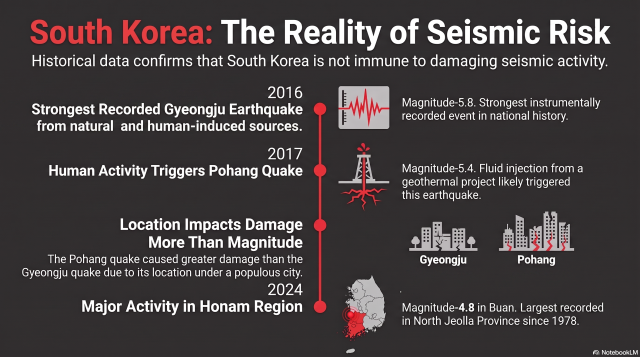
The magnitude-5.8 Gyeongju earthquake in September 2016 remains the strongest instrumentally recorded earthquake since nationwide observations began. A year later, a magnitude-5.4 earthquake struck Pohang, causing greater damage despite its smaller magnitude because it occurred beneath a densely populated city. Government investigations later concluded that fluid injection associated with an enhanced geothermal energy project had likely triggered the earthquake, demonstrating that human activity can also influence seismic hazards.
The Honam region has also experienced notable seismic activity. A magnitude-4.8 earthquake struck Buan County in North Jeolla Province in June 2024, the largest instrumentally recorded earthquake in the province since nationwide monitoring began in 1978.
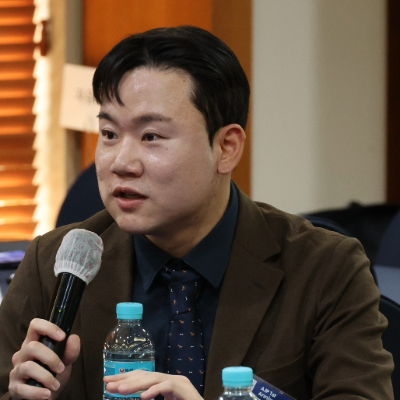
Kim Seong-ryong, professor of Earth and Environmental Sciences at Korea University, said a magnitude-7 earthquake comparable to this week's Japanese event is not considered a realistic scenario for Honam.
A magnitude-5.5 to 5.8 earthquake near Gwangju cannot be ruled out entirely, he said, but such events would likely occur only once every several thousand to tens of thousands of years, if at all.
The seismic risk around Gwangju remains "far lower" than in southeastern regions such as Gyeongju and Busan's Gijang County, where several of South Korea's nuclear power plants are concentrated, Kim said.
Lower hazard, however, does not mean zero risk.
Unlike conventional manufacturing, semiconductor fabrication requires nanometer-scale precision. Even vibrations too small to damage factory buildings can interrupt lithography systems, halt production lines and require lengthy recalibration of equipment, as the temporary shutdown in Kumamoto demonstrated.
Kim pointed to Samsung Electronics' semiconductor campus in Pyeongtaek, another region with relatively low seismic activity. The facility's ability to continue operating through minor tremors suggests that critical manufacturing equipment has been properly anchored and isolated from ground vibrations, he said.
For future semiconductor clusters, that engineering approach will become increasingly important.
Experts say earthquake resilience begins long before construction, with detailed geological surveys to identify hidden faults and assess local soil conditions. That must be followed by seismic structural design, vibration isolation for precision equipment, secure anchoring of manufacturing systems, and redundant electricity and water infrastructure capable of supporting continuous operations during emergencies.
The scientific conclusion is therefore not that Honam is earthquake-proof. Rather, it appears to face lower seismic hazards than southeastern South Korea while still requiring rigorous engineering and site-specific risk assessment.
As South Korea builds an AI economy increasingly dependent on uninterrupted semiconductor production and massive data centers, resilience is becoming a competitive advantage as much as a safety requirement.
The lesson from Kumamoto is not that South Korea should hesitate to expand its semiconductor industry. It is that the next generation of AI factories will compete not only on cutting-edge technology and abundant electricity, but also on their ability to withstand increasingly complex natural risks. For a country investing hundreds of trillions of won in its AI future, earthquake preparedness is no longer merely an engineering consideration. It has become part of industrial strategy.
Copyright ⓒ Aju Press All rights reserved.