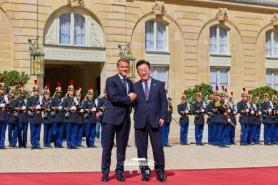
“We are at the stage of reviewing various possibilities,” Wi told reporters when asked about Seoul’s possible practical contribution to ensuring stability in the key Middle East waterway.
“We are responding to these consultations and internally reviewing several possibilities,” he said. “Depending on the issue, there are still matters on which we need to build consensus with the National Assembly or the public.”
Wi said the government believes South Korea should actively participate in and contribute to efforts to protect freedom of navigation through the Strait of Hormuz, given its importance to the country’s economy and security.
“The freedom of navigation through Hormuz is an issue in which we also have important economic and security interests,” he said. “The government is reviewing options for what we can do under the judgment that we should actively participate and contribute.”
His remarks suggest that while Washington has not made a specific request, Seoul is preparing for possible participation in international efforts should they be launched to stabilize the Strait of Hormuz.
Wi also stressed that any decision cannot be made by the government alone.
“Of course, this is not something the government can decide on its own,” he said. “There are still steps to build consensus with the National Assembly and the public under relevant legal procedures.”
Under South Korea’s Constitution, the deployment of troops overseas requires approval from the National Assembly.
Wi also addressed growing concerns over military cooperation between Russia and North Korea, after Ukrainian President Volodymyr Zelenskyy recently said Russia wants North Korea to send an additional 30,000 troops and that discussions are underway.
“We are watching military cooperation between Russia and North Korea with great interest and concern,” Wi said. “We want to make efforts so that it does not move in a more aggravated direction, but rather decreases and eventually disappears.”
Wi did not give a specific assessment when asked about the possibility of additional North Korean troop deployments. But he said such military cooperation violates U.N. Security Council resolutions.
“Our position is that military cooperation that violates the U.N. Security Council resolutions should be stopped,” he said.
On a separate incident in which South Korean forces reportedly mistook a U.S. reconnaissance drone flown during a combined exercise for an unidentified aircraft and prepared a shootdown response, Wi dismissed concerns that the case reflected lax military discipline or poor communication between the allies.
“I understand that there was communication between South Korea and the United States and that our side was aware of such plans,” Wi said, referring to the operation of the drone.
“I do not think there was any particular problem,” he said. “I do not see it as a matter of communication or discipline.”
Asked whether there had been problems in reporting the matter within the South Korean military, Wi said reports that working-level officials failed to pass on the information did not appear to be true.
“We need to look at how far up the chain of command such information should properly be reported,” he said. “I do not think this was a problem of communication or discipline. There does not appear to have been any particular problem.”

Copyright ⓒ Aju Press All rights reserved.