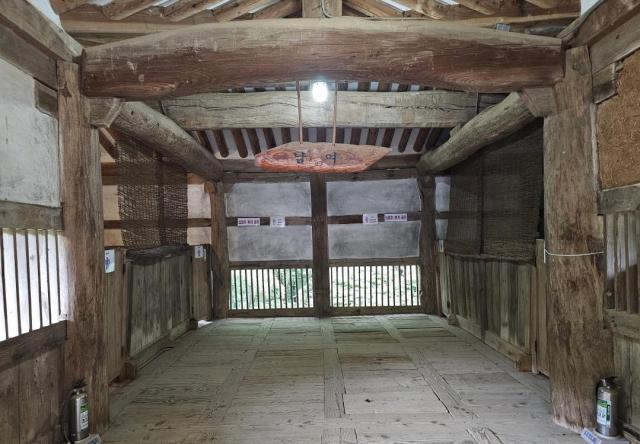
SEOUL, August 04 (AJP) - Three wooden outhouses still in daily use at South Korean Buddhist temples are in line to become national heritage, a decision that pushes state protection past the golden halls and stone pagodas of temple life and into the buildings where monks actually lived.
The Korea Heritage Service (KHS) issued advance notice Tuesday of the designation of three temple latrines as national folklore cultural heritage. They are the Cheukgan at Seonamsa in Suncheon, South Jeolla Province, the Haeuso at Bodeoksa in Yeongwol, Gangwon State, and the Haeuso at Gugiram, a hermitage within the Haeinsa complex in Hapcheon, South Gyeongsang Province.
All three were built more than a century ago. They stand on their original sites in close to their original form, and they are still used by the monks who live there.
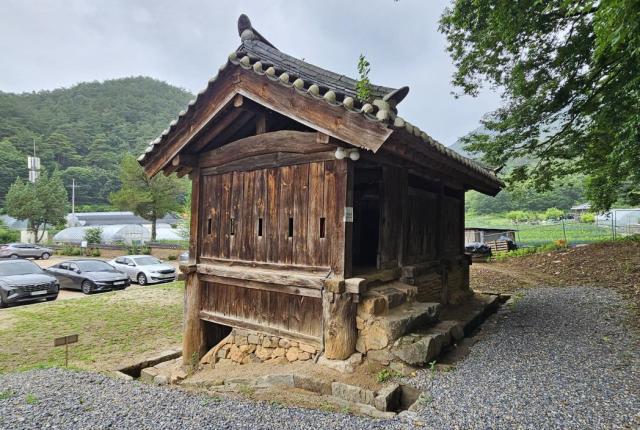
Haeuso means the place where you set down your worries, and the name is more recent than the buildings. KHS credits the coinage to the monk Gyeongbong at Geungnagam, a hermitage at Tongdosa, in the years after the Korean War, and says it spread from there until it became the standard word for a temple toilet.
Before that, temples used Cheukgan, the ordinary word for a latrine, or Dwitgan, or the scriptural Cheongcheuk. The building had status regardless of what it was called.
In the Seon tradition, a monastery was organized around seven core structures. The latrine, known as Dongsa or the east hall, was one of them, alongside the Buddha hall, the lecture hall, the gate, the monks' quarters, the kitchen and the bath. Monastic codes set out how it was to be entered and used.
For two of the three, the notice points to a promotion rather than a first recognition. Seonamsa's toilet has been listed as a South Jeolla provincial cultural heritage resource since June 2001, and Bodeoksa's has carried a Gangwon listing since January 2003. No equivalent provincial listing exists for the Gugiram building, which would enter the register directly at the national level.
Moving up from a provincial list to the national one tightens the permit requirements for any repair or alteration and opens access to central government funding.
Each building can be dated precisely, because Korean carpenters wrote the construction date in ink on the underside of the ridge beam when they raised the frame. Bodeoksa's toilet was built in 1882, and Gugiram's in 1910.
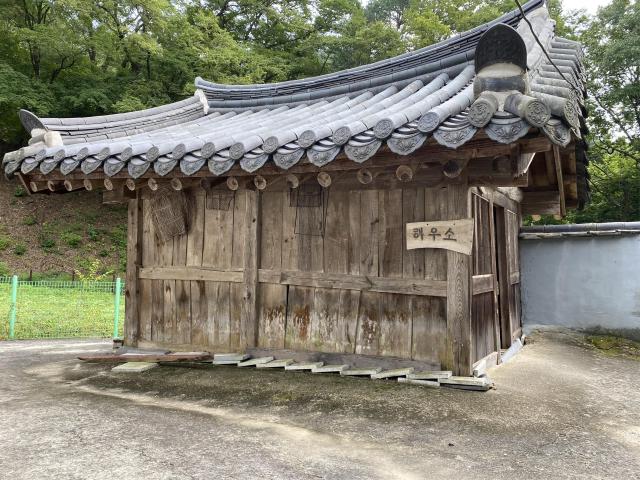
Seonamsa's is harder to pin down. A 1704 temple record refers to a Cheongcheuk on the site, and a photograph from the Japanese colonial period shows the building in place, while an ink inscription records a repair in 1928. KHS dates it to sometime before the 1920s.
Two of the three sit inside UNESCO World Heritage sites. Seonamsa was inscribed in 2018 as part of the Sansa group of mountain monasteries. Haeinsa holds the Tripitaka Koreana, the 13th century set of more than 80,000 carved woodblocks, in a depository that is itself World Heritage.
Bodeoksa carries a different kind of weight. Founded in 668 by the monk Uisang, it was renamed and made the guardian temple of Jangneung, the tomb of King Danjong, the boy king deposed by his uncle and put to death in exile in Yeongwol in 1457.
The buildings share a design logic. All three are cut into hillsides so that the front reads as a single story while the back drops away into a two-story pavilion, which lets waste fall clear and lets air move through the space underneath.
There are no doors. Partitions rise to chest height, and slatted wooden windows sit at eye level, giving light, ventilation and a view of the mountainside at the same time.
Bodeoksa's is the largest of the three, with 12 stalls in two rows of six, separated into sections for men and women, an arrangement that could handle a dozen people at once. Seonamsa's is the best known, familiar to Korean readers partly through a widely anthologized Jeong Ho-seung poem that instructs the grieving to travel there and weep.
Outside the temple walls, the toilet occupied a different place in Korean life, and a more practical one. In a farming country with no sewers and no chemical fertilizer, human waste was an input.
Households kept the Dwitgan at a distance from the living quarters, let the contents age for months, then carried them to the fields in an A-frame pack or in a squat earthenware jar called a Ttongjanggun. In cities, night soil collectors made the same journey on a larger scale, hauling buckets on carrying frames out to farmland at the edge of town. On Jeju Island, the latrine was built over a pigsty, and the pigs did the composting.
Korean folk tales include the story of a miser who refused to relieve himself anywhere but at home, because the loss would have been real. Folk belief also placed a deity in the latrine, a bad-tempered one who had to be warned before anyone entered.
Chemical fertilizer ended that economy. Ammonium sulfate and urea reached Korean farms in volume in the 1960s, and the value of night soil collapsed. Flush toilets and septic tanks spread through the 1970s and 1980s, first in apartment blocks and then almost everywhere else.
Traditional latrines survived longest in rural villages and at temples, and they have been disappearing from both as buildings are modernized for hygiene, for visitor comfort and for the simple reason that a doorless structure with no plumbing is difficult to maintain. KHS describes the three buildings named Tuesday as heritage at risk of vanishing, and cites their continued use as part of what makes them valuable.
At all three, the old cycle still runs. Waste is layered with rice hulls and fallen leaves, left to break down, and returned to temple fields as compost. The leaves also serve a more immediate purpose, which is to control the smell.
KHS will take public comment for 30 days before the National Heritage Committee reviews the case and issues a final decision on designation.

Copyright ⓒ Aju Press All rights reserved.