
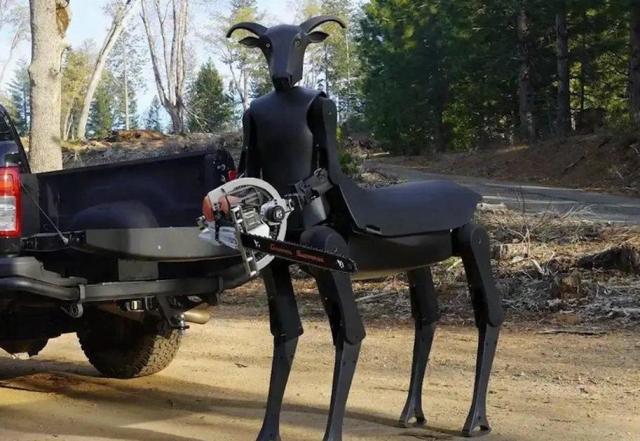
The machine, named Threehalves, is being developed by Satyress Robotics, a startup based in Auburn, California. It grafts a humanoid upper body onto a four-legged base, standing about two meters tall, and is built to work in places too dangerous for people, from wildfire fronts to collapsed structures.
The company positions it as a force multiplier for skilled workers rather than a replacement.
Threehalves is teleoperated, and by the firm's own account it is not yet a functioning robot — the images circulating online are static renders.
The design echoes a concept Korean engineers know well: "Centaur," the country's first humanoid, built decades ago at the Korea Institute of Science and Technology (KIST) with a horse-like lower body rather than legs.
Chipmaker Nvidia, whose processors power most humanoids in development, defines them as general-purpose, bipedal robots modeled on the human form and designed to work alongside people.
Yet many machines now marketed as humanoids stray far from that description, from wheeled torsos to faceless frames.
"The definition of 'humanoid' itself is still unclear," Park Dong-il, director of the Advanced Robotics Research Center at KIST, said in an earlier interview.
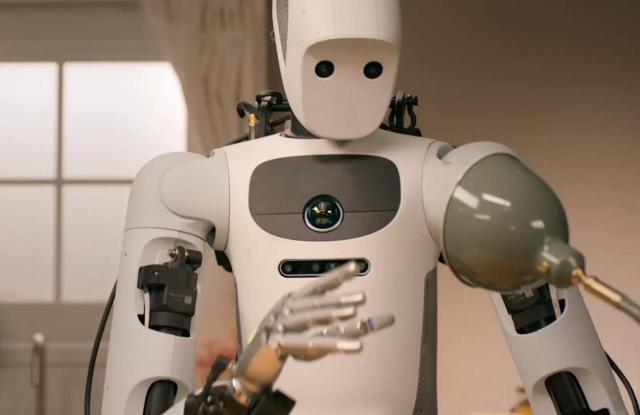
Google DeepMind last week unveiled Gemini Robotics 2, a general-purpose AI model that steers a humanoid's whole body — walking, crouching and manipulating objects — rather than the upper half its predecessor was limited to.
Meanwhile, South Korea's Robotis has open-sourced its AI Sapiens humanoid platform, releasing hardware designs, source code and simulation assets to cut the months of groundwork that precede AI training.
Korea's industrial giants are moving too, and increasingly into defense.
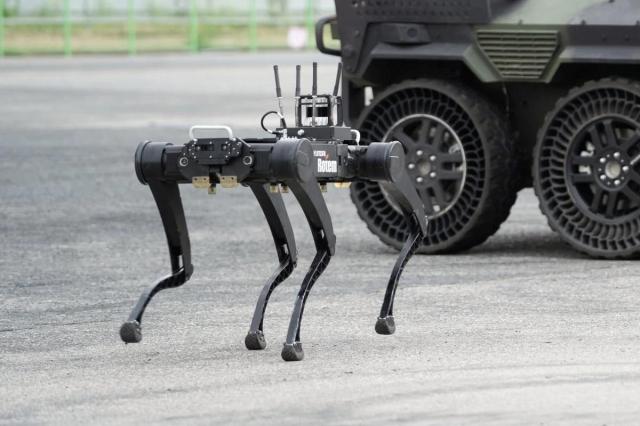
Samsung affiliate Rainbow Robotics and Hyundai Rotem jointly developed the RB-01K, a four-legged combat robot set for deployment with the South Korean Army by year-end, as a shrinking pool of conscripts pushes the military toward automation.
Four-legged machines like the RB-01K may look nothing like a humanoid, but they lean on the same mechanical DNA.
The quasi-direct-drive actuators that give quadrupeds their agile, shock-absorbing legs — pioneered in MIT's Cheetah robots — are now the joints of choice for humanoids as well, and Korean engineers say China vaulted into the humanoid race largely by porting that four-legged know-how onto two legs.
"The essence of a humanoid robot is what it does for work," said Han Jae-kwon, robotics professor at Hanyang University and chief technology officer of Aei Robot. "Replace dangerous, undesirable labor. Help address the population cliff."
Whatever shape the next generation takes — two legs, four, or none — the machines increasingly answer to a common master: the AI learning to move them.

Copyright ⓒ Aju Press All rights reserved.
