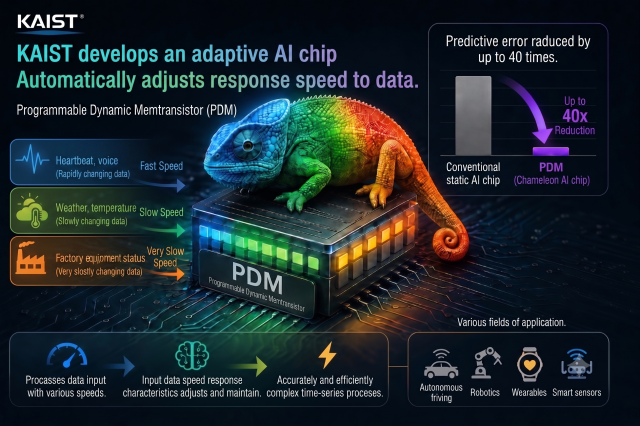
SEOUL, August 07 (AJP) - KAIST researchers have built a semiconductor that can be set to react quickly or slowly, matching the pace of whatever information reaches it, and that keeps the setting after the power goes off.
Arranged in a grid of 256, the devices predicted the course of a mathematical pattern used in the field as a difficulty test about four times more accurately than an identical grid with every device fixed at a single speed.
Nature Communications published the work on July 4. Choi Shin-hyun, a chair professor in KAIST's School of Electrical Engineering and its Graduate School of Semiconductor Technology, led the team. He said the design lets a chip respond "in the way best suited to the rate at which data changes," and that he expects it to lift performance and cut power draw in self-driving cars, robots and wearable devices.
Information does not arrive at one speed. A heartbeat shifts in thousandths of a second. Heat building inside a factory motor drifts over hours. Both are readings taken across time, and both land on a chip that has to make sense of them.
Any chip reading that kind of stream carries two habits set at the factory. One is how fast it reacts when a new signal arrives. The other is how long it holds that signal before the trace fades.
Fixed habits work when everything arrives at one rate. When fast and slow readings come in together, they do not. A chip that lets go too quickly loses the slow pattern. A chip that holds on too long smears the fast one.
The KAIST device adds a control. Beneath the layer that handles the incoming signal sits a second layer holding electric charge. Adding charge there makes the device forget faster. Taking charge away makes it hold on longer.
Once set, that level stays without any current to maintain it. Keeping a chip in a chosen state normally costs a steady trickle of power.
The team moved the forgetting time between roughly 0.7 and 3.8 thousandths of a second, a span of about five times over. The range of signal speeds the device could follow ran from 182 to 1,912 cycles per second. It registered pulses as brief as 50 billionths of a second.
The gain comes from mixing settings across many devices. On the 256-device grid, some fast and some slow, one chip follows quick and slow signals at once without software separating them out first. KAIST ran that grid on the Lorenz system, a pattern whose path is notoriously hard to forecast, and recorded the fourfold improvement.
KAIST's announcement leads with a larger figure, a 40-fold cut in prediction error. That result came from a simpler test on an artificial signal, and it measures the device against itself with the control frozen. No artificial intelligence chip now on the market took part in the comparison.
The university also said the grid matched software at the same task while drawing far less energy. It gave no number for the saving and named nothing to measure it against.
The materials are ordinary ones. A five-nanometer layer of indium gallium zinc oxide does the processing. The control layer stacks silicon dioxide, hafnium oxide and silicon dioxide. KAIST said the combination works with the fabrication process behind most chips now in production, which matters for whether the design could ever be made in quantity.
What exists so far is a laboratory component, 256 cells on a grid. The self-driving cars, the robots and the wearables are what Choi expects. None of them were tested.
Kim Dae-won, a doctoral candidate at KAIST, is first author. Two researchers from Samsung Electronics' semiconductor research center are co-authors, one of them a company Fellow. KAIST did not say what Samsung contributed to the work, and did not name a funding source.
(Reference Information)
Journal/Source: Nature Communications
Title: Programmable memtransistor array with temporal dynamics modulation for efficient time-series data processing
Link/DOI: https://bit.ly/4gkOvzB
----
AJP Takeaways
● Choi Shin-hyun's KAIST team built a semiconductor whose reaction speed can be set to match how fast incoming information changes, moving its forgetting time between roughly 0.7 and 3.8 thousandths of a second and holding that setting with no power.
● Samsung Electronics has two researchers on the paper, one of them a company Fellow. KAIST did not say what the company contributed or name any funding source, and neither point appears in the university's announcement.
● A grid of 256 devices forecasts the Lorenz system about four times more accurately than the same grid fixed at one speed. The 40-fold figure KAIST leads with comes from a simpler test on an artificial signal and measures the device against itself, not against any AI chip on the market.
● Nature Communications published the work on July 4.

Copyright ⓒ Aju Press All rights reserved.