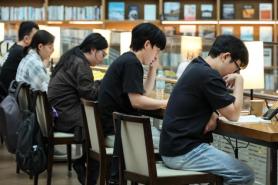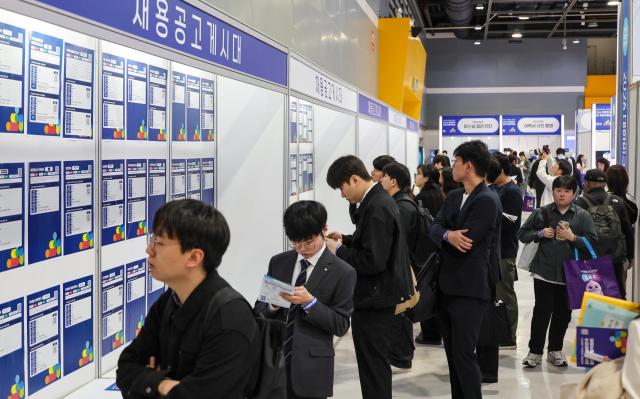
"People my age rarely ask what their children do these days. Some of my friends have kids living with them without regular jobs five years after graduation," said Yun Mi-hyeong, a 56-year-old mother of two living in Seoul's Gangnam district.
Employment among South Koreans in their 20s fell by 204,000 in July, while a 65,000 gain among people in their 30s trailed population growth of 83,000.
The split does not prove that entry-level hiring is shrinking. But 45 months of falling youth employment, coupled with companies' growing preference for experienced recruits, makes the question increasingly difficult to ignore.
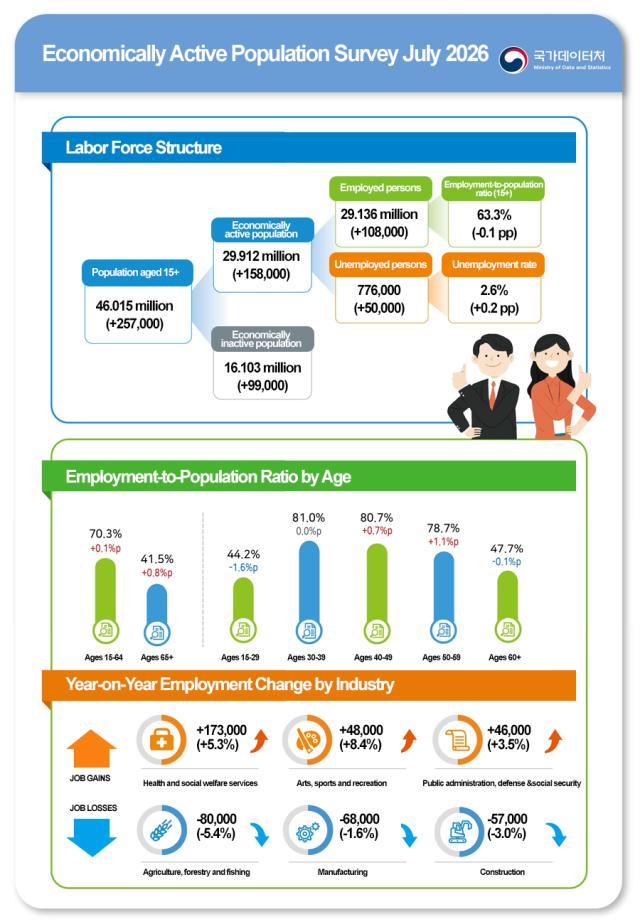
The total number of employed people rose by 108,000 from a year earlier to 29.136 million, accelerating from a gain of 63,000 in June, the Ministry of Data and Statistics said Wednesday.
Employment among people aged 15 to 29 fell by 191,000 to 3.441 million for a 45th consecutive monthly decline. Their employment-to-population ratio dropped 1.6 percentage points to 44.2 percent.
Employment fell by 124,000 among 20- to 24-year-olds and by 80,000 among those aged 25 to 29. The youth population declined by 144,000, less than the drop in employment.
Employment among people in their 30s rose to 5.631 million, but their employment-to-population ratio remained unchanged at 81.0 percent as population growth outpaced job gains.
Their labor force grew by 108,000, while the number of unemployed rose by 42,000. The jobless rate climbed to 3.2 percent from 2.5 percent.
The monthly survey counts people who are working, not companies that are hiring. It does not track entry-level vacancies, actual hires or whether recruits entered with previous work experience.
Bin Hyun-jun, the ministry's director general for social statistics, said public recruitment, a civil-service examination and new listings on Work24 drew more young people into job searches. That may explain part of the rise in youth unemployment, but not the longer decline in employment.
A 2026 Korea Enterprises Federation survey found that 54.8 percent of companies planned to recruit only on a rolling basis, while 67.6 percent ranked relevant experience as their top hiring criterion.
A February 2025 Bank of Korea study estimated the monthly probability of securing a permanent position at 1.4 percent for inexperienced workers and 2.7 percent for experienced workers. Its model attributed seven percentage points of the 17-point employment-rate gap between workers in their 20s and 30s to increased hiring of experienced workers.
A January 2026 BOK study again cited preferences for experienced hires and rolling recruitment as factors delaying young people's entry into the labor market.
For job seekers, that shift is visible before they even send an application.
"In game development, large-scale recruitment has definitely fallen sharply from before," said Kim Sung-yoon, 29, who works in the gaming industry. "Most hiring is now project-based and rolling, and companies often look for people with at least one to three years of experience rather than fresh graduates."
That has changed how young applicants try to enter the industry, he said.
"People who used to aim straight for permanent jobs at large companies are now trying to get a foot in the industry through midsized companies, contract jobs, internships or even by moving into QA or operations just to build experience," Kim said.
He said the problem is not necessarily companies advertising jobs for fresh graduates and then demanding experience.
"They simply ask for experienced workers from the beginning."

Proving that requires recruitment data broken down by age, experience, contract type and job level — information the monthly employment survey does not provide.
Weakness was also concentrated in industries traditionally associated with stable employment. Manufacturing shed 68,000 jobs for a 25th consecutive month and construction lost 57,000 for a 27th.
Employment among people aged 60 and above rose by 231,000, while employment among those in their 40s fell by 31,000.
Health and social welfare services added 173,000 jobs. The overall employment-to-population ratio slipped to 63.3 percent, while the unemployment rate rose to 2.6 percent.
Slower entry-level hiring cannot yet be identified as the cause of Korea's age divide. But with employment among people in their 20s falling for nearly four years, the lack of data on who is getting through the first rung of recruitment is becoming harder to overlook.
___________________________________________________________________________________
AJP Takeaways
• Employment among South Koreans in their 20s fell by 204,000 in July 2026, while job gains among people in their 30s failed to keep pace with population growth.
• Corporate surveys and Bank of Korea research show that rolling recruitment and preferences for experienced workers can put first-time job seekers at a disadvantage.
• Korea's monthly employment survey does not track entry-level vacancies or actual hires by experience, leaving the impact of changing recruitment practices difficult to measure.

Copyright ⓒ Aju Press All rights reserved.