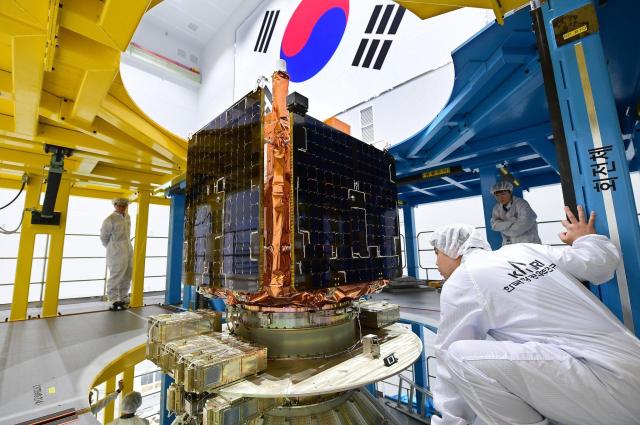
Kairospace said Thursday that its in-house de-orbit system, dubbed DORB, had proven its performance aboard a CubeSat launched into space by South Korea's homegrown Nuri rocket, in what the company described as a full validation under real orbital conditions.
The system is built to stop retired or malfunctioning satellites from lingering in low orbit for years and becoming space junk. It works by expanding a satellite's surface area to increase atmospheric drag, hastening the craft's natural descent.
Stowed, it folds into a sliver measuring 0.25 units — one unit being a 10-centimeter cube — from metal-coated polymer film pleated origami-style, then unfurls into a broad structure once triggered.
Kairospace fitted DORB to KSAT3U, a 3U CubeSat carried aloft on Nuri's third flight in May 2023. The satellite was tasked both with observing weather through polarized imaging of the Earth's surface and with demonstrating that it could dispose of itself to help thin the orbital clutter.
After about a year of normal operation, the company deployed the device and found the satellite's rate of orbital descent had more than doubled. Other CubeSats launched alongside it now sit about 80 to 150 kilometers higher, a gap Kairospace said makes the effect plainly visible.
The firm said that even the public can watch the shift themselves through the satellite's NORAD tracking number, 56746.
KSAT3U remains fully operational even after the device unfurled, and in May it captured and transmitted footage of the Busan New Port area.
"Space debris is a critical challenge that the entire global space industry must solve together," said Shin Gyung-woo, Kairospace's chief executive, adding that the company would channel the result into European trials and global commercialization to build "a product that can compete in world markets."
AJP Takeaways
• A domestically built CubeSat, launched on the Nuri rocket, has become a rare in-orbit proof point for South Korean space-debris mitigation technology, an area where global regulation is tightening but few players have flight-verified hardware.
• The measured result — a doubling of descent speed, publicly trackable via NORAD ID 56746 — gives Kairospace a credible export pitch as it moves to European trials with Gyeongnam Technopark backing.
• Worth watching: the company's own project page describes a hydrogen-inflated balloon rather than the folded-film mechanism in this release. Reconciling that discrepancy, and confirming the projected reduction in total de-orbit time, would strengthen any follow-up.

Copyright ⓒ Aju Press All rights reserved.