In a post in a question-and-answer format on the website of the Center for Strategic and International Studies (CSIS) on Thursday, Victor Cha, the think tank's Korea Chair, raised the possibility of renewed talks between Pyoung and Washington.
"The conventional policy wisdom is that Trump's enthusiasm for reengagement is not shared by the North Korean leader. But a unique set of drivers could spur a renewal of diplomacy," he said, suggesting a possible summit between Trump and Kim after the U.S. midterm elections in November, although Pyongyang has traditionally shown little interest in engaging with Washington while strengthening ties with Russia and China.
"If [Kim] is revisionist in his outlook, he would look to capitalize on any available opportunity to advance the core goal of cementing his status as a nuclear weapons state," he said.
Many pundits argue that, given everything Kim is getting from Russia and China, the risks of another meeting with Trump "appear unattractive." But Cha dismissed their assessment, saying they may be overlooking the possibility that Kim's foreign policy is driven by a desire to reshape the current geopolitical order rather than maintain the status quo.
He cited North Korea's growing cooperation with Russia following the coronavirus pandemic as an example, saying Pyongyang was widely expected to focus on restoring trade with China after years of pandemic-related border restrictions but instead moved to deepen its military ties with Moscow.
"Kim may see opportunities in reengaging with Trump. Aside from the U.S. president's expressed desires to meet, North Korea surmises that Trump's commitment to denuclearization as the premise of any negotiation is malleable at best as the president alternates between supporting such a goal and admitting that North Korea is a 'nuclear power.'"
Cha also said the prolonged conflict in the Middle East could have given Kim a lesson, as he may have learned that "maintaining contact may be the best way to manage Trump's unpredictability and penchant to use military force."
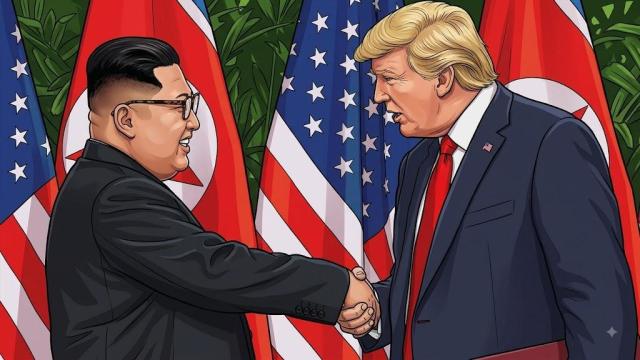
"If revisionist, Kim may target a meeting with Trump, potentially after a U.S. midterm election loss for the party in power, to reaffirm the basic tenets of the Singapore Declaration from their first meeting in 2018," he argued.
However, Cha said the two leaders would likely avoid major negotiations including talks on denuclearizing the Korean Peninsula, predicting that any summit between them would produce only "modest" outcomes.
"They would likely avoid detailed denuclearization negotiations, leaving it to their teams to hash out over the next six months. Instead, Kim might push the conversation toward peace treaties, stopping U.S. military exercises, and ending the hostile state of relations between the United States and North Korea, appealing to Trump's resume-building for the Nobel Peace Prize," he said.
He added that even a summit without tangible progress could be "significant" for North Korea, as it could serve its "perennial goal of achieving de facto U.S. acceptance of the country as a nuclear weapons state."
But Cha ruled out the possibility of Pyongyang resuming dialogue with Seoul, despite South Korean President Lee Jae Myung's efforts to improve ties with North Korea through his rapprochement policy toward the North.
"In 2024, North Korea swore off any further dialogue with the South. Rather than engage in peaceful coexistence as the Lee government has proposed, a revisionist diplomatic strategy that engages Washington and Tokyo while bypassing Seoul would be most attractive," he said.
But he believed that China could support such talks, as Beijing seeks to improve its relationship with the United States and also wants to curb Russia's growing influence over Pyongyang.
"Under normal circumstances, China would not support U.S.-North Korea diplomacy. But for Beijing, today's circumstances are far from normal. The main driver for China in this scenario is whether Beijing wants to hedge against both Trump's unpredictability and Putin's ties to Kim," he speculated.
AJP Takeaways:
- North Korean leader Kim Jong-un could seek renewed talks with U.S. President Donald Trump after the U.S. midterm elections in November 2026 if Trump’s Republican Party loses, according to Victor Cha, Korea Chair at the Center for Strategic and International Studies.
- Victor Cha said Kim could pursue a Trump summit as part of a "revisionist" strategy aimed at cementing North Korea's status as a nuclear weapons state, despite Pyongyang's growing ties with Russia and China.
- A renewed Trump-Kim summit would likely avoid major negotiations on denuclearizing the Korean Peninsula and instead focus on issues such as a peace treaty, ending hostile relations and suspending U.S.-South Korea military exercises, Cha said.
- Cha said even a summit without tangible progress could benefit North Korea by supporting its long-standing goal of securing de facto U.S. acceptance as a nuclear weapons state.
- Cha said North Korea would likely bypass South Korea and seek closer engagement with the United States and Japan, while China could support renewed U.S.-North Korea talks to balance Trump's unpredictability and Russia's growing influence over Pyongyang.
Copyright ⓒ Aju Press All rights reserved.