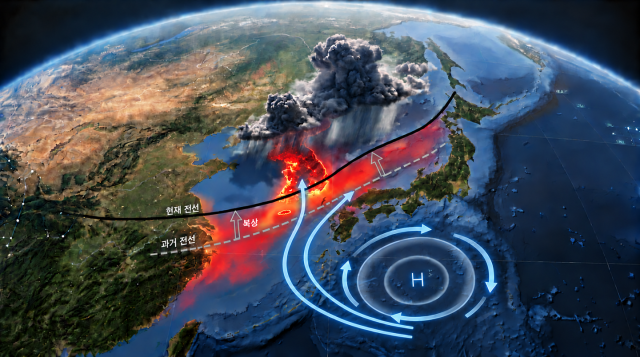
Researchers from the Korea Advanced Institute of Science and Technology (KAIST) and the APEC Climate Center found that the East Asian summer front has steadily migrated northward, bringing wetter and hotter conditions to the Korean Peninsula.
The research team, led by KAIST professor Kim Hyung-jun and APEC Climate Center researcher Moon Su-yeon, analyzed 47 years of climate data from 1979 to 2025.
The findings suggest that summer seasons here are increasingly likely to bring weather patterns associated with warmer, more humid climates, raising concerns about flooding and heat-related illnesses.
According to the study, the average position of the summer rain front between Sept. 10 and 30 during the most recent 20-year period, from 2006 to 2025, was approximately 213 kilometers farther north than during the earlier period from 1979 to 1998.
During the peak monsoon season, from June 25 to July 15, the front shifted northward by an average of 146 kilometers.
In previous decades, the late-summer rain belt typically remained over China's Yangtze River basin or waters south of Jeju Island. In recent years, it has extended into the southern Korean Peninsula.
The northward movement has altered the geographical distribution of rainfall and heat, bringing more precipitation to northern areas while intensifying heat stress farther south.
Researchers found that when the late-summer front moved north, days with both above-normal precipitation and heat stress occurred approximately eight to 19 times more frequently than in years when the front remained farther south.
Even after accounting for long-term climate trends, the frequency remained three to nine times higher, suggesting that the relationship cannot be explained solely by rising temperatures and increasing rainfall.
The study also found that the northward shift was associated with an increase of more than 0.4 degrees Celsius in wet-bulb globe temperature, an index that measures heat stress by accounting for factors including temperature and humidity.
Higher humidity makes it harder for sweat to evaporate, increasing the risk of heat exhaustion and heat stroke.
Researchers attributed the movement of the rain front to a combination of factors, including warming sea surface temperatures and changes in atmospheric circulation.
Warmer ocean waters supply additional moisture to the atmosphere, while changes in wind patterns influence the movement of the boundary between warm and cold air masses.
The research team used high-resolution climate data from the European Centre for Medium-Range Weather Forecasts, tracking the position of the East Asian summer front at six-hour intervals.
The findings were published in npj Climate and Atmospheric Science, a peer-reviewed journal published by Springer Nature on Oct. 11.
"Not only the intensity but also the position of fronts is changing," Kim said, explaining that rainfall and extreme heat are increasingly affecting different locations and periods of the summer.
Kim warned that September, traditionally receiving less attention in summer disaster preparedness, now requires greater consideration.
He called for a comprehensive climate adaptation strategy that treats late-summer heavy rainfall and extreme heat as interconnected hazards rather than separate threats.

Copyright ⓒ Aju Press All rights reserved.