
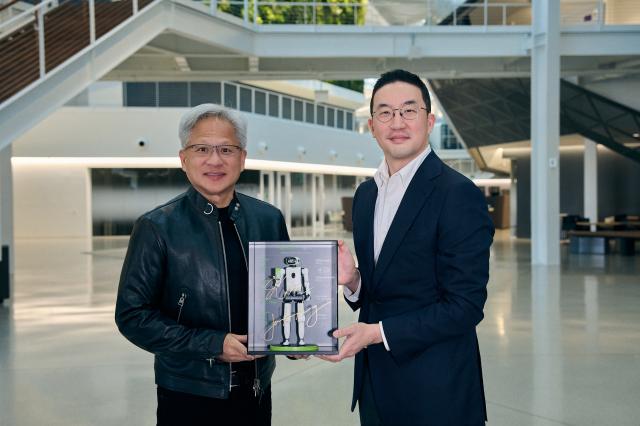
SEOUL, August 14 (AJP) -South Korea's LG Group plans to unveil a bipedal humanoid robot powered by Nvidia's artificial intelligence technology in the first quarter of next year, pushing partnership beyond technology and component supply into joint development and commercialization across robotics, AI factories and autonomous driving.
The electronics giant said Friday it signed a memorandum of understanding with Nvidia at the U.S. chipmaker's headquarters in Santa Clara, California, on Thursday, following talks between LG Chairman Koo Kwang-mo and Nvidia CEO Jensen Huang in Seoul in June.
The agreement puts concrete timelines behind that partnership, with the companies targeting a humanoid debut in early 2027, an Nvidia Vera Rubin-based AI factory reference site later that year and an 80-megawatt facility in Cheonan in 2028.
The first major project will be a next-generation bipedal humanoid built on Nvidia's Isaac GR00T open foundation model. The robot will use Nvidia's Jetson Thor computing platform and Halos for Robotics safety system.
LG will contribute hardware from across its affiliates, including actuators from LG Electronics, sensors from LG Innotek and batteries from LG Energy Solution. The group aims to unveil the robot in the first quarter of 2027.
Before then, LG Electronics plans to deploy its wheeled CLOiD robot on a washing machine production line at its Tennessee factory by the end of this year for proof-of-concept testing, taking its robotics push from household demonstrations into an actual manufacturing environment.
LG and Nvidia will also work on a physical AI data factory using LG CNS' PhysicalWorks robotics platform, creating a system for collecting, generating, training and validating robot data. Data gathered from factory deployments will feed back into a robot foundation model that LG is developing in-house.
The partnership extends into the infrastructure needed to train and operate those AI systems.
LG plans to build a reference AI factory in the first half of 2027 using Nvidia's next-generation Vera Rubin platform and DSX architecture to test its cooling, power and IT technologies.
The project will expand into an 80-megawatt AI factory in Cheonan, South Chungcheong Province, in the first half of 2028. LG said the facility will use prefabricated modular construction, with servers, cooling equipment and power systems assembled in modules before installation on site, cutting construction time by more than 20 percent.
LG plans to combine cooling technology from LG Electronics, batteries from LG Energy Solution, the data-center design and operating capabilities of LG CNS and LG Uplus, and power solutions from LS. It ultimately aims to package those technologies into integrated AI infrastructure that can be offered to global technology companies.
The Cheonan facility will also serve as an operating base for physical AI and the development of robot foundation models, linking LG's infrastructure investment directly with its robotics ambitions.
In mobility, the companies will develop a high-performance computing platform for AI-defined vehicles based on Nvidia's Drive Hyperion architecture and LG's in-vehicle infotainment and automotive software technologies.
The project would push LG's automotive electronics business beyond its traditional strength in infotainment and further into autonomous driving and in-vehicle AI, opening another potential route to global automakers.
The companies will establish a joint task force covering research and development, field testing and commercialization.
"As our collaboration gains speed, the areas where we can work together in AI factories, physical AI and mobility have become clear," Koo said. "We will accelerate the adoption of AI by building industry-leading reference cases."
Huang said physical AI could give machines the ability to understand and reason about the real world and operate safely alongside people.
"LG and Nvidia are combining LG's leadership in product engineering and manufacturing with Nvidia's technology to usher in a new era of robotics, AI factories and autonomous vehicles," Huang said.
Shares of LG Electronics rose 2.2 percent to 210,000 won ($419) as of 11:10 a.m. Friday.
AJP Takeaways:
- LG targets the first quarter of 2027 to unveil a bipedal humanoid using Nvidia's Isaac GR00T, Jetson Thor and robotics safety technologies.
- The alliance stretches from robots into infrastructure, with a Vera Rubin reference site planned for 2027 and an 80 MW Cheonan AI factory in 2028.
- LG is using the Nvidia partnership to connect businesses spanning electronics, batteries, IT services and automotive components into a broader physical-AI platform.

Copyright ⓒ Aju Press All rights reserved.
