
SEOUL, August 14 (AJP) - South Koreans increasingly see themselves having a higher standard of living than people in Japan, a survey released ahead of Liberation Day showed.
According to a survey released Thursday by online polling platform Now & Survey, 37.2 percent held that view, compared with 23.3 percent who said people in Japan had a higher standard of living.
The poll, conducted by South Korean IT company Elimnet Inc.’s survey platform, questioned 1,007 adults nationwide from Aug. 7 to 10 ahead of the country's 81st Liberation Day on Saturday, which marks Korea's liberation from Japanese colonial rule in 1945. The survey had a margin of error of plus or minus 3.1 percentage points at a 95 percent confidence level.
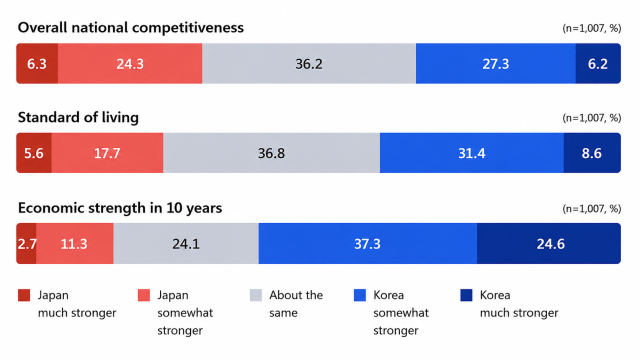
Perceptions of the two countries' overall economic strength were much closer. Some 33.5 percent said Korea had the stronger economy, while 30.0 percent chose Japan. The largest group, 36.5 percent, viewed the two economies as roughly equal.
The gap widened sharply when respondents looked a decade ahead. More than half, or 51.9 percent, expected Korea to have a stronger economy than Japan in 10 years, compared with 14.0 percent who expected Japan to be stronger.
Views also differed by age. Respondents aged 60 and older were the only age group more likely to see Japan as the stronger economy, pointing to a generational divide in how the two countries are perceived.
Confidence in Korea was more pronounced when respondents assessed individual industries. Respondents were asked to compare competitiveness in 13 sectors on a five-point scale, with 1 indicating a strong Japanese advantage and 5 a strong Korean advantage. Korea was rated as more competitive in nine of the 13 sectors.
Semiconductors ranked highest at 4.25, followed by cultural content at 4.07 and shipbuilding and marine industries at 4.01.
Artificial intelligence and software scored 3.73, followed by rechargeable batteries at 3.72 and electronics and home appliances at 3.71. Defense came in at 3.59, while biotechnology and healthcare scored 3.26 and automobiles and mobility 3.24.
The confidence was less clear in industries more dependent on core technologies. Advanced materials, components and manufacturing equipment and precision machinery and robotics both scored 3.17, while aerospace came in at 3.09. With scores only slightly above the neutral midpoint of 3, respondents viewed the two countries as broadly comparable in these fields.
Basic science and core technologies ranked last at 2.69 and were the only category in which Japan was seen as having an advantage. The score was 1.56 points below that of semiconductors, the highest-ranked sector, showing a contrast between confidence in the country’s major industries and Japan's perceived strength in the fundamental technologies behind them.
Despite differences in how the two economies were perceived, respondents broadly supported closer economic ties. 70 percent agreed that Korea should expand economic cooperation with Japan to sustain its long-term growth, while just 4.2 percent opposed it.
The survey also asked respondents about Korea's achievements since liberation. Economic growth ranked first at 49.4 percent, followed by the global rise of K-content at 31.0 percent. Industrialization and export growth came next at 29.7 percent, followed by the development of democracy at 27.0 percent.
AJP Takeaways
• A Now & Survey poll conducted from Aug. 7 to 10, 2026, found that 37.2 percent of South Korean adults viewed living standards in South Korea as higher than in Japan, compared with 23.3 percent who viewed Japan's as higher.
• On overall economic strength, 36.5 percent viewed South Korea and Japan as roughly equal, while 33.5 percent rated South Korea higher and 30.0 percent rated Japan higher.
• Looking 10 years ahead, 51.9 percent expected South Korea to have a stronger economy than Japan, compared with 14.0 percent who expected Japan to be stronger.
Copyright ⓒ Aju Press All rights reserved.
